What is Post-release Documentation? A Definitive Guide


The code is merged. The CI/CD pipeline is green. The sprint is closed and the team is already in the next planning session.
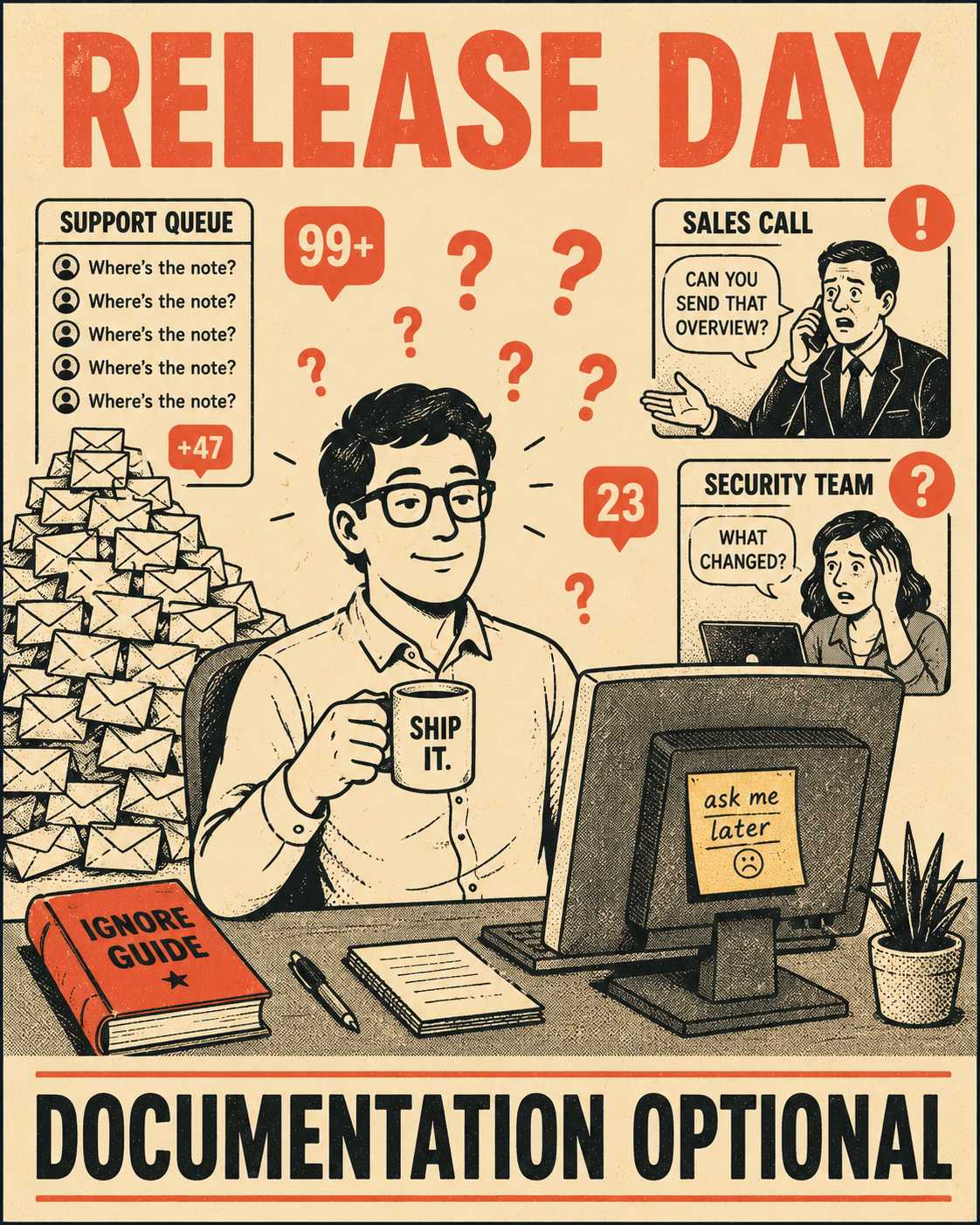
Somewhere in the support queue, a customer is trying to figure out why their API integration broke overnight. The sales team is on a call with a prospect who wants to see what changed in the last release. The security team is trying to determine whether a patch that shipped two weeks ago covered the vulnerability they just heard about.
Nobody documented any of it.
Post-release documentation is the operational record of what shipped: release notes, changelogs, API references, breaking change announcements, upgrade guides, and customer-facing updates that document software after it leaves engineering's hands. It is distinct from pre-release documentation (design specs, internal planning docs, architecture decision records) in a specific and important way. Pre-release documentation is for the team building the thing. Post-release documentation is for everyone who has to live with it.
That distinction sounds obvious. In practice, most engineering organizations treat the two as interchangeable, which is why post-release documentation is almost always the one that doesn't get written.
Why This Category of Documentation Matters More Than Most Teams Think
The operational consequences of poor post-release documentation are concrete and measurable, and they tend to show up in places that feel disconnected from the documentation problem.
Support ticket volume is the most immediate signal. When users can't find upgrade instructions, they open tickets. When breaking changes aren't announced clearly, they open more tickets. Good documentation reduces a support team's workload by allowing users to find answers without ever contacting anyone. Poor documentation does the opposite: it converts every release into a support event.
The security angle is less discussed but arguably more serious. The Log4Shell vulnerability (CVE-2021-44228) required organizations to identify every system running an affected version of Log4j and apply a patch. CISA's advisory was clear and detailed. But the teams that struggled to respond quickly were often the ones who didn't have reliable records of what versions they were running or what had changed in recent releases. Incomplete patch notes and missing changelogs don't just frustrate developers; they create real exposure windows.
Sales friction is quieter but persistent. 84% of developers use technical documentation for learning, and 90% of those rely on documentation found in API and SDK packages. When a prospect asks what changed in the API between version 2.1 and 2.3, and the answer is "we'll have to ask engineering," that's a deal that takes longer to close, or doesn't close at all. 52% of developers identify poor documentation as their biggest obstacle when working with APIs. That's not a documentation problem; that's a revenue problem.
And then there's the slow drain of institutional knowledge. 74% of organizations lack a formal method of capturing and retaining technical knowledge, and the cost compounds over time. When the engineer who built a feature leaves, and there's no changelog entry explaining why a particular design decision was made, the next engineer spends hours reverse-engineering something that should have taken minutes to understand. Stripe's Developer Coefficient report found that developers spend more than 17 hours a week on maintenance issues like debugging and refactoring. A meaningful portion of that is documentation debt coming due.
Why Teams Chronically Underinvest
The reasons are structural, not motivational.
The Agile Manifesto's preference for "working software over comprehensive documentation" gets misread as a license to skip documentation entirely. Research on documentation in continuous software development has found that documentation is often poor in Agile and DevOps environments, not because teams are careless, but because the methodology creates no natural forcing function for it. Documentation isn't a story. It doesn't ship. It doesn't have an acceptance criterion.
Engineers don't enjoy writing it, either. A Stack Overflow analysis found that developers broadly view documentation as toil work, the kind of task that feels like it belongs to someone else's job description. That's not a character flaw; it's a rational response to incentive structures that reward shipping features and penalize everything that slows the sprint down.
Organizations try to solve this in three ways, and all three have the same failure mode.
The first is hiring technical writers and throwing them at the problem. This works until the writers can't keep up with the release cadence, or until a hiring freeze eliminates the team. The second is requiring engineers to write documentation as part of the definition of done. This works until engineers start writing the minimum viable sentence to clear the checkbox. The third is routing everything through product managers, who write marketing-flavored updates that are accurate about the business value and wrong about the technical details.
All three models treat documentation as a separate workflow, something that happens after the engineering work is finished. That's the root of the problem. A 2024 study on practitioners' expectations for automated release note generation tools (Abebe et al., Journal of Software: Evolution and Process) found that adoption of automated tools remains limited partly because they require significant workflow adjustments. Teams don't want another workflow. They want the documentation to emerge from the workflow they already have.
The Structural Fix

The engineering systems that track what's being built and shipped already contain most of what post-release documentation needs: commit history, pull requests, issue trackers, CI/CD pipeline outputs. The information exists. The problem is that it's in a format (raw engineering artifacts) that doesn't translate directly into something a customer can use.
Research on automated release note generation has shown that approaches extracting changes from version control and issue trackers can produce output that closely approximates manually written release notes. The gap between "raw engineering artifact" and "usable documentation" is smaller than most teams assume. It's a translation problem, not a creation problem.
When generation happens automatically from those engineering systems, and a skilled technical writer or engineering lead validates and manages the output, teams get the speed and consistency of automation with the accuracy and judgment of human oversight. That's the model that works for organizations that have reduced documentation headcount but still need reliable output at scale: not a large documentation department, but a lean team with good tooling and a clear process for validating what the system produces.
Doc Holiday generates release notes, changelogs, and API references directly from engineering workflows, then provides the structure for that lean team to validate, refine, and publish without rebuilding a documentation department from scratch. The engineering systems already know what shipped. The question is whether that knowledge makes it to the people who need it.