How to Write Release Notes for a Security Patch


It is 3:00 PM on a Thursday, and the patch is ready. The engineering team found a vulnerability, built a fix, and tested it. Now they want to deploy it silently. Their argument: publishing detailed release notes will just give attackers a roadmap to exploit the unpatched systems still running in production.
The compliance team disagrees. They point out that under GDPR's 72-hour breach notification requirement and ISO 27001 Annex A 8.8 vulnerability management controls, failing to disclose is a liability, not a strategy. The support team just wants to know what to tell customers when the patch breaks a custom integration.
You are stuck in the middle, staring at a blank document, trying to write release notes that satisfy all three groups without causing a panic.
Writing release notes for a security patch is not like writing notes for a new feature. You are not trying to drive adoption. You are trying to drive action while managing risk. You have to balance transparency, compliance, and user trust, often under extreme time pressure.
Anyway. We need a framework for this.
The Transparency Trap
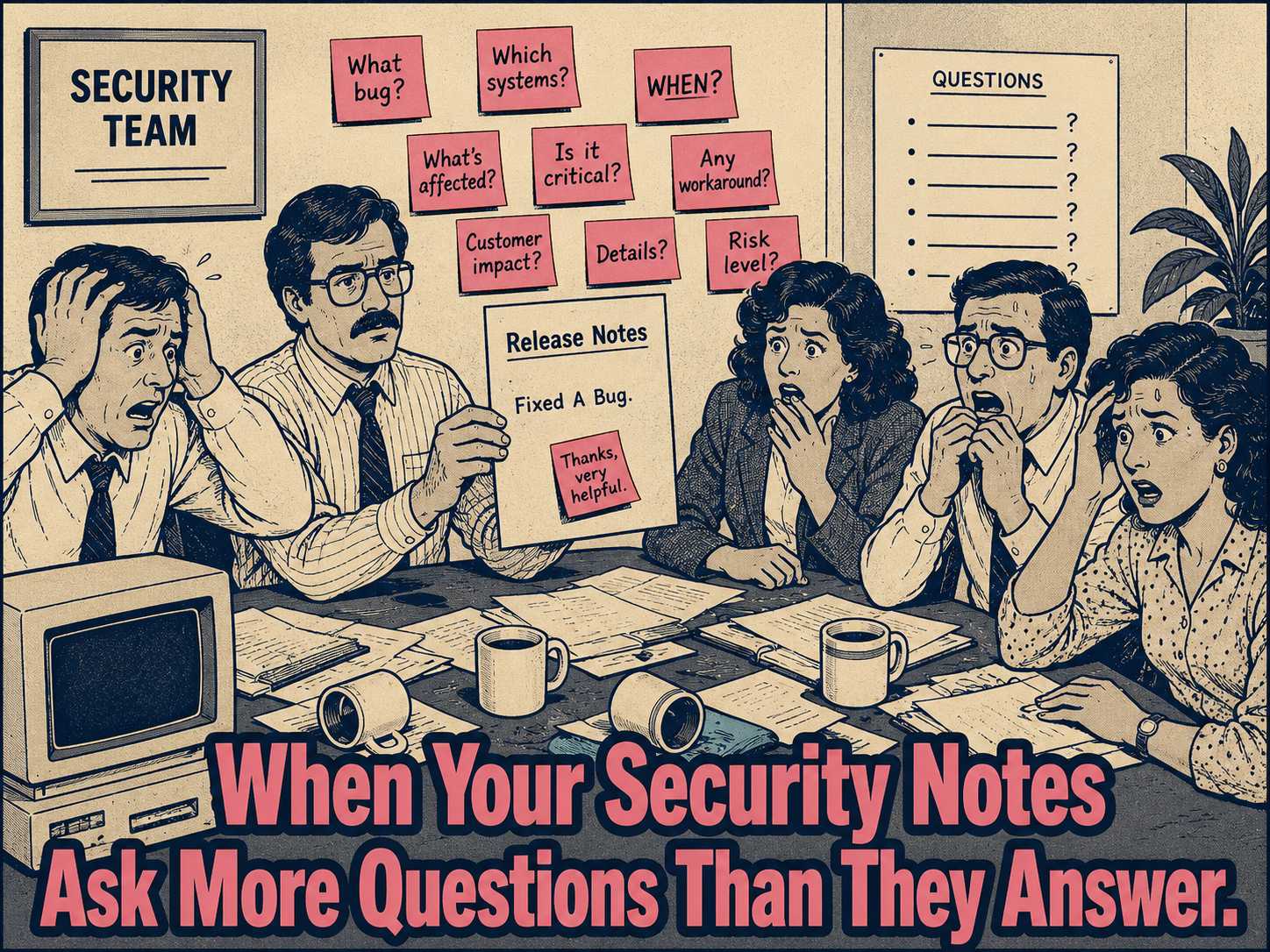
The instinct when writing about a security flaw is to be vague. "Fixed a security issue" is the most common, and least useful, release note in software history.
Vagueness does not protect you. It erodes trust. A large-scale empirical study of security patches found that end-user trust in applying patches drops when communication is poor. If users do not understand the severity of the issue, they will delay the update. If they delay the update, they remain vulnerable. And the Cyber Threat Alliance has noted that a higher number of disclosed vulnerabilities with clear communication often signals better security practices, not worse ones.
On the other hand, you cannot publish the exploit code. The goal is to describe the vulnerability clearly without providing an instruction manual for attackers.
The trick is to focus on impact and action, not mechanics. You do not need to explain the specific buffer overflow in the authentication module. You need to explain that an unauthenticated user could potentially gain access to the system, and that updating to version 2.4.1 fixes it. That is enough for users to understand the urgency. It is not enough for an attacker to reproduce the exploit.
The OWASP Vulnerability Disclosure Cheat Sheet puts it plainly: organizations should publish clear security advisories and changelogs. The question is not whether to disclose, but how much.
What You Actually Have to Say
Different audiences need different information. End users need to know if they are affected and what to do. Security teams need the severity to justify emergency patching to their leadership. Compliance auditors need an audit trail showing you followed coordinated vulnerability disclosure practices.
A strong security release note covers five elements. The CERT/CC Basic Vulnerability Advisory format and the NIST SP 800-216 federal vulnerability disclosure guidelines both converge on the same core requirements.
| Element | What to include | Why it matters |
|---|---|---|
| Affected versions | Explicit version ranges, including what is not affected | Lets users quickly determine if they need to act |
| Severity | CVSS score and/or qualitative label (Critical, High, Moderate, Low) | Helps security teams prioritize and justify emergency patching |
| CVE identifier | CVE number if assigned; omit if under embargo | Enables automated scanners and audit trail tracking |
| Recommended action | Update to version X, or specific workaround if no patch exists | Drives the behavior you need from users |
| Timeline | Discovery date, fix date, disclosure date | Demonstrates responsible handling for compliance auditors |
On CVE identifiers specifically: include one when it exists and when the vulnerability is publicly disclosed. If you are still in an embargo period coordinating with other vendors, hold the CVE until the synchronized disclosure date, as outlined in the FIRST multi-party vulnerability coordination guidelines. Publishing a CVE before the patch is available creates the exact window of exposure you are trying to avoid.

On severity: use the Common Vulnerability Scoring System (CVSS). It is a published standard that gives security teams a quantitative measure to justify emergency patching. If you use qualitative terms, define them. Red Hat's severity ratings, for example, clearly distinguish between "Critical" (remote unauthenticated exploit leading to system compromise) and "Moderate" (difficult to exploit under specific conditions). Undefined terms like "high severity" mean nothing to an auditor.
Now, the before and after.
Weak release note: "Version 3.4.1 — Security enhancements and bug fixes."
Strong release note: "Fixed a Critical vulnerability (CVE-2026-1234, CVSS 9.1) in the authentication module that could allow a remote unauthenticated attacker to execute arbitrary code. Affects versions 3.1 through 3.4. Version 3.5 contains the fix. Update immediately. No known active exploitation in the wild as of this publication. Discovered internally on May 12, 2026. Patch available May 19, 2026."
The strong version tells users exactly what is at stake, who is affected, what to do, and when. It does not explain how the authentication module fails. It does not provide a proof of concept. It gives the curl security advisory format its due: affected versions, the solution, the timeline, and the recommended action, in plain language.
The Timing Problem
Security patches move faster than documentation cycles.
In a normal release, technical writers have weeks to draft, review, and polish the notes. In a security release, the patch might be deployed hours after the vulnerability is confirmed. The empirical research on patch development found that security fixes are poorly timed with public disclosures, often allowing attackers who monitor open-source repositories to get a jump of weeks to months on targeting unpatched systems.
This is the timing problem. When do you publish?
If you publish notes before the patch is widely available, you create a window of exposure. Attackers know about the vulnerability, but users cannot fix it yet. If you delay notes too long after the patch, users will not realize the update is critical and will defer it.
The standard practice, as outlined by Google's Project Zero, is a 90-day disclosure deadline for vendors to provide a patch, followed by public disclosure 30 days after the patch is available. For your own release notes, the timing is tighter: publish simultaneously with patch availability.
For compliance purposes, the timing documentation matters as much as the content. GDPR Article 33 requires notification to supervisory authorities within 72 hours of becoming aware of a breach. ISO 27001 Annex A 8.8 requires an audit trail of all vulnerability management activities. SOC 2 auditors will look for evidence that you disclosed the issue in a timely and documented manner. Your release notes, with their explicit timeline section, are part of that evidence.
The tone matters too. The goal is calm urgency, not alarm. Phrases like "critical vulnerability requiring immediate action" are accurate and clear. Phrases like "severe security breach affecting all users" are accurate but will generate support tickets faster than your team can handle them. The CISA coordinated vulnerability disclosure program emphasizes that disclosure should be "accurate and actionable." Both words matter.
The Operational Reality
The reality of modern software development is that technical writers are rarely looped in early enough during a security crisis.
Engineers are focused on the code. They merge the pull request, tag it as a security fix, and move on to the next fire. The release notes are drafted by an exhausted developer at the last minute, resulting in the dreaded "Fixed a bug" message. As one senior technical writer observed in a detailed analysis of release note automation, developers are talented in many ways, but they are not writers, and commit messages like "Fixed a bug" leave everyone with more questions than answers.
This is an operational failure, not a writing failure. You cannot expect precise disclosure language from someone who just spent 14 hours debugging a zero-day.
You need a system that bridges the gap between the engineering workflow and the documentation requirement. When you generate draft release notes directly from commit metadata, pull request descriptions, and tagged security issues, you give the team a validated starting template. The system pulls the affected versions, the severity tags, and the basic description automatically.
A technical writer or security lead can then review the draft, adjust the tone, ensure compliance requirements are met, and approve it. The human oversight focuses on nuance, not on starting from scratch.
Doc Holiday is built for this exact operational reality. It is a documentation engine that generates output directly from engineering workflows. When a pull request is tagged with security metadata, Doc Holiday generates a structured draft covering severity, affected versions, and required actions. For teams that need to move fast on a security patch, it provides a starting point that a technical writer or security lead can validate, adjust for disclosure timing, and approve. That is how lean teams maintain quality and consistency without bottlenecking the release.
Speed and clarity matter more than perfection when users need to patch. Give them the facts, tell them what to do, and let them get back to work.
Security patch release note checklist
Before publishing, confirm your release note includes:
- Affected version range (and explicitly what is not affected)
- Severity level with CVSS score
- CVE identifier (if assigned and not under embargo)
- Recommended action (update version, apply workaround, or both)
- Timeline (discovery date, fix date, disclosure date)
- Contact or link for further information
That is the minimum. Everything else is context.