The Velocity Trap: Why AI-Assisted Coding Demands Documentation Automation


An engineer merges a pull request on a Tuesday afternoon. The code is live, the tests pass, and a complex new integration that would have taken two weeks to build in 2022 is now in production after just three days. It is a triumph of modern development.
Then the support queue lights up.
A customer wants to know how to configure the new integration. The customer success team scrambles to find an answer, but the internal wiki is silent. The engineer who wrote the code is already two tickets deep into the next sprint, aided by an AI coding assistant that never sleeps. The feature shipped, but the knowledge didn't.
This is the reality of AI-accelerated software development. The acceleration is not theoretical. Developers using AI tools are 21% faster at completing enterprise-grade tasks. Those using Copilot specifically complete tasks 55% faster. The 2025 Stack Overflow Developer Survey puts AI tool adoption at 84% of the developer workforce, either active or imminent.
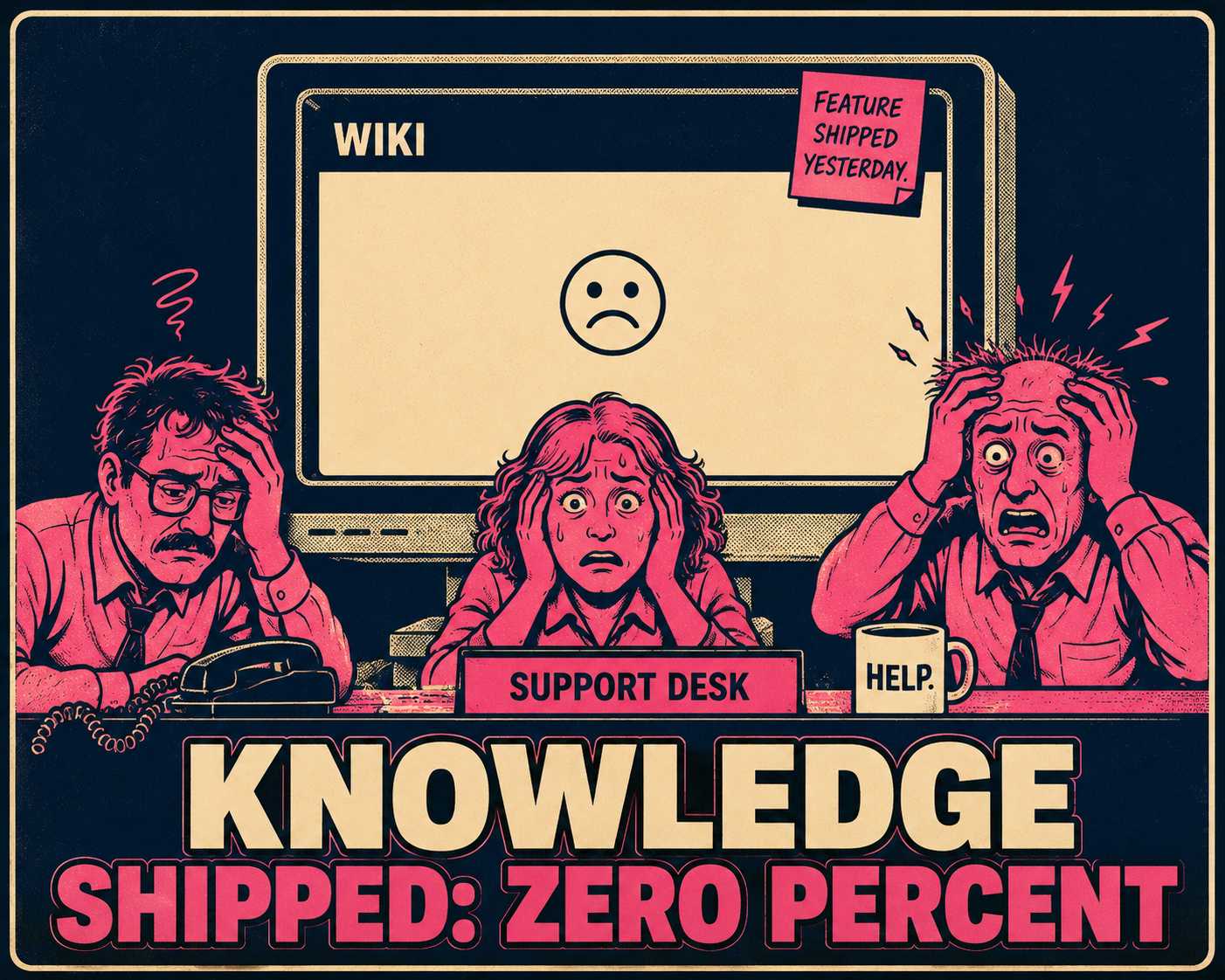
We are writing code faster than ever before. But we are not explaining it any faster.
When development cycles compress from weeks to days, but the documentation process still requires a human to sit down and write a comprehensive guide from scratch, the lag compounds with every sprint. The result is a growing, structural gap between what is live in production and what is explained to users, support teams, and future maintainers.
What Happens When the Code Outruns the Explanation
The consequences of this gap are not abstract. They show up on the balance sheet.
Support tickets increase because users encounter undocumented behavior. Tier 1 support resolutions cost approximately $22 per ticket, and escalating issues to Tier 3 can cost $104 or more. When features ship without documentation, those escalations become the default path for discovery.
Technical debt accumulates as tribal knowledge never gets written down. The code is functional, but the reasoning behind it (the assumptions, the constraints, the trade-offs) remains locked in the heads of the engineers who wrote it. If those engineers leave, the knowledge leaves with them. Replacing an engineer costs 6 to 9 months of their salary in recruiting, onboarding, and lost productivity.
Onboarding new engineers becomes harder because the codebase moves faster than the explanation layer. New hires spend weeks trying to understand systems that are constantly shifting underneath them. Senior engineers are pulled away from their work to answer repetitive questions that should be in the documentation.
We have accelerated the creation of code, but we have neglected the creation of context.
Why You Can't Just Point an LLM at Your Repo
The obvious question is: why can't the same AI tools that accelerate coding also handle the documentation?
They can generate draft content quickly. But unsupervised output lacks the institutional context, edge-case awareness, and accuracy validation that production documentation requires.
AI models are trained to predict the next likely token, not to understand the nuanced business logic of your specific application. They will confidently generate documentation that looks plausible but is factually incorrect. 45.1% of AI-assisted pull requests required human revisions to align with project-specific standards, reflecting unstated design decisions the AI made without access to architectural patterns or codebase history.
The issue isn't AI capability. The issue is the workflow gap between code commits and validated, published documentation.
You cannot simply point an LLM at a repository and expect a reliable API reference to emerge. The AI needs human governance to maintain architectural coherence.
The Operational Reality of Automated Documentation
The solution is not to abandon AI, nor is it to force engineers to spend half their week writing docs. The goal is to match documentation velocity to code velocity.
This requires documentation automation systems that generate output directly from engineering workflows (commits, pull requests, release branches) and provide structure for human validation at scale. The 2024 DORA State of DevOps Report found that documentation quality is one of the strongest predictors of software delivery performance, and that a 25% increase in AI adoption is associated with a 7.5% improvement in documentation quality — but only when teams have the processes to capture and validate that output.
Automation in this context means triggering documentation generation from the same events that trigger deployments. It means extracting context from commit messages, PR descriptions, and code diffs. It means structuring output so a technical writer or product manager can validate it in minutes, not hours. It means publishing updates in sync with releases instead of days or weeks later.
Start with high-velocity areas like release notes, API references, and changelogs. Assign one strong technical writer or product lead to validate AI-generated output rather than drafting from scratch. Measure time-to-publish as a KPI alongside feature delivery speed.
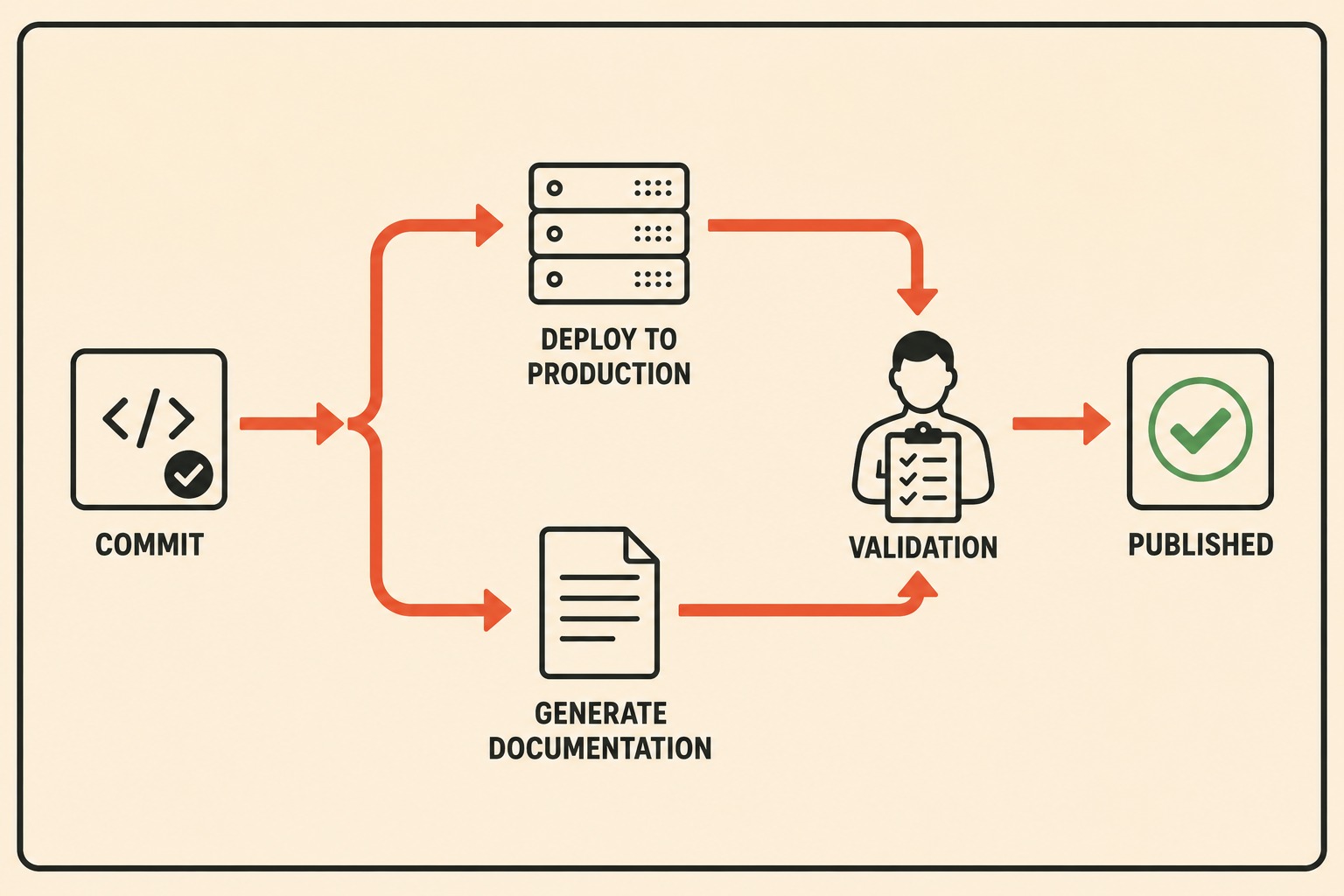
Treat documentation lag as a production risk, not a nice-to-have.
If your code generation is automated but your documentation is manual, you haven't actually accelerated your delivery. You have just moved the bottleneck. The systems that generate the code must be paired with systems that explain it. This is exactly what Doc Holiday does. It pulls release notes, API references, and changelogs directly from your engineering workflows, providing the structure for validation and scaling that lets a lean team keep documentation velocity matched to code velocity.