Extending Github Copilot's Automation to Release Notes


If you run an engineering team today, you likely have a front-row seat to a quiet revolution. You watch a pull request come in. The code is clean, the tests are comprehensive, and the logic is sound. A significant portion of it was generated by GitHub Copilot. The developer reviewed it, adjusted the edges, and hit merge. The system works. We have successfully automated the hardest part of software development.
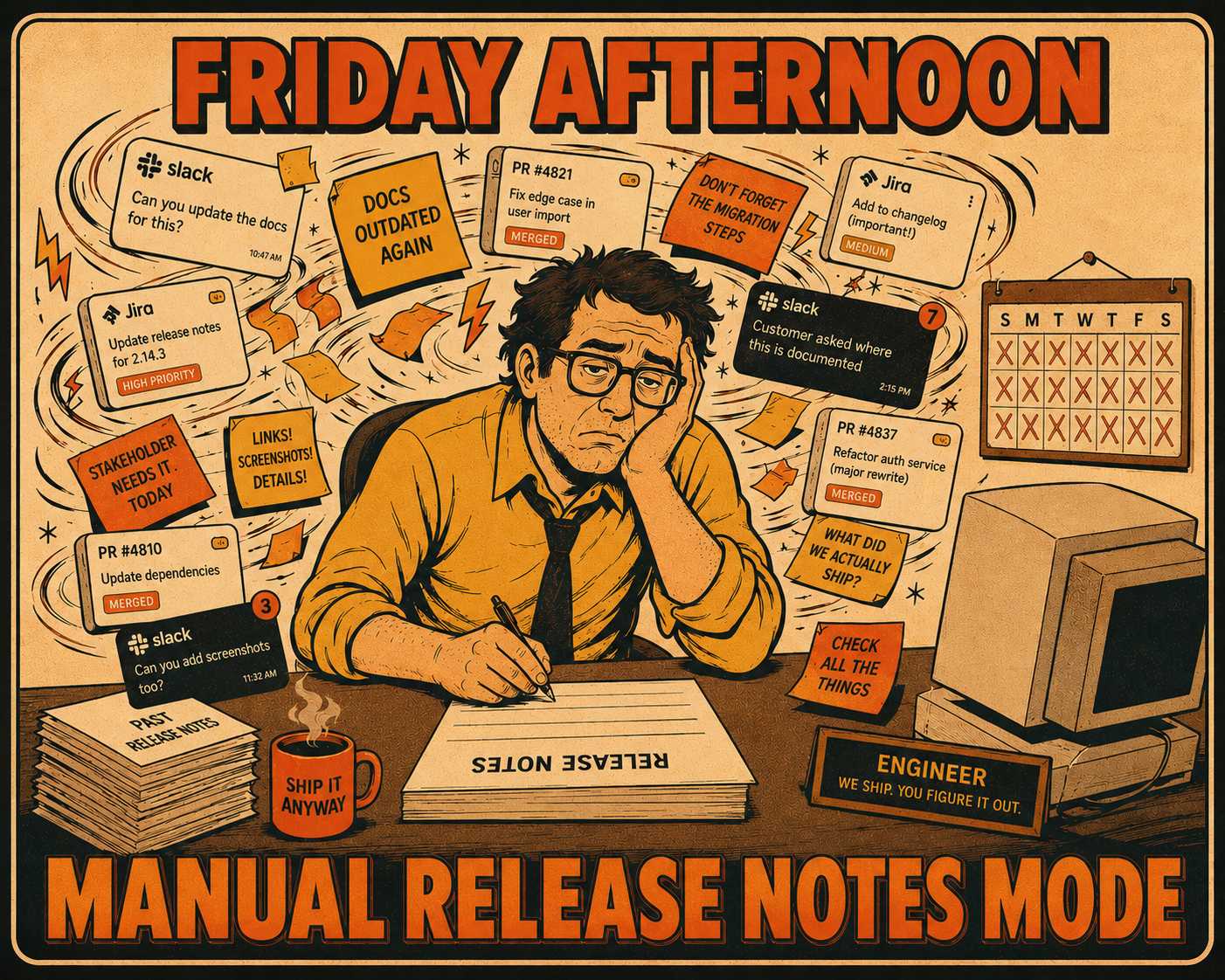
Then the code deploys. And somewhere, an engineer or a product manager opens Jira, scrolls through a week's worth of merged PRs, reads through Slack threads to remember what actually shipped, and starts manually typing out release notes.
We have crossed the AI adoption threshold for code generation. The question now is whether the same efficiency gains apply to release notes, changelogs, and API documentation. And if they do, how you actually implement that without building custom pipelines or hiring a dedicated docs team.
The short answer is yes, they do. But the mechanics of getting it right require understanding what AI can actually extract from your repository, how the plumbing connects, and where human oversight fits into the loop.
What Actually Survives the Trip from Code to Docs
Not all documentation is created equal.
Conceptual guides, deep-dive tutorials, and marketing-focused launch posts still require human authorship. They require narrative. They require an understanding of the customer's emotional state and business goals.
But release notes, changelogs, API diffs, and breaking change alerts are different. They are derivative artifacts. They are downstream consequences of the code itself.
When we talk about generating documentation from source, we are talking about extracting intent from the exhaust of the development process. Commit messages, PR descriptions, code comments, and function signatures.
The problem is that developers write commit messages for other developers. A commit message that says fix: resolve race condition in payment webhook is technically accurate. But it is not a customer-facing release note. A user does not care about the race condition. They care that their payments will no longer occasionally fail without warning.
AI bridges this gap. It can read the diff, read the PR description, and translate the technical implementation into a behavioral outcome. It groups related commits, filters out the noise of dependency bumps and typo fixes, and structures the output. LLM-powered release note generation can successfully synthesize these technical inputs into high-quality, contextually personalized release notes that outperform traditional generation methods.
How the Plumbing Connects
The technical implementation of this automation is not a mystery. It relies on the infrastructure you already have.
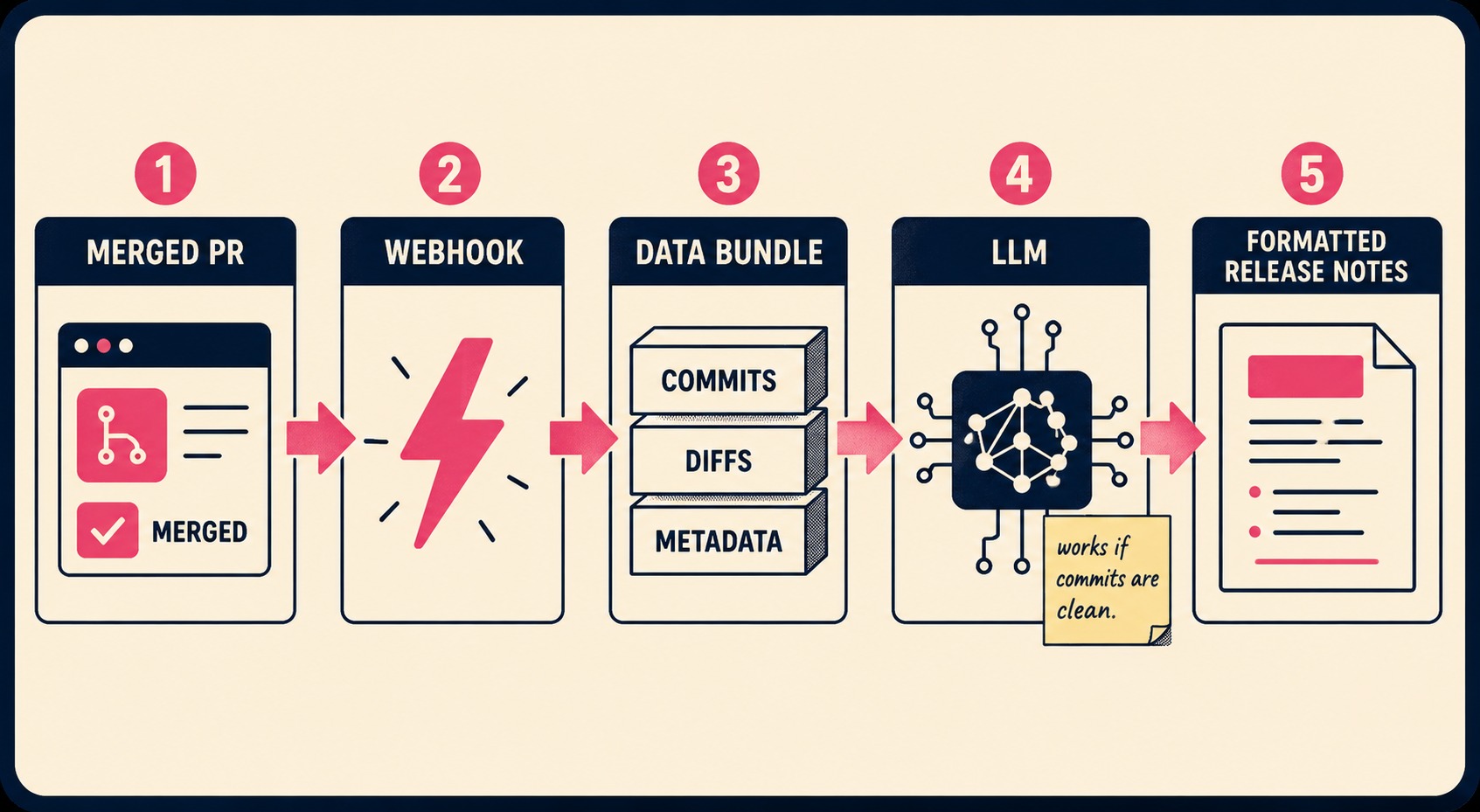
The most common approach hooks directly into your CI/CD pipeline — the automated system that builds, tests, and deploys your code. When a PR is merged or a release is tagged, a webhook fires. The payload includes the PR metadata, the commit history, and the code diffs.
This data is fed to a large language model. The model is prompted to categorize the changes (feature, bug fix, breaking change), synthesize the technical descriptions into user-facing language, and format the output according to your team's conventions.
You can build this yourself with GitHub Actions and a few API calls. But there is a difference between a bolt-on automation script and a purpose-built documentation engine. A script will blindly summarize whatever is in the commit log. If the commit log is garbage, the release notes will be garbage.
A purpose-built engine understands the hierarchy of changes. It knows that a PR labeled breaking change needs to be surfaced at the top, regardless of how many other commits are in the release. It understands how to trace a change back to the original issue to pull in business context.
Companies with high-quality engineering cultures have been building these pipelines for years. Stripe's engineering team has detailed how API changes flow through their documentation infrastructure at scale — a process that treats documentation as a first-class output of the engineering process, not a downstream task. Linear's public changelog reflects the same philosophy: tightly integrated with their issue tracking, formatted consistently, and shipped on the same cadence as the product.
The practical foundation for this kind of automation is the Conventional Commits specification, a lightweight standard that structures commit messages as type(scope): description. When developers follow this convention, the commit log becomes machine-readable. The AI can reliably distinguish a feat from a fix from a breaking change without guessing. Without it, the model is working from noise.
The Quality Control Layer
Teams using Copilot understand a fundamental truth: AI-generated code still gets reviewed. You do not blindly merge Copilot's suggestions into production.
The same principle applies to documentation.
The goal is not to remove humans from the process. The goal is to elevate the human from a writer of first drafts to an editor and reviewer.
Effective review of AI-generated documentation looks like spot-checking for technical accuracy. It means ensuring the customer-facing language strikes the right tone. It means validating that breaking changes are flagged prominently and include the necessary migration steps.
Who owns this validation depends on your team structure. It might be a support engineer who knows the customers best. It might be a technical writer. It might be the senior engineer who led the release.
The review process should be fast. It should take minutes, not hours. The AI handles the structure, the consistency, and the coverage. The human ensures the accuracy and the tone.
This is the same multiplier effect that makes Copilot valuable for code. Developers using Copilot completed tasks significantly faster and reported lower cognitive load. The mechanism is identical for documentation: the AI absorbs the rote work of drafting and structuring, freeing the human to focus on judgment calls about accuracy, tone, and customer impact.
Where It Falls Apart
When release note automation is done poorly, the failure modes are obvious.
The most common failure is output that reads like a commit log. If the AI simply concatenates and slightly polishes every commit message, you end up with a list of technical minutiae that users do not understand or care about.
Another failure mode is missing context. The AI might accurately describe what changed, but fail to explain why it matters.
And perhaps the most dangerous failure is missing a breaking change, or burying it under a list of minor bug fixes. Customers who upgrade without warning and find their integration broken are not happy customers.
Avoiding these failures requires structured inputs and mandatory human review. It requires PR templates that force developers to explain the impact of their changes in plain language. It requires prompting the AI to prioritize behavioral outcomes over technical implementation details.
In fast-moving teams, documentation is routinely treated as waste, with information scattered across tools and rarely synthesized into coherent customer-facing artifacts. The automation layer does not solve this problem on its own. It amplifies whatever discipline already exists in the development process. If the inputs are structured, the outputs are useful. If the inputs are chaotic, the automation makes the chaos faster.
The Operational Reality
Consider a team that ships weekly releases. They use Copilot for code generation. Their velocity is high. But every Friday, one engineer spends two hours manually compiling release notes from Slack threads and Jira tickets. It is tedious, error-prone work. Changes get missed. The tone is inconsistent. The notes go out late.
This is where Doc Holiday fits into the workflow. It connects to the repository and generates formatted release notes directly from the commit history and PR metadata. It categorizes the output by feature, fix, and breaking change, with links back to the source PRs.
More importantly, it provides the structure for validation. It offers a review interface where a technical writer or senior engineer can approve, edit, or flag entries before publication. The AI generates comprehensive, consistent coverage. The human ensures it is accurate and customer-ready.
It is the exact same human-in-the-loop model the team already uses for code generation, applied to the documentation that explains that code to the world. The source data is the same. The workflow is the same. The only difference is the artifact on the other end.