How to Review AI-Generated Code for Documentation Debt


The pull request looks perfect. The tests pass. The syntax is clean, idiomatic, and exactly matches the style guide. The developer used an AI coding assistant to refactor a messy module in an afternoon, and the reviewer approves it without a second thought.
But neither the machine nor the reviewer noticed the subtle shift.
The AI, optimizing for local correctness, changed a response shape. It added a required field to a configuration object. It shifted a process from synchronous to asynchronous. The code works flawlessly, but it just broke the documentation contract that external users rely on. The setup guide still shows the old three-field example. Nobody updated it, because nobody flagged it, because the standard review process wasn't looking for it.
Yes, AI code generation creates a new documentation review surface. Most teams are flying blind on this.
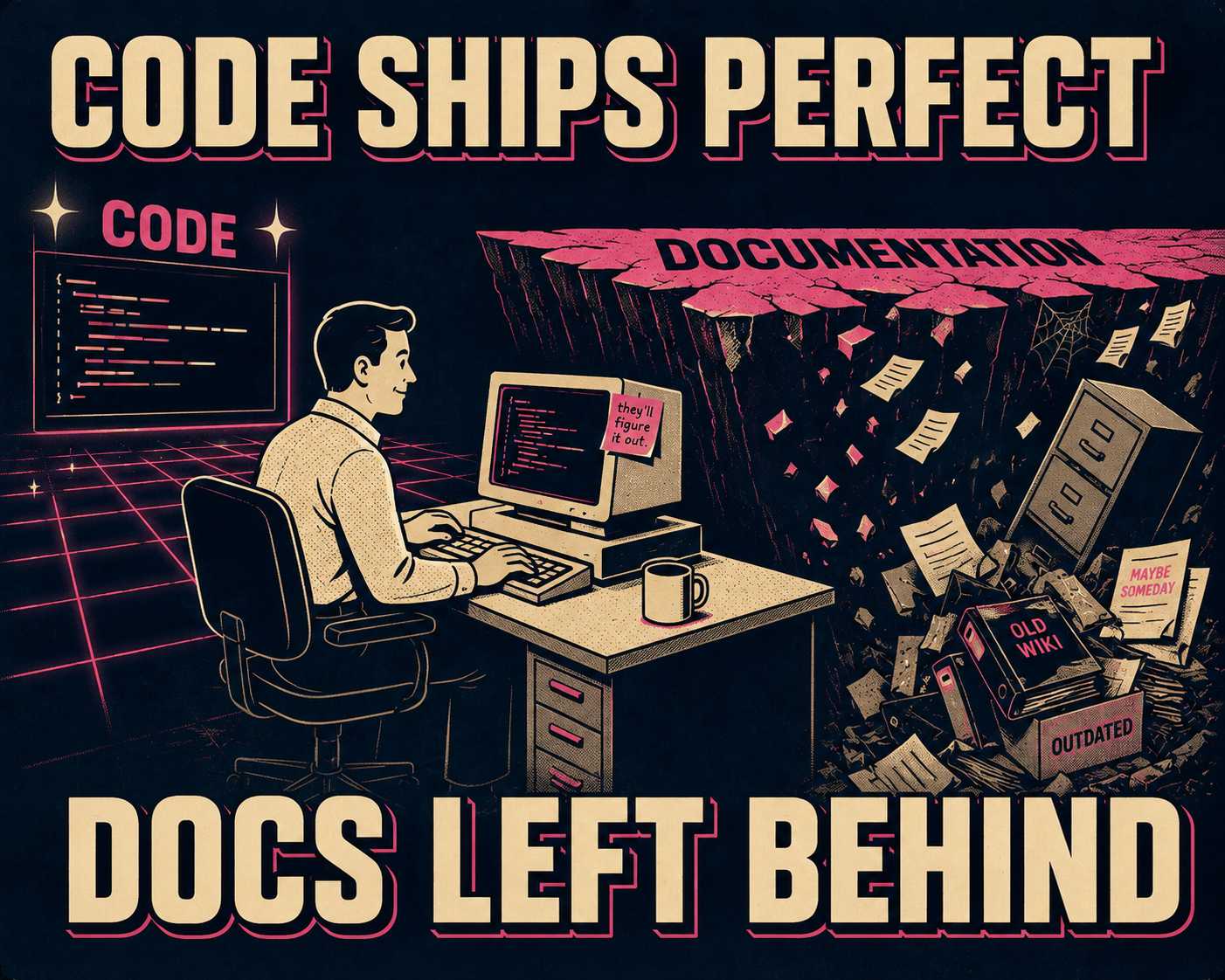
AI assistants are excellent at producing syntactically correct code that solves local problems. They operate, however, without awareness of your documentation contracts, existing API guarantees, or the prose explanations living in your docs repo. When a developer relies on an AI to generate significant portions of a codebase, the standard code review process (designed to catch logic errors and style violations) misses the silent accumulation of cognitive and intent debt: the erosion of shared understanding and the absence of externalized rationale that developers need to work safely with code.
The speed numbers are real. Developers using AI tools are completing tasks up to 55% faster, and AI now contributes 46% of all code written by its users. The code flows, features ship, and the velocity charts look incredible. But when code velocity increases by 50%, documentation doesn't just fall behind. It becomes actively untrustworthy.
If the documentation is always a week behind the codebase, engineers stop trusting it. When they stop trusting it, they stop updating it. The drift becomes permanent.
What Actually Changes When the Machine Writes the Code
When humans wrote every line of code by hand, the cadence of change was slow enough that a technical writer (or a diligent engineer) could eventually catch up. A major architectural shift took weeks. Now, an AI assistant can refactor a module before lunch.
This speed introduces a specific kind of documentation drift: the gap between the product users interact with and the docs they rely on to use it. The AI makes decisions about error handling, dependencies, and edge cases, embedding them silently into the code. These assumptions are invisible in a standard code review. Research on AI-induced technical debt finds that AI-assisted development tends to shift self-admitted debt toward later development stages, particularly requirement completion and validation activities. The debt doesn't disappear; it just moves somewhere harder to see.
To catch this, teams need a systematic approach to identify when AI-generated code creates undocumented behavior. The following review checklist integrates into existing PR workflows without rebuilding them from scratch.
The surface-level scan. Start with the obvious: what user-facing behavior did this PR change? Did it add parameters, modify return types, change error codes, or alter any interface that external users or downstream systems depend on? If yes, documentation impact is automatic. This is the fastest gate to apply and the one most teams skip entirely.
The documentation contract check. Does your existing documentation make promises this change might break? Cross-reference the changed code against API references, integration guides, and troubleshooting sections. The specific failure mode to watch for: an AI assistant adds a new required field to a configuration object, but the setup guide still shows the old three-field example. The code is correct. The docs are now a trap. Context rot research shows that applying existing documentation consistency tools to a representative sample of repositories identifies stale code element references in 23% of them. That's before AI-accelerated development compounds the problem.
Implicit behavior changes. AI-generated code often changes performance characteristics, error handling patterns, or side effects without explicit intent. A refactor that moves from synchronous to asynchronous processing might be functionally correct. It might even be better code. But it breaks every code example in your docs that doesn't await the call. A study on AI-generated code quality and security found that even code passing all functional tests still averages 1.45 to 2.11 static analysis issues per task. The functional tests pass; the behavioral assumptions embedded in your docs do not.
Changelog and release note triggers. Define clear criteria for when a code change requires a release note entry. AI assistants don't have context on what your users consider breaking versus non-breaking. A change that's technically backward-compatible in the API might still surprise users enough to warrant a mention. As research on API breaking changes notes, even additive changes can break poorly coded client applications when they affect payload size, pagination, or response timing.
The validation step. Run a quick manual test against the updated code using your own documentation as the test script. If the docs don't work as written, the PR isn't done. This sounds obvious, and yet it's the step that almost never happens. The documentation is treated as a description of what the code does, not as a test of whether the description is still accurate.
Where This Lives in the Workflow
Code review is already a bottleneck. Building is now limited to how fast teams can review the newly generated code. Adding another manual review gate sounds expensive, and it is, if you implement it wrong.
The ROI comes from catching documentation debt at commit time instead of six months later, when a support engineer discovers your API docs describe a version that hasn't existed for three releases. The cost of fixing an API reference now is a few minutes. The cost of fixing it after it has misled users, generated support tickets, and eroded trust in your documentation is considerably higher. DORA research found that high-quality documentation leads to 25% higher team performance relative to low-quality documentation. That's not a soft benefit. It shows up in deployment frequency, change failure rate, and time to restore.
Most teams should add documentation impact as a formal review criterion alongside security, performance, and test coverage. In practice, this means one person (your most documentation-aware engineer or technical writer) has the authority to flag a PR as requiring a documentation update before it merges. That's the gate. It's lightweight. It doesn't require everyone to become a documentation expert.
The harder question is what happens after the flag is raised. If the answer is "someone writes the update manually," you've just created a new bottleneck. A GitClear analysis of 211 million changed lines found that AI assistants are writing more code than ever, with duplicate code blocks and short-term churn both increasing. The volume of changes requiring documentation review is growing faster than any team's capacity to manually document them.
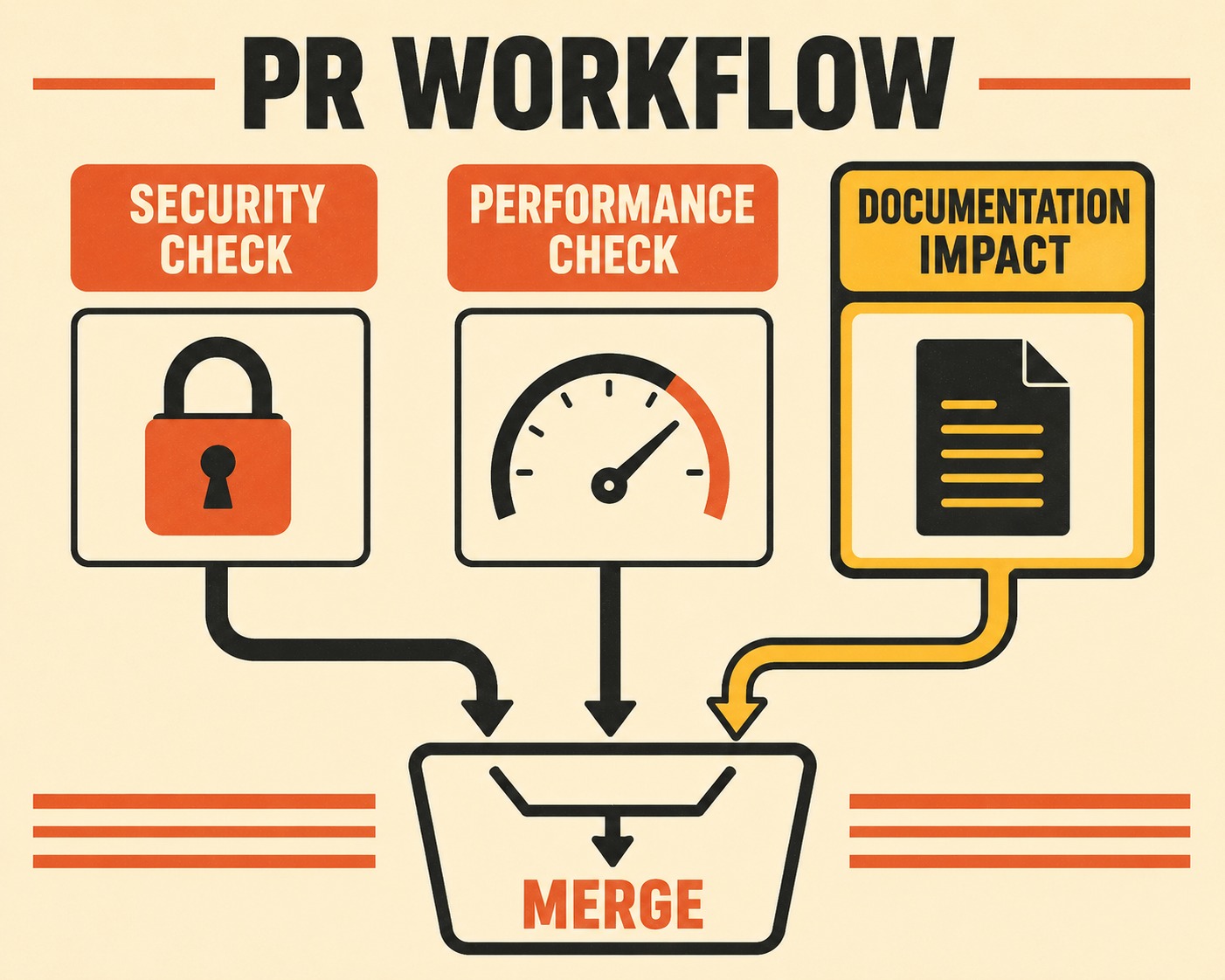
The answer is to give the reviewer the tools to generate the update, not write it. The reviewer marks the PR for documentation update. The documentation engine produces the draft release note, API reference change, or changelog entry from the diff and context. The reviewer edits and approves. The PR merges.
That's the difference between documentation review as a tax and documentation review as a quality gate that actually closes the loop.
Doc Holiday is built for exactly this workflow. It generates release notes, API references, and changelogs directly from your engineering workflows, creating first drafts from code commits. A senior writer or engineer reviews the output for accuracy, edge cases are flagged, and patterns are fed back to improve future drafts. The documentation-aware engineer you already have becomes the editor of a system, not the author of every page.