How to Write AI Release Notes That Survive Production


There is a specific kind of support ticket that product managers dread. It arrives three weeks after a major AI feature ships. The customer is not angry, exactly. They are confused. They write something like: "Your release notes said the assistant would analyze our support tickets and suggest responses. We've been using it for two weeks and it keeps suggesting we apologize for shipping delays on orders that aren't delayed. Is this a bug?"
The answer is: sort of. The feature works. It just doesn't work the way the release notes implied it would. And now someone on the support team has to explain the difference between "analyzes tickets to suggest responses" and "analyzes tickets accurately enough to suggest responses you'd actually want to send." That distinction didn't make it into the release note. It seemed too technical. Too hedging. Too much like admitting the feature wasn't ready.
This is the trap. And almost every team shipping AI features falls into it at least once.
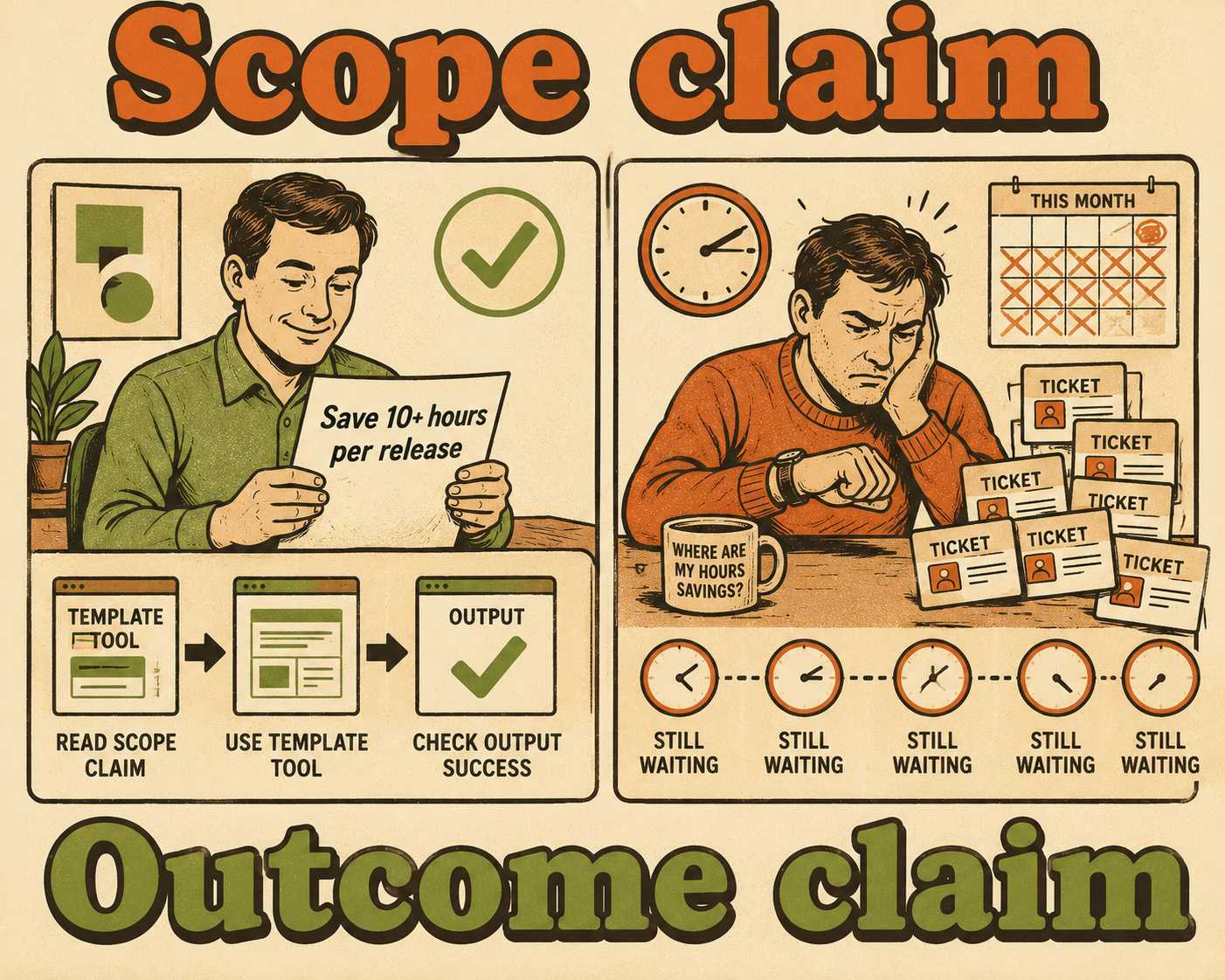
The problem isn't that AI features are hard to describe. It's that the incentives around release notes push in exactly the wrong direction. Marketing wants to lead with impact. Engineering wants to list every caveat. Legal wants to say nothing actionable. The result is either a vague claim that gives users no mental model, or an overclaim that creates expensive support load when the feature encounters the edge cases you didn't anticipate in testing.
Vague release notes ("improved recommendations," "smarter insights") give users nothing to act on. They either ignore the feature entirely or misuse it and blame the product when it behaves unexpectedly. Overclaimed release notes are worse. They generate support tickets, damage trust, and, increasingly, attract attention from legal and compliance teams who are now reading AI feature descriptions looking for exposure.
The gap between what you said it does and what it actually does is now a reputational surface area. Release notes are often the first thing a skeptical journalist or regulator will screenshot. Being specific and honest is a competitive advantage, not a liability.
What follows is a structured method for writing AI release notes that are specific enough to be useful and honest enough to survive contact with production.
What the Feature Actually Does (Not What You Hope It Will Do)
The most important discipline in writing AI release notes is the distinction between scope and outcome. Scope describes the input/output relationship. Outcome describes the business impact. When you describe scope, you are making a promise you can keep. When you describe outcome, you are guessing.
"Analyzes support tickets to suggest response templates" is scope. "Reduces response time by 50%" is an outcome claim. The first describes what the feature does. The second describes what might happen if the feature works perfectly in your customer's environment, which you cannot guarantee.
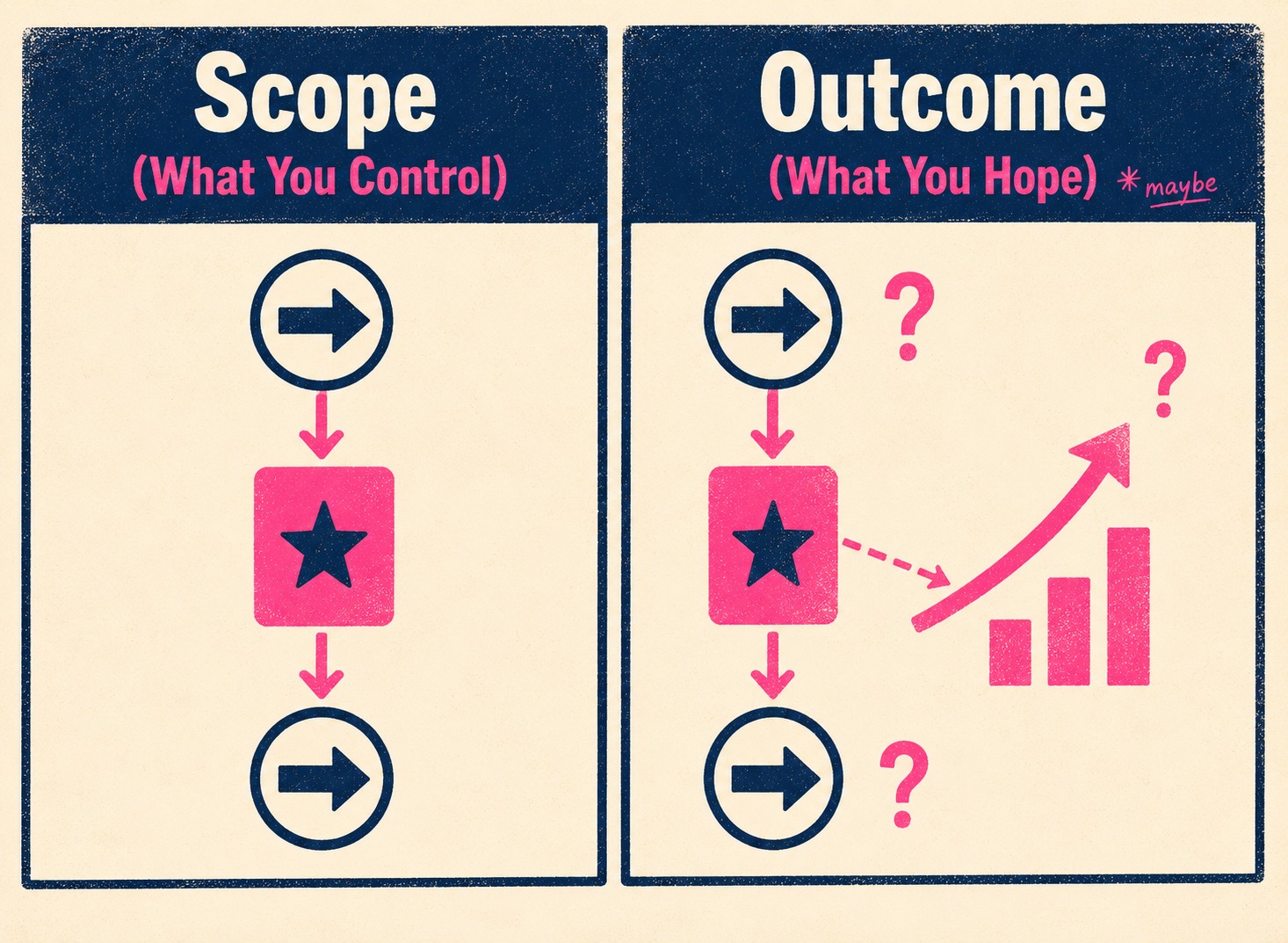
This is not just a semantic distinction. It changes what the user expects, and it changes what happens when the feature behaves differently than they anticipated. A user who understood the scope ("it suggests templates") will evaluate the suggestions and decide whether to use them. A user who understood the outcome claim ("it reduces response time") will wait for the time savings to materialize, and when they don't, they'll file a ticket.
The before/after version of this looks like:
Before: "Our AI-powered assistant makes your support team faster and more efficient."
After: "The response assistant analyzes incoming tickets and suggests three response templates based on your team's historical replies. You review and send, or edit before sending."
The second version is longer. It is also more useful. The user knows what the feature does, what they need to do, and what the output looks like. There is no gap between the description and the experience.
When to describe business impact at all is a judgment call. If you have real data from a controlled pilot, you can include it with appropriate framing: "Teams in our beta reduced average response time by 20–35%, depending on ticket volume and template adoption rate." That is specific, bounded, and honest about variance. "Reduces response time by 50%" is none of those things.
Communicating Accuracy Without Sounding Like You're Apologizing
AI features work most of the time. That sentence is both true and completely unhelpful, because "most of the time" covers an enormous range. A feature that works 99% of the time and a feature that works 60% of the time are both "most of the time." The user needs to know which one they're getting.
The instinct is to avoid accuracy language entirely, because it feels like admitting the feature is broken. It isn't. Framing reliability as a spectrum is more honest and more useful than pretending the feature is binary. Users who understand the accuracy profile can calibrate their trust appropriately. Users who don't will either over-rely on the feature or abandon it when they hit the first failure.
There is a meaningful difference between these two sentences:
"May not work if the input is too long or contains unusual formatting."
"Correctly identifies product names in 85% of cases in our testing. Works best when tickets are under 500 words and written in English."
The first is defensive. It protects the company without helping the user. The second tells the user something they can act on. They know the accuracy level. They know the conditions under which it performs best. They can decide whether to use the feature for their specific use case.
When to include accuracy metrics in the release note versus saving them for documentation is a judgment call that depends on how central accuracy is to the user's decision to adopt the feature. If the feature is a "nice to have" that users will try and discard if it doesn't work, a brief accuracy note in the release note is enough. If the feature is something users will build workflows around, the accuracy profile belongs in the release note, with a link to deeper documentation.
Model confidence levels are worth describing when the feature surfaces them. "The assistant shows a confidence score next to each suggestion. Scores above 80% are based on close matches to historical replies; scores below 50% indicate the ticket type is new to the model" is the kind of sentence that helps a product manager explain the feature to their team. "Uses advanced AI" is not.
What Users Actually Need to Know About Training and Limitations
There is a difference between a legal disclosure and a useful limitation. Legal disclosures protect the company. Useful limitations help users succeed. The best release notes do both, but they prioritize the second.
"Model trained on proprietary dataset. Performance not guaranteed across all domains." That is a legal disclosure. It says nothing the user can act on. It doesn't tell them what the model was trained on, what "all domains" means, or what they should expect in their specific environment.
"Trained on e-commerce support tickets from 2020 to 2024. It will struggle with highly technical B2B inquiries, tickets written in languages other than English, and requests involving custom product configurations." That is a useful limitation. The user knows the training data. They know the failure modes. They can decide whether their use case fits.
Data dependencies are worth describing when they affect the user's experience. If the feature requires a minimum amount of historical data to function well, say so. "Requires at least 200 historical tickets to generate meaningful suggestions. New accounts will see generic templates until the model has enough data to personalize." That sentence prevents a specific category of support ticket: the one from a new customer who enabled the feature and got garbage output.
The test for whether a limitation belongs in the release note is whether a user who reads it will change their behavior. If the answer is yes, include it. If the answer is no, it belongs in the documentation, not the release note.
The Off Switch (And Why It Matters More Than You Think)
Every AI feature announcement should include what happens when the user doesn't trust the output. This is not a concession. It is a trust signal.
Users who know they can override the AI are more likely to adopt the feature, because they know they're not locked into its decisions. Users who feel like the AI is making decisions for them, with no clear path to override, will either avoid the feature or disable it entirely when they hit the first failure.
The release note equivalent of an off switch looks like this: "If the suggested template doesn't fit, click 'Draft Manually' to start from scratch. You can also mark a suggestion as unhelpful to improve future recommendations."
That sentence does three things. It tells the user how to override the AI. It tells them how to give feedback. And it implies that the feature will improve based on their input, which is a more honest version of "our AI learns from you" than most release notes manage to deliver.
Feedback loops are worth describing in the release note when they are real and observable. "We retrain the suggestion model monthly based on aggregate feedback. You'll see recommendations become more tailored to your team's tone over the first few weeks of use." That is specific, honest about the timeline, and gives the user a reason to engage with the feedback mechanism.
"Beta" Is Honest Until It Isn't
Labeling a feature "beta" is honest when the feature is genuinely in an early state and you are actively iterating based on user feedback. It is a crutch when you just want an excuse for poor performance without committing to a timeline for improvement.
The difference is visible in the language around the label. "This feature is in beta. We're actively improving accuracy based on your feedback and will remove the beta label when we reach our internal quality threshold" is honest. "This feature is in beta" with no further context is a hedge.
Versioning language is worth getting right because it shapes how users invest in the feature. A user who reads "this is an early version and we're improving it" will engage differently than a user who reads "this is our production-ready AI assistant." The first user will give feedback. The second user will file tickets when the feature doesn't meet production-ready expectations.
Describing model updates in release notes is worth doing when the update changes the user's experience in a meaningful way. "We updated the suggestion model to improve accuracy on tickets involving refund requests. Teams that handle high refund volumes should see noticeably better suggestions starting today." That is a release note worth reading. "Improved model performance" is not.
The Stakeholder Problem
Engineering wants to include every caveat. Marketing wants to say it's magic. Legal wants to say nothing. The release note has to thread all three without becoming unreadable.
The tiebreaker is simple: if the user cannot act on the information, it doesn't belong in the release note.
Engineering's caveats belong in the release note when they describe conditions the user will encounter. They belong in the documentation when they describe edge cases the user is unlikely to hit. Marketing's impact claims belong in the release note when they are supported by real data with appropriate variance. They belong on the landing page when they are aspirational. Legal's disclosures belong in the release note when they describe limitations the user needs to know before adopting the feature. They belong in the terms of service when they are protective boilerplate.
The release note is not the place to resolve every internal disagreement about the feature. It is the place to give the user enough information to make a decision.
What the First 30 Days Will Tell You
Instrument AI features so you know whether your release notes matched reality. The metrics to watch in the first 30 days are not the ones you might expect.
Feature adoption rate tells you whether users found the release note compelling enough to try the feature. Disable rate tells you whether the feature met their expectations. Support ticket themes tell you where the gap between the release note and the experience is widest. If you're seeing tickets that ask "why does it do X," the release note didn't explain X. If you're seeing tickets that ask "how do I turn this off," the release note didn't include the off switch.
Issue a clarification when users are systematically misunderstanding the feature's boundaries. Let the feature speak for itself when the confusion is isolated. The threshold for a clarification is roughly: if more than a handful of users are asking the same question, the release note failed to answer it.
Customer feedback should shape the next release note you write for an AI feature. The questions users ask in the first 30 days are the questions the next release note should answer before they have to ask.
The Brand Risk Is Real
Companies that overpromise on AI are now getting press attention when features underperform. This is a relatively new dynamic. A year ago, "our AI is smarter than ever" was a harmless marketing claim. Today, it is a claim that journalists, regulators, and enterprise procurement teams will test against the actual product.
The EU AI Act, which began applying to high-risk AI systems in August 2024, includes transparency requirements that extend to how AI systems are described to users. The FTC has published guidance on AI performance claims warning companies against unsubstantiated assertions about what their AI can do. The NIST AI Risk Management Framework similarly identifies transparency as a core trustworthiness property, including how AI capabilities and limitations are communicated to users. Release notes are not marketing copy. They are product documentation. The gap between what you said it does and what it actually does is now a compliance surface area, not just a trust problem.
Being specific and honest is not just the right thing to do. It is the defensible position.
The Structural Advantage of Starting From What Actually Shipped
The hardest part of writing honest AI release notes is not knowing what to say. It is knowing what actually shipped. Most release notes are written from a combination of the feature spec, the marketing brief, and whatever the PM remembers from the last engineering standup. None of those sources are reliable descriptions of the production feature.
Doc Holiday generates release notes directly from the engineering commit history and feature flags. The description starts grounded in what actually shipped, not what marketing hoped would ship. The output still needs a product manager to add context about capability boundaries and user-facing limitations, but the foundation is already accurate. That structure makes it easier to write release notes that survive production, because you're editing a factual baseline instead of drafting from aspiration.