The Hidden Cost of AI Coding Assistants


We finally got what we wanted. After years of trying to make software development faster, AI coding assistants arrived and actually did it. Developers are completing tasks up to 55% faster.
The code is flowing. Features are shipping. The velocity charts look incredible.
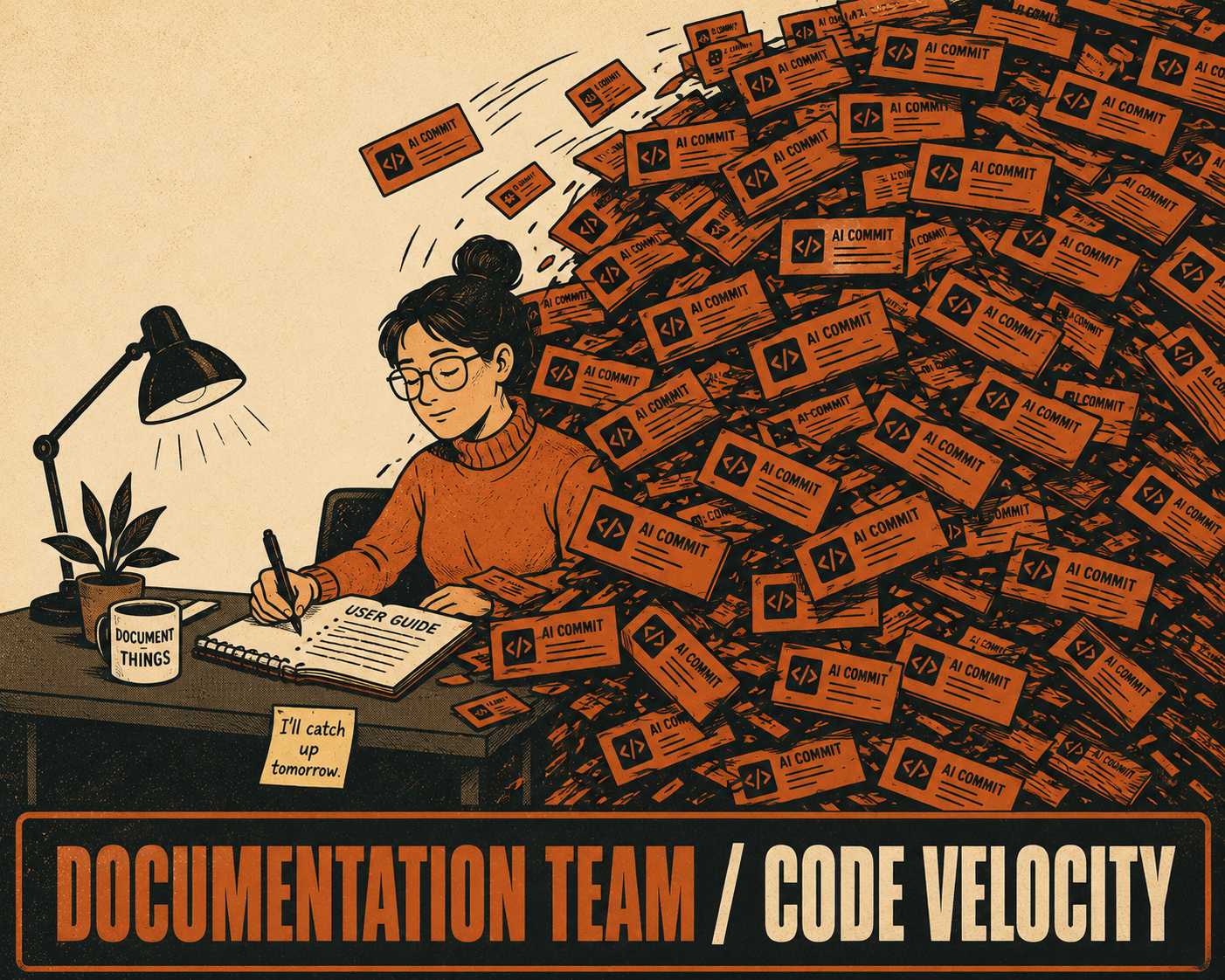
And the documentation is completely broken.
The problem isn't that developers stopped caring about documentation. The problem is that the fundamental physics of software development have changed. AI coding assistants don't just speed up typing; they compress the time between ideation and implementation. A developer using an AI assistant can generate hundreds of lines of structurally valid code in minutes.
Our documentation workflows were designed for a world where humans wrote every line of code by hand. They assume a natural cadence where code changes happen slowly enough that a technical writer, or a diligent engineer, can eventually catch up.
That cadence is gone. When code velocity increases by 50%, documentation doesn't just fall behind. It becomes actively untrustworthy.
If the documentation is always a week behind the codebase, engineers stop trusting it. When they stop trusting it, they stop updating it. The drift becomes permanent.
The question for engineering leaders isn't whether to use AI coding tools. You are going to use them. The question is how to redesign the documentation process so it scales with this new velocity.
Why The Old Ways Break Under New Speed
Manual documentation was always reactive. You write the code, you test the code, you merge the code, and then you write down what the code does.
This lag was tolerable when major architectural changes took weeks. It is not tolerable when an AI assistant can refactor a module in an afternoon.
The issue compounds because AI-generated code increases codebase complexity by around 41%. The AI makes decisions about error handling, about dependencies, about edge cases, and embeds them silently into the code. These assumptions are invisible in a standard code review, and they are certainly invisible to a technical writer trying to document the change after the fact.
There's a second-order effect that's easy to miss. When engineers know the docs are always wrong, they stop reading them. They start asking Slack instead. The documentation becomes a liability rather than an asset, because it actively misleads people who trust it.
Research on continuous software development has consistently found that documentation is frequently out-of-sync with the software, regardless of whether it lives in source code comments or wiki-like systems. That was true before AI coding tools. It is dramatically more true after them.
Documentation written by humans after the fact now arrives days or weeks late. By the time the runbook is updated, the underlying architecture has already shifted again.
The Things We Try That Don't Work
Engineering teams are not ignoring this problem. They are trying to fix it. The fixes just aren't working.
Requiring engineers to update docs before merging is the most common attempt. It is also the least successful. It directly opposes the velocity benefit of the AI coding tools you just invested in. Engineers will ignore the requirement, or they will write the absolute minimum necessary to pass the gate. (The resulting documentation is technically compliant and practically useless.)
Asking the AI coding tools to generate the docs inline seems like the obvious solution. It works well for simple, isolated functions. It fails completely for cross-module behavior, API contracts, and anything requiring architectural context. The AI assistant in the IDE doesn't know how this change affects the deployment pipeline, or what the downstream consumer of that API is expecting.
Hiring more technical writers doesn't solve the velocity mismatch. It just adds headcount. You cannot hire enough humans to manually chase down AI-generated code changes at the rate they are now being produced.
Letting the docs drift and planning a "documentation sprint" for later is the final stage of grief. The sprint never happens. The drift becomes the new reality, and eventually the only people who understand what the system actually does are the three engineers who built it last quarter.
Treating Documentation as a Build Artifact
The correct solution is structural. You have to stop treating documentation as a separate work stream and start treating it as a build artifact.
If code changes are being committed multiple times per day, documentation should regenerate multiple times per day.
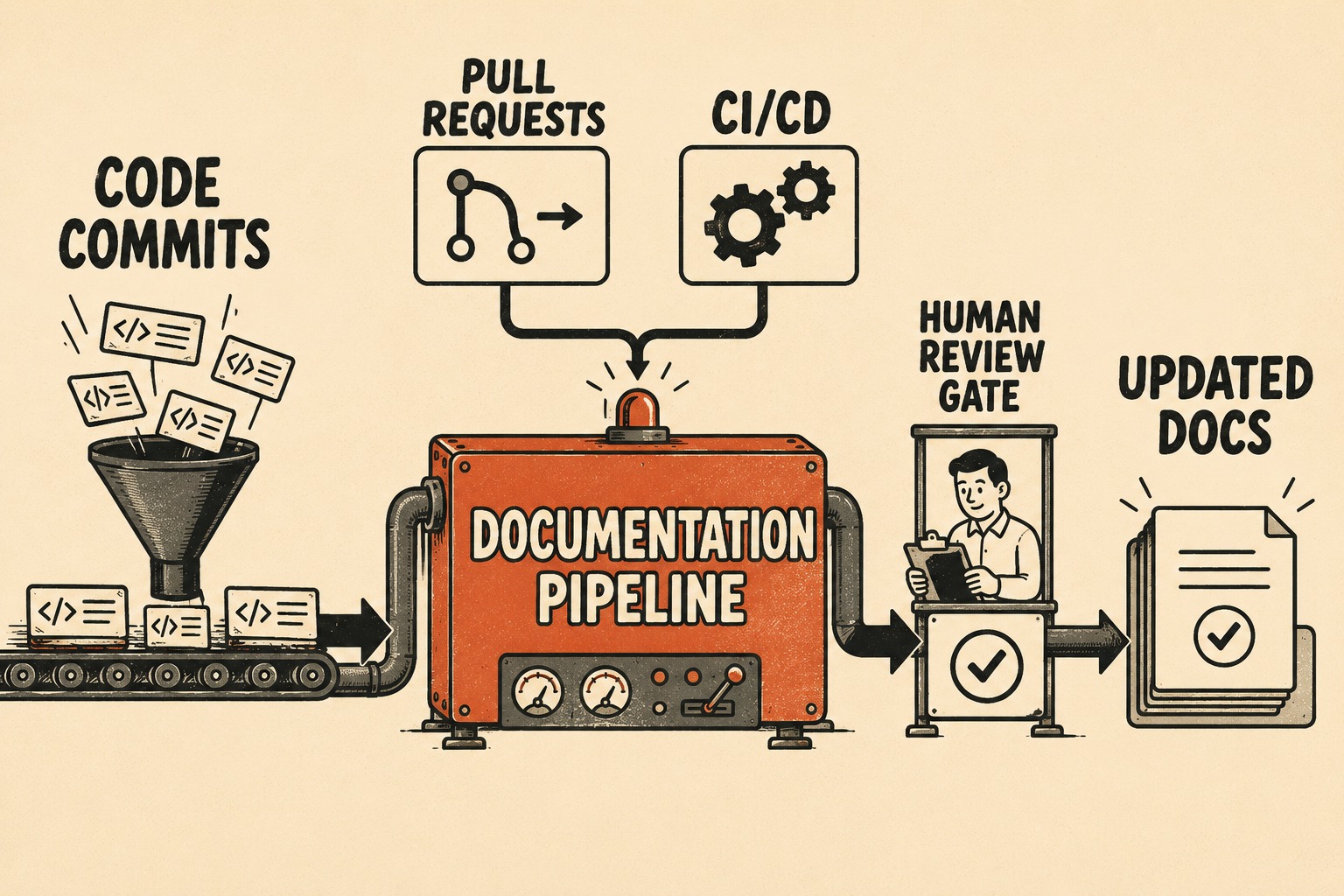
This requires tooling that hooks directly into the engineering workflow. The documentation system needs to read from the pull requests, the commit logs, the CI/CD pipelines, and the issue trackers. It needs to pull from the exact same context the AI coding tool is acting on.
It needs to know what changed, why it changed, and what it affects.
The docs-as-code philosophy has been pointing in this direction for years: treat documentation with the same tools, the same version control, and the same review processes as the code itself. AI generation is the natural next step in that evolution. It's not enough to store docs alongside code; the docs need to be generated from the code, continuously.
Effective AI documentation tools don't replace technical writers. They change the nature of the job. They give technical writers a system to manage and validate output, rather than asking them to manually chase down every code change. The technical writer becomes the editor of a system, not the author of every page.
How To Validate Without Rebuilding The Bottleneck
Automation without validation is just generating garbage faster. You need human oversight. You just need to apply it at the right leverage points.
Assign one senior technical writer or engineering lead to own the documentation system. Their job is not to write every changelog. Their job is to spot-check the automated output, flag errors, and tune the generation prompts. One person managing a system is far more scalable than five people manually writing docs.
Build this validation into the existing review process. Engineers should review the AI-generated documentation at PR time, when the context of the change is still fresh. This is the moment when a developer can confirm in thirty seconds whether the generated description is accurate. Three weeks later, they won't remember.
Use diff-based review for the docs. Engineers shouldn't have to read the entire updated manual. They should only review the specific paragraphs that changed in this release. Make the review surface small and the friction low.
Set quality gates. If the AI-generated release notes don't accurately reflect the actual changeset, the PR doesn't merge. You fix the prompt, or you fix the input context, before you proceed.
Track documentation drift as a core engineering metric. If the generated docs and the actual system behavior diverge, treat it exactly like a test failure. It is a test failure; the test just happens to be "does this document describe reality."
How To Sell This To The Team
If you are an engineering leader, frame this as protecting your investment. You bought AI coding tools to speed up development. If you don't automate the documentation, you are just moving the bottleneck further down the pipe. Documentation becomes the new constraint, and you've spent a significant budget to create it.
If you are a technical writer, frame this as a force multiplier. You are no longer spending your days begging engineers for changelog updates. You are managing a system that drafts them automatically. You get to focus on the high-value work (structure, accuracy, user experience) that AI cannot do unsupervised.
This is a workflow redesign, not just a tooling swap. Teams that have adopted AI coding assistants and are now struggling with documentation drift are not facing a people problem or a motivation problem. They are facing a systems problem. The system was designed for a slower world. It needs to be rebuilt for the one we're in.
The code is never going to slow down again. We have permanently changed the speed limit of software development.
Doc Holiday is built for this exact operational reality. It hooks directly into your engineering workflows, generating release notes, API references, and changelogs from your actual commits. It gives lean teams the structure they need to validate, manage, and scale their documentation output, so that when the code ships, the truth ships with it.