Splitting Documentation Responsibilities Between Engineering and Product Teams


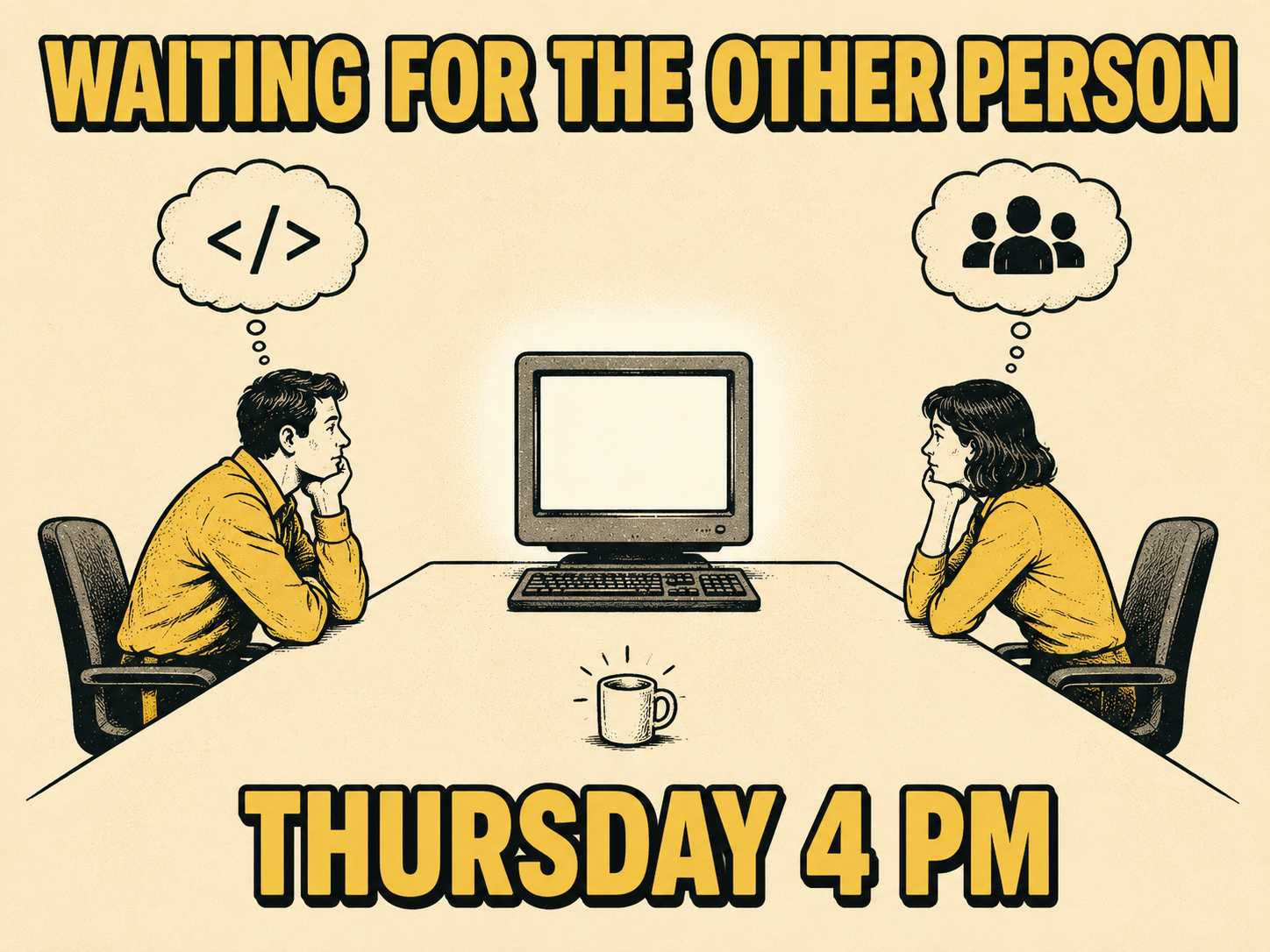
It is 4:00 PM on a Thursday, and the release is blocked. The code is merged, the tests are green, and the feature flag is ready to flip. But the release notes are a blank page.
The product manager assumes the engineer who built it will document it. The engineer assumes the product manager who requested it will explain it to the users. They are both staring at an empty Google Doc, waiting for the other to start typing.
This is what happens when documentation ownership is informal.
For a long time, the model was simple: "whoever has time writes it." Or, if a company was lucky enough to have a dedicated technical writing team, they handled everything. But as engineering organizations scale and technical writing headcount is often reduced, the informal model breaks down. The alternative—endless alignment meetings where no one commits—is worse.
What is needed is a clear ownership model that respects what each function is actually good at. The 2023 Accelerate State of DevOps Report found that high-quality documentation leads to 25% higher team performance relative to low-quality documentation. It amplifies the impact of technical capabilities. But that quality requires accountability.
The Breakdown of "Whoever Has Time"
When no one explicitly owns documentation, it decays. Research on documentation essential to software maintenance highlights that these artifacts are crucial for communicating implementation details across time to maintenance teams. Without ownership, those details are lost.
The "whoever has time" approach inevitably leads to documentation debt. This is not just a nuisance; it is an operational risk. Missing or outdated documentation forces team members to rediscover decisions. It creates a barrier to scale.
If everyone owns documentation, no one owns it.
Own the Source, Own the Documentation
The core principle is straightforward: Own the source, own the documentation.
Engineering owns anything that describes how the system works. Product owns anything that describes what the system does for users. The boundary is sharper than most teams assume.
API documentation, internal architecture docs, setup guides, deployment notes, and troubleshooting references belong to engineering. These artifacts require an understanding of implementation details that only the engineers possess. Google's software engineering practices treat documentation like code — it should have clear ownership responsible for maintaining it. Product can request these documents, but they should not be writing them.
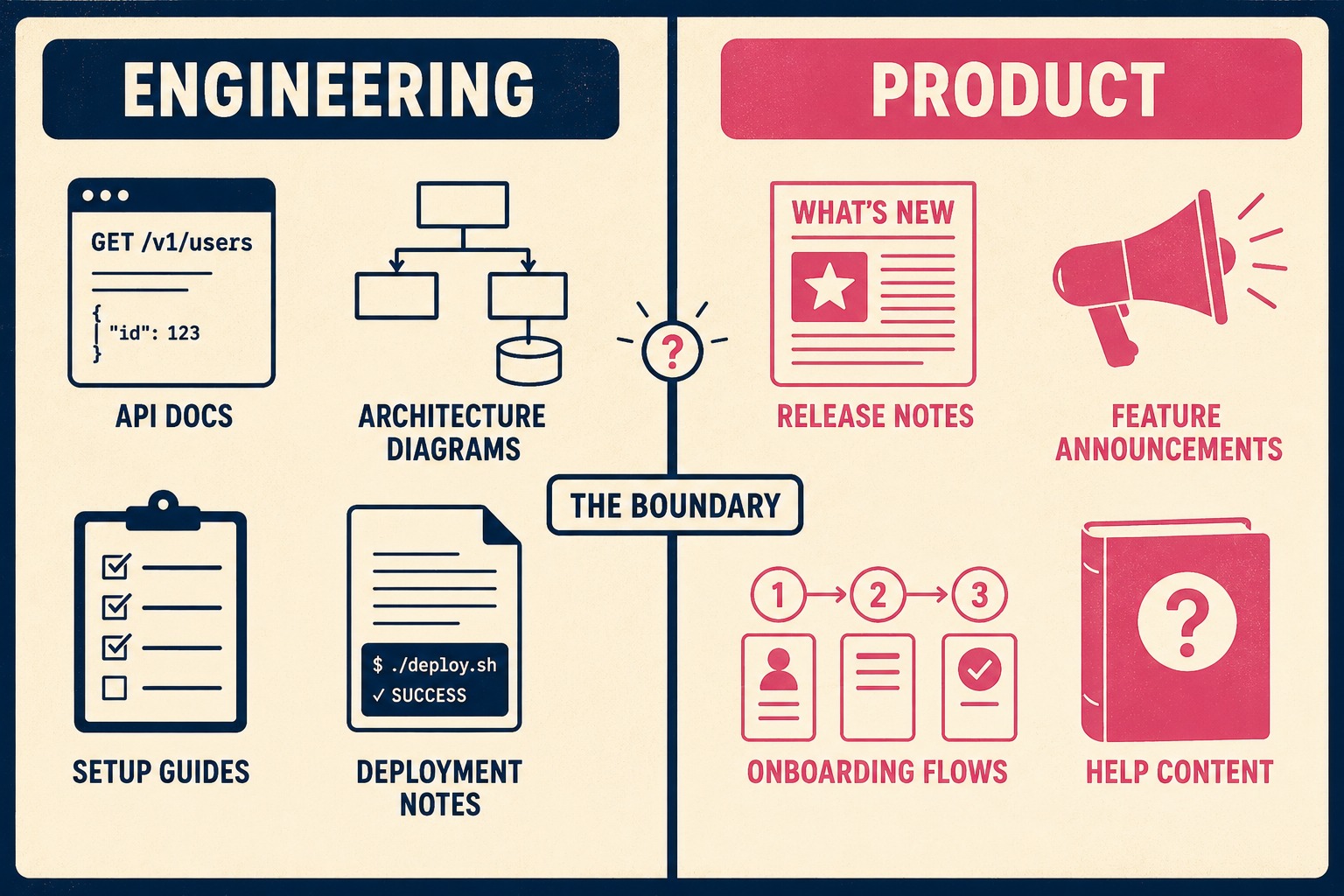
Feature announcements, user-facing release notes, onboarding flows, help center content, and competitive positioning belong to product. These artifacts require an understanding of user problems and business context. Engineering can contribute technical accuracy reviews, but they should not be drafting.
The Messy Middle
Then there is the messy middle.
Integration guides, configuration references, and feature specifications require both perspectives. The solution here is not joint ownership. Joint ownership means no ownership.
Assign a primary owner. Usually, this means engineering for configuration references and product for feature specifications. Then, build a lightweight review gate where the other function validates for accuracy or clarity.
Clear ownership does not mean solo work. Engineering should review product's user-facing documentation for technical accuracy. Product should review engineering's setup guides for clarity.
But reviews are faster than drafting, and the split keeps work moving.
How to Avoid the Bottleneck
The problem most teams hit is that assigning clear ownership sounds good until someone on the critical path is underwater. A product manager who knows they own the release note but is staring at a blank page is likely to procrastinate.
You address this with two mechanisms: templatization and AI-assisted drafting.
A template means the person writing knows exactly what is expected. It prevents the blank page problem. A product manager who can generate a structured first draft from a commit log is far more likely to actually do it than one starting from scratch.
Teams that have built AI-assisted release note pipelines consistently find that extracting structured text from issue summaries and commit messages saves days of effort — not because the AI writes everything, but because it eliminates the blank page.
The Role of the Technical Writer
Some teams respond to this split by appointing one person from each function to handle all documentation. They call them the "documentation liaison."
This just recreates the bottleneck. The correct model is distributed ownership with structured templates, not centralized gatekeeping.
If your organization still has technical writing headcount, their role shifts. The industry is already moving in this direction — toward the documentation product manager model, where writers move from production to governance.
They maintain templates, audit for gaps, ensure consistency, and manage the validation process. They become the system operators, not the production line.
If you do not have technical writers, the absence of structure becomes the risk. Someone needs to own the process even if they are not writing every word.
The Infrastructure of Accountability
Framing the split clearly prevents operational failures. It prevents a product launch where the feature is ready but the documentation is not. It prevents a critical bug fix that ships without updated troubleshooting notes. It prevents an API change that breaks integrations because no one documented the deprecation timeline.
The missing piece for most teams is the drafting infrastructure. If your engineers are writing API references manually and your product managers are drafting release notes from scratch, the process will stall.
This is where a tool like Doc Holiday becomes structurally useful. It drafts the base documentation artifact — the API reference, the changelog, the release note — from your engineering workflow, then surfaces it to the right owner for human review and finalization before anything goes out. You get the speed of automation with the accountability of clear ownership.