How to Secure Buy-in From Engineering Leadership for Documentation Investment


Every engineering leader agrees that documentation is important. Nobody argues against it. But when budget season arrives, the headcount goes to shipping new features, and documentation gets deferred until next quarter.
This cycle continues until a major customer threatens to churn because they cannot figure out how to use the API. Suddenly, documentation is an emergency. A task force is assembled, a few engineers are pulled off their sprint to write a flurry of README files, and the crisis is averted. Then the cycle begins again.
This reactive approach guarantees that documentation is always underfunded. It happens because documentation advocates usually make the wrong pitch. They argue that documentation is the right thing to do. Engineering leaders do not fund the right thing to do. They fund things that unblock their teams and reduce operational risk.
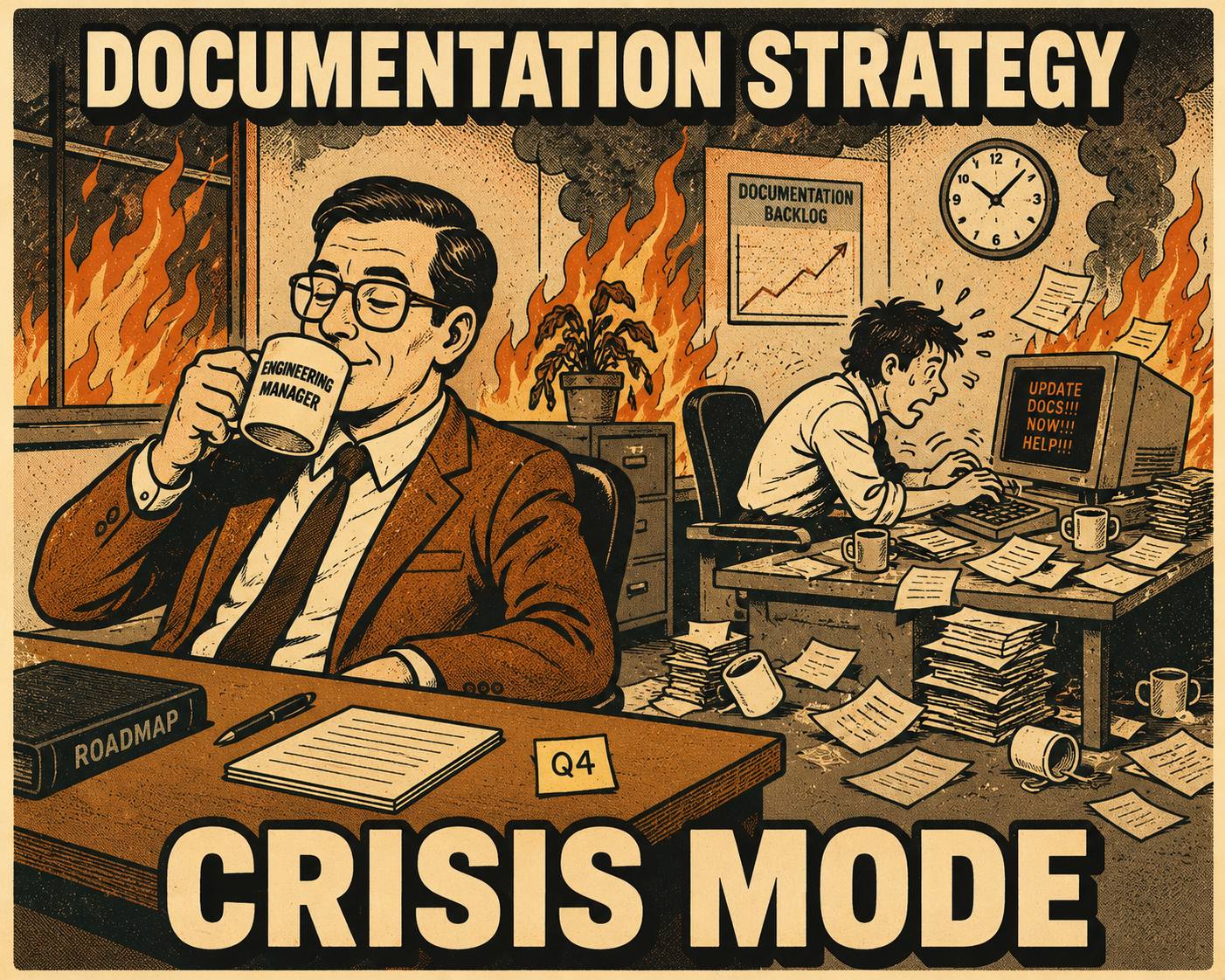
If you want to secure investment for documentation, you have to stop pitching it as compliance theater and start pitching it as interrupt reduction.
Here is how you make the case.
The Argument About Velocity
Engineering leaders care deeply about velocity. They want their teams shipping code, not answering the same questions in Slack over and over again.
Poor documentation is a velocity killer. It does not cause dramatic, system-halting failures. It quietly erodes productivity through repetitive interruptions. When an API endpoint is undocumented, every engineer who needs to use it has to interrupt the engineer who wrote it.
The data on this is striking. The average developer spends more than 17 hours a week dealing with maintenance issues, including debugging and refactoring, according to Stripe's Developer Coefficient report. A significant portion of that time is spent navigating undocumented or poorly documented codebases. Separately, 61% of developers spend more than 30 minutes a day just searching for answers or solutions to problems. That is roughly 2.5 hours a week per engineer, across your entire team, spent on a problem that better documentation would largely eliminate.
When you pitch this to leadership, do not talk about how nice it would be to have clean docs. Talk about the tax they are currently paying on interruptions.
The pitch: "Our engineers are currently spending an estimated 15 hours a week answering internal support questions about our core APIs. That is roughly $X in engineering time per month spent acting as human search engines. If we invest in a dedicated technical writer to document these surfaces, we can redirect that time back into feature development. We are currently paying for documentation through lost velocity; I am proposing we pay for it efficiently."
The Argument About Technical Debt
Engineering leaders already understand technical debt. They know that taking shortcuts now means paying interest later.
Documentation debt is a specific, highly corrosive category of technical debt. The longer a system goes undocumented, the harder it becomes to reconstruct how it works. The people who built it leave the company, taking the institutional knowledge with them. A systematic mapping study published in the Journal of Systems and Software found that poor documentation in agile and DevOps environments directly hinders knowledge transfer, makes maintenance harder, and introduces steep learning curves for new team members.
When you frame documentation as debt repayment, you align it with a concept leadership already budgets for. You are asking them to pay down the principal while the engineers who hold the knowledge are still in the building. The accumulated technical debt in US software alone has grown to an estimated $1.52 trillion. Documentation debt is a meaningful slice of that number, and it compounds.
The pitch: "We have shipped three major features this year without updating the corresponding architecture documentation. We are accumulating documentation debt at a rate that will soon impact our ability to safely modify these systems. I want to allocate resources to pay down this debt now, before the original authors transition to other projects and the cost of reconstructing this knowledge doubles."
The Argument About Competitive Risk
Poor documentation makes products harder to adopt. It slows down integration times and increases the likelihood that a customer will simply give up and go to a competitor.
This is a measurable problem. 84% of developers use technical documentation as their primary resource for learning, with 90% of those relying specifically on API and SDK documentation. And 52% of developers cite poor documentation as the single biggest obstacle when working with APIs. If your documentation is a mess, developers will route around your product.
It also impacts hiring. Top engineers evaluate a company's engineering culture before joining, and public-facing documentation is often the clearest signal of that culture. Companies with poor documentation signal that they do not invest in foundations. That signal reaches candidates before the first interview.
The pitch: "Our API integration time is currently averaging three weeks, and our sales team reports that prospects are stalling during the technical evaluation phase. Competitor X has a self-serve portal that allows developers to integrate in two days. Our poor documentation is no longer just an internal inefficiency; it is actively costing us deals. We need to treat our developer experience as a tier-one product feature."
What You Are Actually Asking Them to Fund
Once you have their attention, they will want to know what this costs. You need to present clear tiers of investment.
The minimum viable investment is one dedicated technical writer. This person should be integrated directly into sprint planning. They need clear ownership of high-impact surfaces, such as API references and onboarding guides.
The scaled investment is a small documentation team. This includes a lead to manage the process and tooling to automate repetitive work. This unlocks broader coverage and faster updates.
The automated investment is a lean team augmented by an AI documentation engine. This approach generates output directly from engineering workflows, with human oversight for validation.
This third tier is where the conversation usually lands. If your argument is that documentation prevents interrupt storms, the logical question from leadership is how to maintain that quality without endlessly scaling the technical writing headcount as the product grows.
The Doc Holiday platform was built specifically for this problem. It generates release notes, changelogs, and API references directly from code commits and tickets. It does not replace skilled technical writers; it gives them the structure to validate, manage, and scale output without rebuilding a massive department. The ROI case here is about funding documentation quality without funding proportional headcount growth.
How to Show the Math
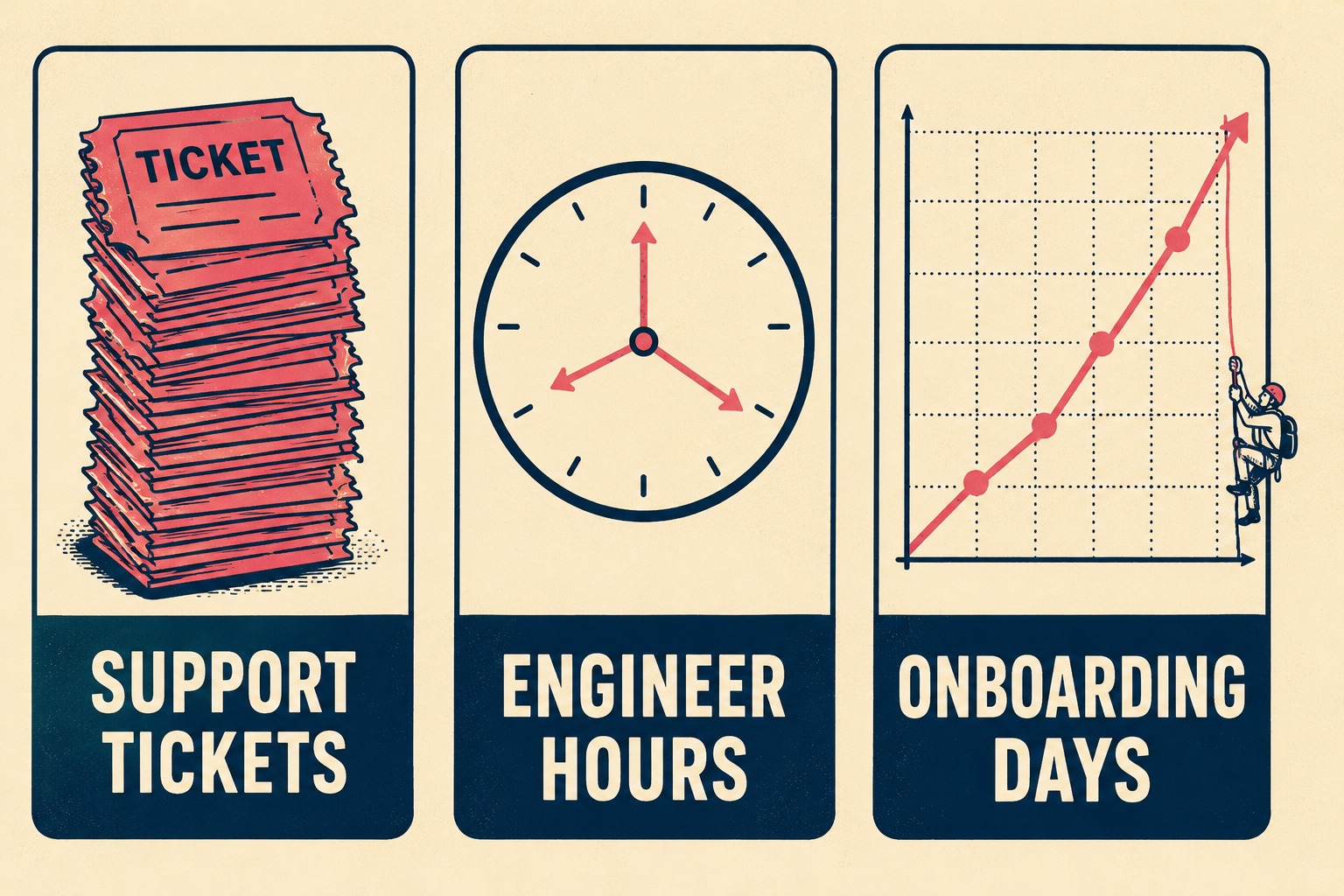
Engineering leaders want to see the math. You need to provide before and after metrics.
Start by establishing a baseline. Calculate the current volume of support tickets related to documentation gaps. Estimate the time engineers spend answering repeat questions per week. Measure the onboarding time for new hires before they push their first commit. These three numbers, multiplied by average engineering salaries, give you a rough monthly cost of your current documentation deficit.
Then define the success metrics. Propose a target reduction in doc-related support tickets. Set a goal for decreasing new hire time-to-productivity. Establish a coverage percentage for critical APIs. These become your 90-day success criteria.
If you cannot measure the impact, they will not fund the initiative. The good news is that these numbers are not hard to gather, and the results tend to be dramatic enough to make the case on their own.
When to Walk Away
Sometimes, you make the perfect pitch. You show the math. You prove that poor documentation is burning engineering hours and costing the company money.
And leadership still says no.
If an engineering leader looks at the concrete cost of not having documentation and still refuses to fund it, the dysfunction is deeper than the documentation itself. It means the organization does not value foundational work. It means they prefer the illusion of velocity over actual, sustainable progress.
If you find yourself in that situation, the best return on investment might be updating your resume. Sometimes the clearest signal a company can give you is that it is time to take your skills somewhere that values them.