How to Write Release Notes for a Customer Success Team


It is Tuesday morning. A customer success manager logs in, opens their inbox, and finds three urgent emails from their biggest accounts. A button has moved. A workflow is broken. A report looks different.
The CSM checks the internal Slack channels. Nothing. They check the product roadmap. Nothing. Finally, they dig into Jira and find a ticket closed late last night: "Refactor auth flow and update UI components."
The CSM is now on a call with a frustrated customer, trying to reverse-engineer what "refactor auth flow" means for the user's daily operations. They are translating engineering shorthand into business impact in real time, while apologizing for the surprise.
This is how most customer success teams find out about product updates. They find out when the customers do.
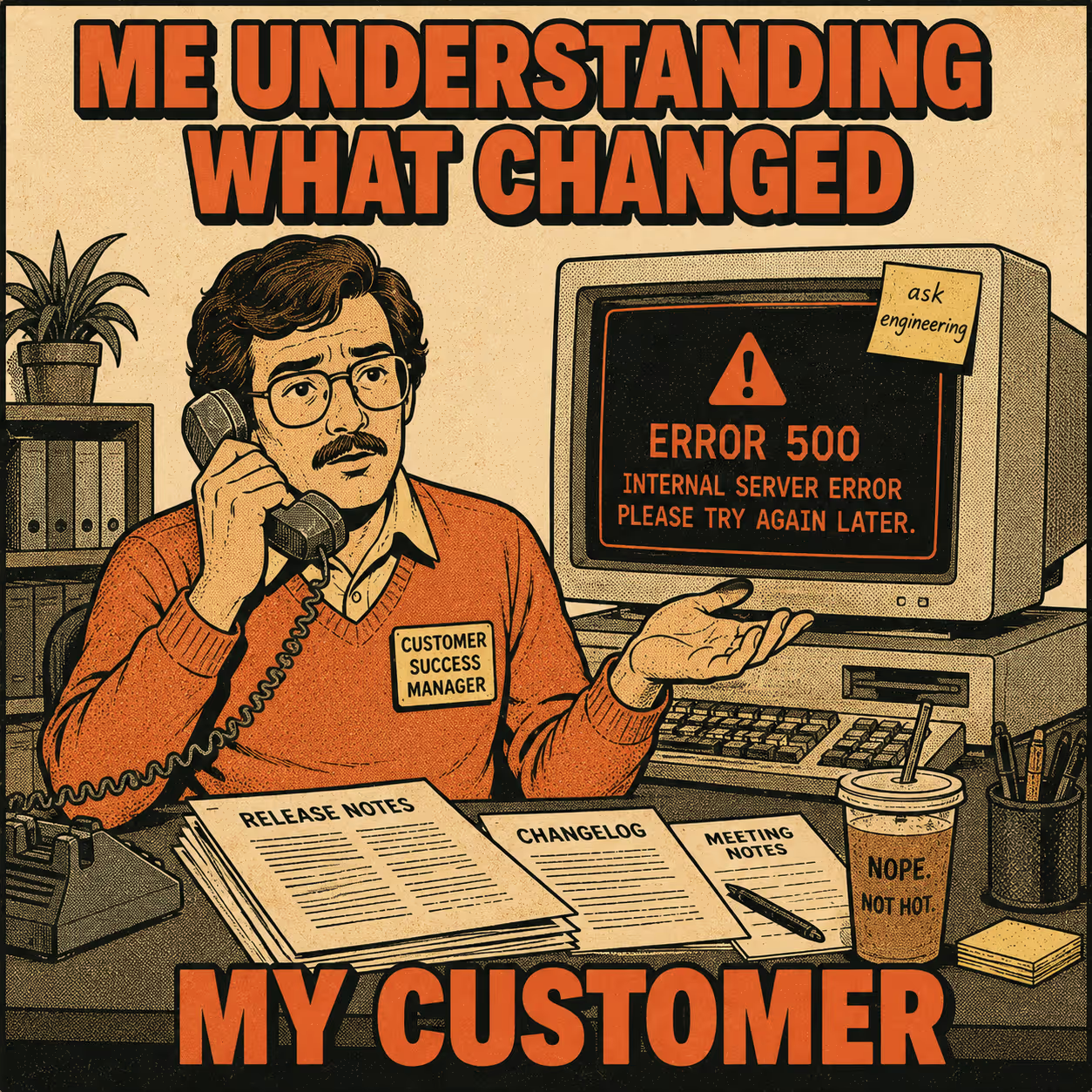
When they do get advance notice, it often comes in the form of a technical changelog. A list of bug fixes, API updates, and merged pull requests. That's not a communication strategy. That's a paper trail.
The gap here is structural. Product development has dedicated tooling, dedicated process, and dedicated headcount. Internal communication, the work of making sure the right people know what changed and why, has almost none of that. It gets treated as a handoff step at the end of the release cycle, which means it gets afterthought-level results.
Engineers document what shipped. Customer success needs to know what changed for the user. Those are two different documents.
Anyway. Here is how to write the second one.
What They Actually Need to Know
Release notes written for engineers are useless to customer success.
A technical changelog might say: "Deprecated legacy reporting endpoint."
A CS-ready release note needs to say: "The old reporting dashboard stops working on Friday. Customers using it need to click 'Migrate' in their account settings. This affects enterprise accounts on the legacy plan. Reach out to them today."
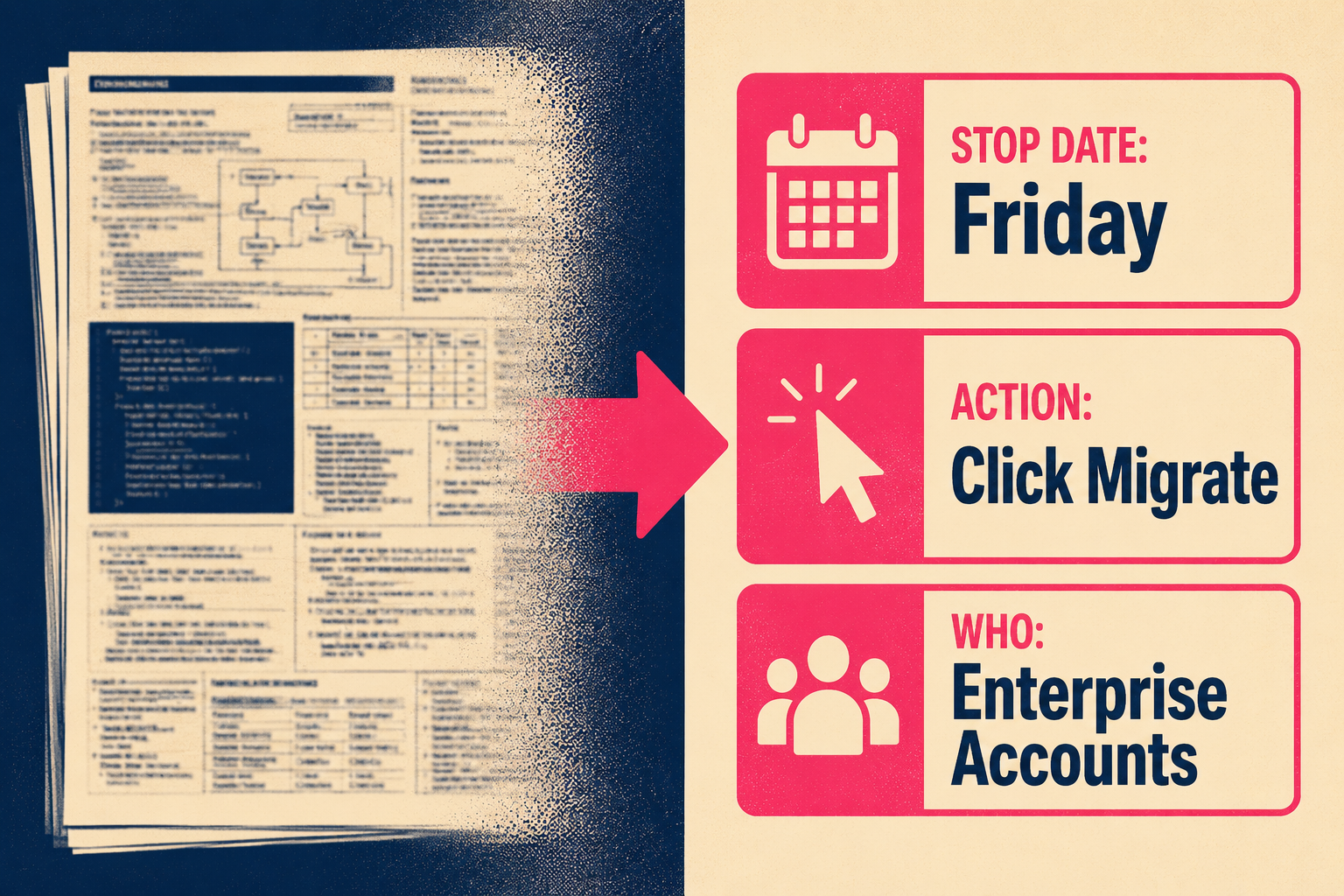
The difference is purpose, not tone. The engineering entry documents a decision. The CS entry enables an action.
Research on release note production confirms what anyone who has worked in customer success already knows: there are significant discrepancies between how release note producers and users perceive the same document. Engineers write for internal stakeholders and future developers. Customer-facing teams need something else entirely.
What CS actually needs from a release note:
- Customer-visible impact. What is different today than yesterday, described in the language a customer would use, not the language a developer would use.
- Affected segments. Which customers will notice this change? Enterprise accounts? Free tier users? Anyone using the legacy API?
- Mandatory vs. optional. Is this something customers need to act on, or something that just happens to them?
- Objections and framing. If a feature was removed to improve performance, the CSM needs to know how to frame that tradeoff when a customer pushes back. Give them the language.
- Breaking changes and workarounds. Slack's content team has written about this directly: when something is going away, avoid euphemisms like "sunsetting" and vague language that "delays understanding and wastes time." Name exactly what will happen and when.
- Whether this is proactive or reactive. Should CS reach out to high-touch accounts before they notice? Or wait for inbound questions?
If you don't provide this context, the CS team will invent their own explanations. Or they'll give inconsistent answers across accounts, which is worse. Inconsistent messaging erodes customer trust and drives support ticket volume.
Not all releases require the same depth. Major features need narrative and positioning. Minor updates need clear scope so CS doesn't over-explain them to customers. Bug fixes need honesty about what was broken and for how long. Deprecations need migration paths, timelines, and a clear call to action, because as Slack's team puts it, customers need "a next step (other than complaining on Twitter) to help them process the information and move on."
Getting Engineering and CS in the Same Room
Engineering and product teams often don't realize that CS needs advance warning. They assume shipping the code is the finish line.
Shipping is the beginning of the adoption cycle. A feature sitting in production with no communication strategy is, as one product team put it, "like a billboard in an empty field. Technically it's there, but nobody's seeing it."
The fix is to build communication into the release process itself, not bolt it on at the end. That means CS gets a review window before the release goes live, not a dump of notes on launch day.
A practical timeline looks something like this. Minor updates and bug fixes: two to three business days of advance notice, enough time for CS to update macros and flag any accounts that might ask. Significant feature changes or workflow updates: one to two weeks, enough time to prep the team, update help documentation, and identify high-touch accounts for proactive outreach. Breaking changes and deprecations: four to six weeks minimum, because customers need time to adjust, and CS needs time to run the outreach campaign. Atlassian, for example, starts displaying deprecation banners sixty days before the actual change, because "very rarely, if ever, do people enjoy surprises from their software".
This doesn't require slowing down development. Fast-moving teams can use async review processes, CS-tagged fields in the ticket system, or standing release briefings. The goal is a predictable cadence, not a bureaucratic gate. Atlassian's structured approach to release notes, which includes nearly twenty metadata fields and a cross-functional "Trusted Change" review process, resulted in a 300% increase in engagement with their release notes. The structure is not overhead. The structure is the product.
When the System Breaks Down
When this process doesn't exist, the costs are specific and predictable.
CS burns hours hunting down engineers in Slack to understand what shipped. Customers get inconsistent answers depending on which CSM they reach. The team invents explanations that may or may not be accurate. High-touch accounts find out about breaking changes the same way everyone else does: by hitting the error.
The hidden cost is larger than it looks. Low feature adoption after launch means engineering effort that never drives retention or expansion. Support tickets pile up for problems that were already fixed. Sales pitches outdated capabilities. All of it compounds with every release cycle.
Ad hoc Slack messages are not a substitute for structured communication. A message in a channel is not a document. It doesn't persist, it doesn't get updated, and it doesn't reach the person who was out of office on Friday.
Organizations scaling quickly often can't staff a dedicated release communications role. But they still need customer success to have the context to do their job. The tooling has to close that gap. Doc Holiday generates structured release notes directly from engineering activity, then provides a review and validation layer so CS can shape the output before it goes live. It gives lean teams the infrastructure to produce what used to require a dedicated program manager coordinating across five Slack channels.