How to Write Release Notes When You Have No Technical Background


It is release day. You are a product manager, or maybe the director of support, and the engineering team just shipped 40 commits.
The only documentation they provided is a Jira ticket titled "Refactor auth middleware for edge cases" and a Slack message saying "it's live." You now have 30 minutes to explain to 5,000 customers what actually happened.
If you have a technical background, you might open the codebase, read the diffs, and figure it out. If you don't, you stare at the Jira ticket, try to Google "auth middleware," and eventually write something vague about "performance improvements."
This happens constantly. Lean teams cut technical writers. Product and support absorb the work. And suddenly, someone with budget authority but no engineering degree is responsible for customer-facing documentation.

The instinct is to try to become an engineer. It doesn't work. Release notes are a translation problem, and the solution is a reliable input pipeline from engineering combined with a consistent output template. You don't need to fake technical knowledge you don't have. You need a system.
The Part Where We Pretend to Understand the Code
When non-technical people inherit release communications, the first move is usually to sit in sprint planning meetings, nodding along to discussions about database indexing and hoping to absorb enough context to write a paragraph later.
It doesn't work.
The gap here isn't knowledge of the codebase. It's the absence of a structured way to extract the right information from the people who built it.
Release notes are the critical bridge between development teams and users. But the information developers care about — how it was built, what was refactored, which dependencies changed — is fundamentally different from the information users care about, which is what it does and whether anything they rely on will break.
If you rely on ad-hoc Slack messages and Jira descriptions written for other engineers, you are trying to translate a language you don't speak using a dictionary that is actively working against you.
The fix is process. Specifically, a repeatable process that relies on institutional structure rather than personal expertise.
Building the Intake Valve
The core of the system is a standard intake form that engineering fills out for every release. This is a review gate. No release goes out until engineering answers the template.
The template doesn't need to be complex. It needs to capture four things: what changed, why it matters, who it affects, and whether there are breaking changes. That's it.
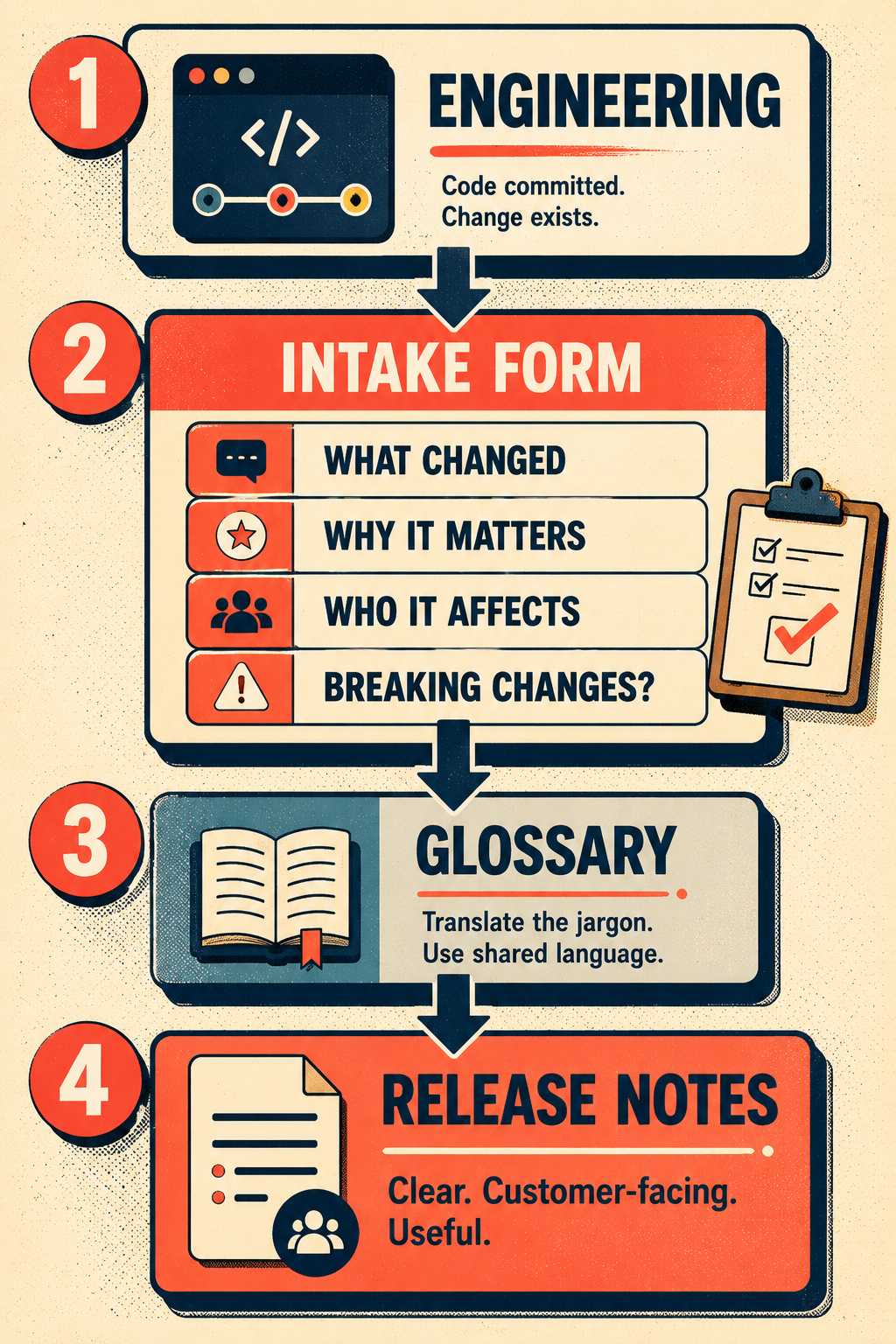
Then you apply a fixed output structure. Summary, details, impact, action required. You are always filling the same boxes. You are never staring at a blank page trying to invent a narrative. The Good Docs Project's open-source release notes template formalizes exactly this structure, with sections for new features, improvements, bug fixes, and known issues.
Keep a glossary of internal terms and their customer-facing translations. When engineering says "deprecated legacy API," your glossary tells you that means "removed the old data export tool." When they say "optimized query execution plan," you know to write "reports load faster." The glossary grows with every release.
Finally, schedule a 15-minute standup with an engineering lead before every release. Not to discuss the code, but to clarify anything ambiguous in the intake form. This is not a technical briefing. It is a translation session.
The Four Questions That Actually Matter
When you talk to engineering, the question "how does this work?" will get you an architecture diagram. That is not what you need.
Ask these four things instead.
"What will users notice?" This gets you the customer-facing change. It bypasses the backend refactoring and focuses on the UI or the workflow.
"What breaks if they do nothing?" This surfaces breaking changes, which are any modifications that disrupt compatibility with previous behavior. Breaking changes are the most important thing to communicate clearly, and they should appear at the top of the release notes, not buried in a list of minor fixes.
"Who should read this?" This defines the audience scope. Does this affect administrators, end-users, or developers? Research on release note production consistently shows that tailoring notes to specific audiences is what makes them genuinely useful rather than noise. A project manager wants to know about new capabilities. A developer wants to know about API changes. An end-user wants to know if the thing they reported is fixed.
"What's the one-sentence version?" This forces clarity. It stops the engineer from explaining the history of the feature and makes them summarize the value.
These four questions are the intake form in conversation form. If engineering can answer all four in plain language, you have everything you need to write the release notes.
The Traps
There are common failure modes when non-technical people write release notes, and they tend to cluster around the same mistakes.
The most obvious is copying internal Jira descriptions verbatim. Jira tickets are written for engineers, by engineers. They are not user guides. "Refactored auth middleware for edge cases" tells a customer nothing about whether they need to do anything differently.
Another trap is assuming you need to explain how the fix works. You need to explain what it fixes. The user doesn't care about the optimized SQL query. They care that the report loads faster now. The distinction between internal implementation language and customer-facing outcome language is exactly the translation work you are doing.
Waiting until release day to gather information is a guaranteed way to fail. Build the intake process into sprint planning. Documentation should be part of the definition of done, not a 30-minute scramble after the deployment.
And trying to sound technical when you're not is the last trap. Clarity beats jargon every time. If you don't understand what you wrote, your users won't either.
When the Process Breaks
You will eventually hit a wall. An engineer will refuse to fill out the form, or they will fill it out with jargon that means nothing to you.
This is when you escalate. But you do it structurally.
If engineering can't explain the customer impact in plain terms, the feature probably isn't ready to ship. That is a product readiness problem, and it is worth surfacing.
If you're seeing the same questions from customers after every release, your input template is missing something. The feedback loop is broken, and the template needs a new field.
If release notes take more than 30 minutes to write per release, the process is broken. The tools that make this manageable are not exotic: structured intake forms in Google Forms, Notion, or Linear; version control for release notes so you can reuse past phrasing for similar changes; a dedicated Slack channel where engineering answers release-note-specific questions asynchronously. Research on practitioner expectations for release note generation consistently points to structured artifacts — issues, pull requests, commits — as the raw material that makes documentation tractable.
The goal is to stop translating Jira tickets by hand. If you are managing this process, you are managing a pipeline. And the pipeline should be as automated as possible.
This is the operational problem that Doc Holiday is built for. It handles the initial extraction of structured release notes directly from engineering workflows — pulling from the tools developers already use — so that the person responsible for release communications starts from a validated draft rather than a blank page. The human review step is built into that workflow, not bolted on afterward; you are editing and approving output that already has the right structure, rather than building the pipeline manually from scratch every release cycle.