How to Write Customer-Facing Incident Summaries Without Creating Legal Risk


It is 2:14 PM on a Thursday, and your primary database cluster just refused to fail over.
The support queue is filling up with tickets. Engineering Slack is a blur of panic and stack traces. Your CEO is asking when the status page will be updated. And your general counsel just messaged you to say, "Do not admit fault."
You have about forty-five minutes to write a summary of what happened.
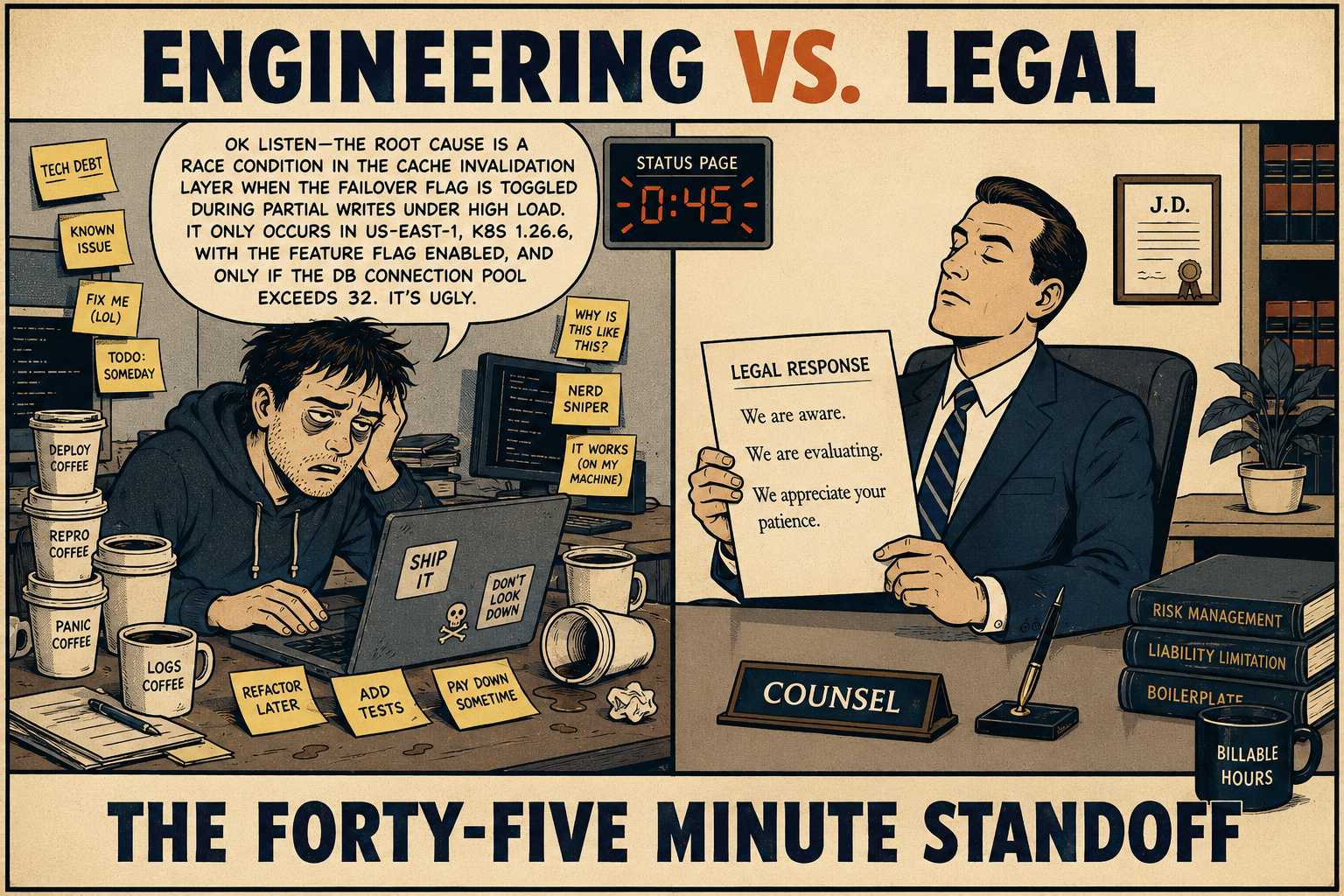
If you write what the engineers want to write, you will publish a deeply honest, cathartic document about how the team knew the failover script was flaky but never got the sprint points to fix it. If you write what legal wants to write, you will publish a corporate haiku that says "We experienced a service interruption and are investigating."
Customers will read the first one and respect your honesty. The plaintiff's bar will read the first one and attach it as Exhibit A in a breach of contract lawsuit. Customers will read the second one and start evaluating your competitors.
There is a way out of this trap.
You do not have to choose between lying to your customers and handing a loaded gun to a litigator. You just have to understand what actually creates legal risk in the aftermath of an outage.
The risk is not in describing what happened. The risk is in describing what you should have done.
When you describe what happened, you are providing a factual account. The database failed over at 2:14 PM. The failover took 14 minutes. During that time, write requests timed out. These are facts. They are objectively true, and they are usually already known to the customer.
When you describe what you should have done, you are establishing a standard of care. "We failed to properly configure the timeout threshold." "This should have been caught in staging." "We did not follow our own deployment process."
These phrases are dangerous. They create a documented record of internal standards that the company violated. In a legal context, this is an admission of negligence. You are providing the plaintiff with the exact wording they need to prove you breached your duty of care (breach of duty in cyber litigation).
I am sympathetic to the desire to be fully transparent. We all want to be the kind of company that owns its mistakes. But there is a difference between accountability and self-immolation.
If your SLA was breached, that is already a documented fact. Restating it in customer communications does not create new liability. What does create risk is expanding the scope of what you are responsible for beyond what the contract says.
If your SLA covers uptime but not data integrity, do not apologize for data integrity issues in ways that imply you were contractually obligated to prevent them. Stick to the facts of the outage as they relate to your specific contractual obligations. Over-apologizing for things outside your SLA can inadvertently broaden your legal liability.
This brings us to the structure of the summary itself.
Start with the impact scope. Describe what the customer experienced in measurable terms. Did 10% of users experience login failures? State that.
Next, provide the timeline. When did the incident start? When was it detected? When was it mitigated? When was it resolved? Stick to timestamps and factual events.
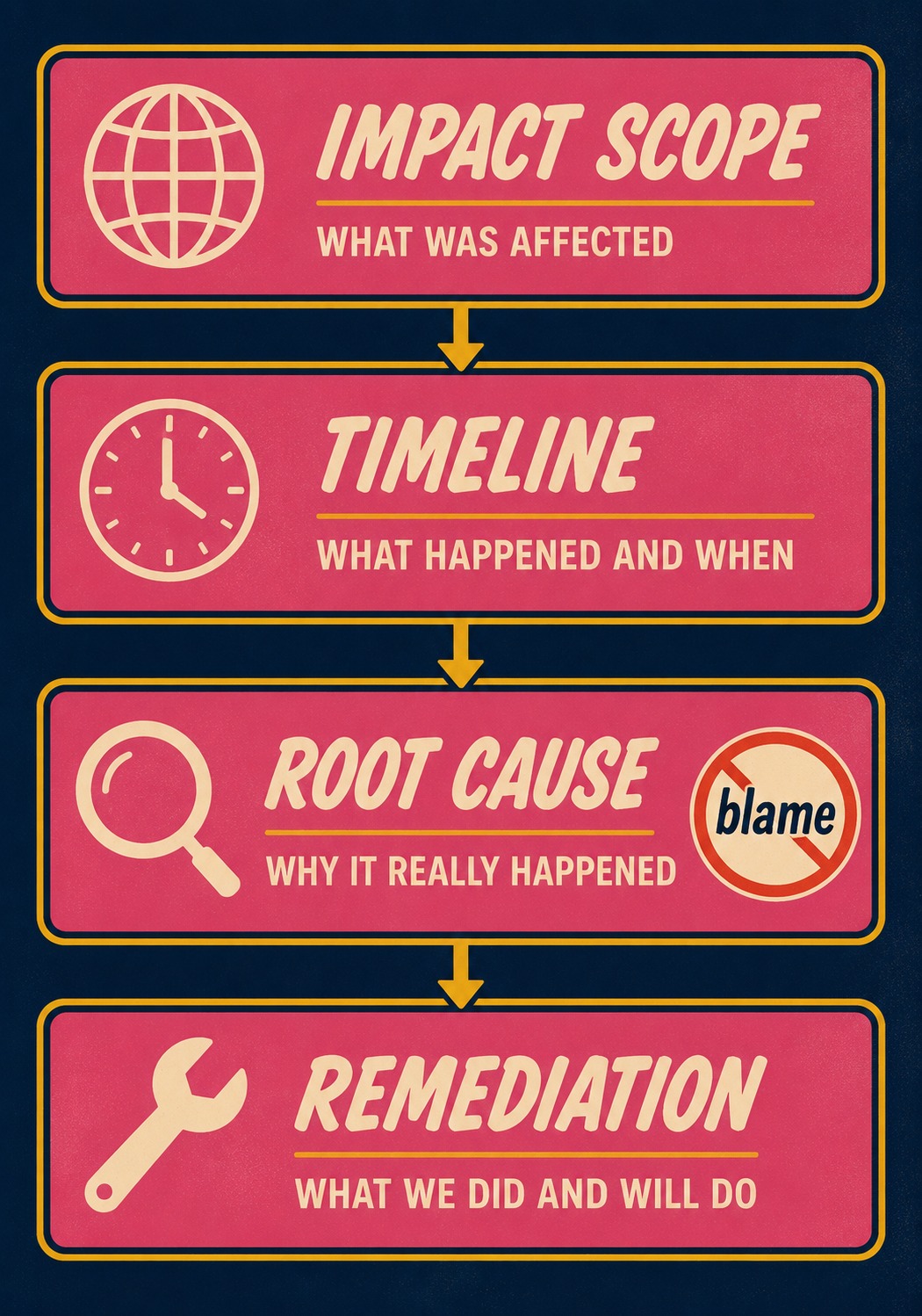
Then, explain the root cause in the most neutral technical terms that are still accurate. Do not assign internal blame. Do not speculate about what could have happened. Do not compare this incident to other incidents.
Finally, outline the remediation steps. What are you doing to prevent recurrence? Focus on system improvements, not human errors.
Not every incident needs a public postmortem.
If the incident was brief, affected a small number of customers, and was resolved quickly, a short status update may be sufficient.
If the incident was long, visible, or widely reported, a detailed postmortem may be necessary to prevent customer churn. The question is not what is fairest to customers. The question is what minimizes reputational and legal risk given what customers already know. You must balance the need to maintain trust with the need to protect the company.
Tone and phrasing matter.
The goal is to sound competent and accountable without sounding negligent. "We experienced an outage due to a database failover delay" is fine. "We failed to properly configure our database failover" is not. The first describes what happened. The second admits you did something wrong.
Similarly, explain the difference between "We are improving our monitoring" and "We should have been monitoring this already." The second implies you knew you should have been doing something and chose not to. Always frame improvements as forward-looking enhancements, not corrections of past negligence.
Blameless postmortems are excellent for internal learning. They allow engineers to discuss failures openly without fear of retribution.
However, they are dangerous to publish externally without legal review.
If you run blameless postmortems internally, do not assume the same document can be shared with customers. The internal version will contain statements like "We didn't have adequate coverage" or "This was a known gap." These statements are useful for learning but catastrophic in litigation. Keep the internal learning document separate from the external communication document.
The faster you publish, the more you control the narrative. The slower you publish, the more legal review you can get. Find the middle ground.
Write a short initial update that describes the impact and timeline without speculating on the root cause. Publish that within hours. Follow up with a detailed postmortem after legal review. The initial update buys you time and credibility. The detailed postmortem gives you a chance to control the technical narrative after you understand what actually happened.
Speculation is what creates legal risk.
If your incident summaries are generated from engineering workflow data (timestamps, deploy logs, service health checks) rather than written from memory under pressure, they are more accurate and less speculative.
A summary that says "Database failover took 14 minutes, exceeding the expected threshold" is a factual statement based on data. It is much safer than an engineer writing, "I think the database took too long to failover because we didn't test it recently."
This is where Doc Holiday provides structure (automating postmortems from incident data). It generates documentation directly from engineering workflows. It pulls the facts (the deploy logs, the timestamps, the system states) and drafts the summary. A senior engineer or writer then reviews it for accuracy. It gives lean teams the structure to validate, manage, and scale output without rebuilding a large headcount, ensuring your incident communications are driven by data, not speculation.