Why Release Notes Break When Good People Leave


Sometime last week, a senior technical writer logged out of Slack for the last time.
She left behind a comprehensive wiki, a meticulously organized workspace, and a well-meaning style guide. She also left behind a massive problem for the engineering team that just inherited her responsibilities.
Within two release cycles, the quality of the company's release notes will drop. The formatting will drift. The terminology will become inconsistent.
Bugs that users care about will go unmentioned, while trivial backend refactoring will get front-page treatment. The new owner will struggle to figure out which issue tracker labels actually map to customer-facing features. Delays will start creeping into the deployment schedule.
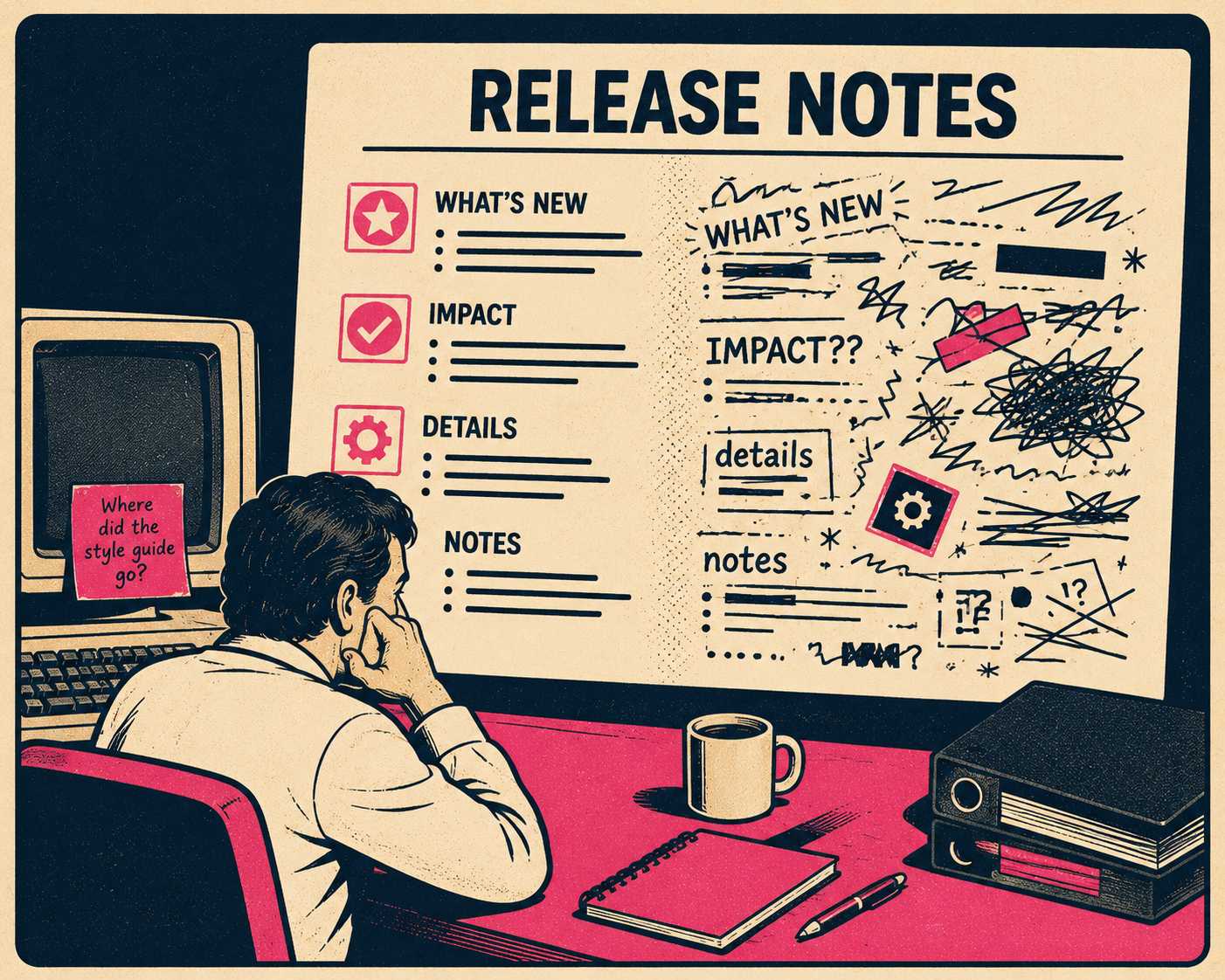
This is a failure of architecture. It is caused by treating documentation as a personal artifact rather than a systemic requirement.
Release notes are typically owned by a person, not a system. When that person leaves, the institutional knowledge goes with them. The next person is left to decode a workflow that was never fully captured in the documentation.
The problem with documentation about documentation is that it rarely survives contact with reality.
The Warm Handoff
When a team transition happens, we tend to rely on the warm handoff. We schedule transition meetings, record walkthroughs, and point to process documents.
We assume that if we just write down enough steps, the next person can pick up exactly where the last person left off.
But process documentation often fails to transfer actual knowledge. A style guide can tell you to use active voice, but it cannot tell you why the previous writer always double-checked the API changes with the security team before publishing.
A template can enforce a structure, but it does not capture the judgment calls. It does not explain which bugs deserve a mention, how to explain breaking changes, or when to loop in customer success.
These are the silent dependencies of software delivery. They live in people's heads, in private direct messages, and in the unwritten habits of experienced practitioners.
In software engineering, this is known as tacit knowledge, the highly internalized expertise that is difficult to articulate or record. When you rely on a single person to manage this knowledge, your bus factor drops to one. If they leave, the process stalls.
The bus factor is a measure of how many people would need to leave a project before it becomes incapacitated due to knowledge loss. A bus factor of one means a single departure can derail the entire workflow.
And the cost of that knowledge loss is staggering. Research indicates that large organizations lose billions annually due to inefficient knowledge sharing and the inability to retain critical operational context when employees depart.
Building the Workflow Into the Tools
The solution is to stop relying on documents to enforce the process.
In high-performing engineering cultures, documentation is treated as a systemic requirement, not an individual chore. But for release notes specifically, the workflow should be self-evident from the system itself.
The quality controls must be built in. The institutional knowledge should live in structured prompts, validation rules, and automated checks, not in a page that has not been updated since 2021.
This is the principle of mistake-proofing applied to technical communication. Instead of hoping the new owner remembers to check the style guide, the system should validate terminology automatically.
Instead of hoping they know which pull requests matter, the system should aggregate and categorize them based on the actual commit history.
A handoff-resistant system changes the nature of the work. It shifts the burden of consistency from the human to the machine.
How It Actually Works
When you encode the release note process into the tooling, specific failure points disappear.
The input becomes standardized. Whether the new owner has been there for five years or five days, the release notes are generated from a consistent source of truth. They pull from pull request data, issue tracker fields, and commit messages — a well-studied source of truth for automated release note generation. The raw material is always gathered the same way.
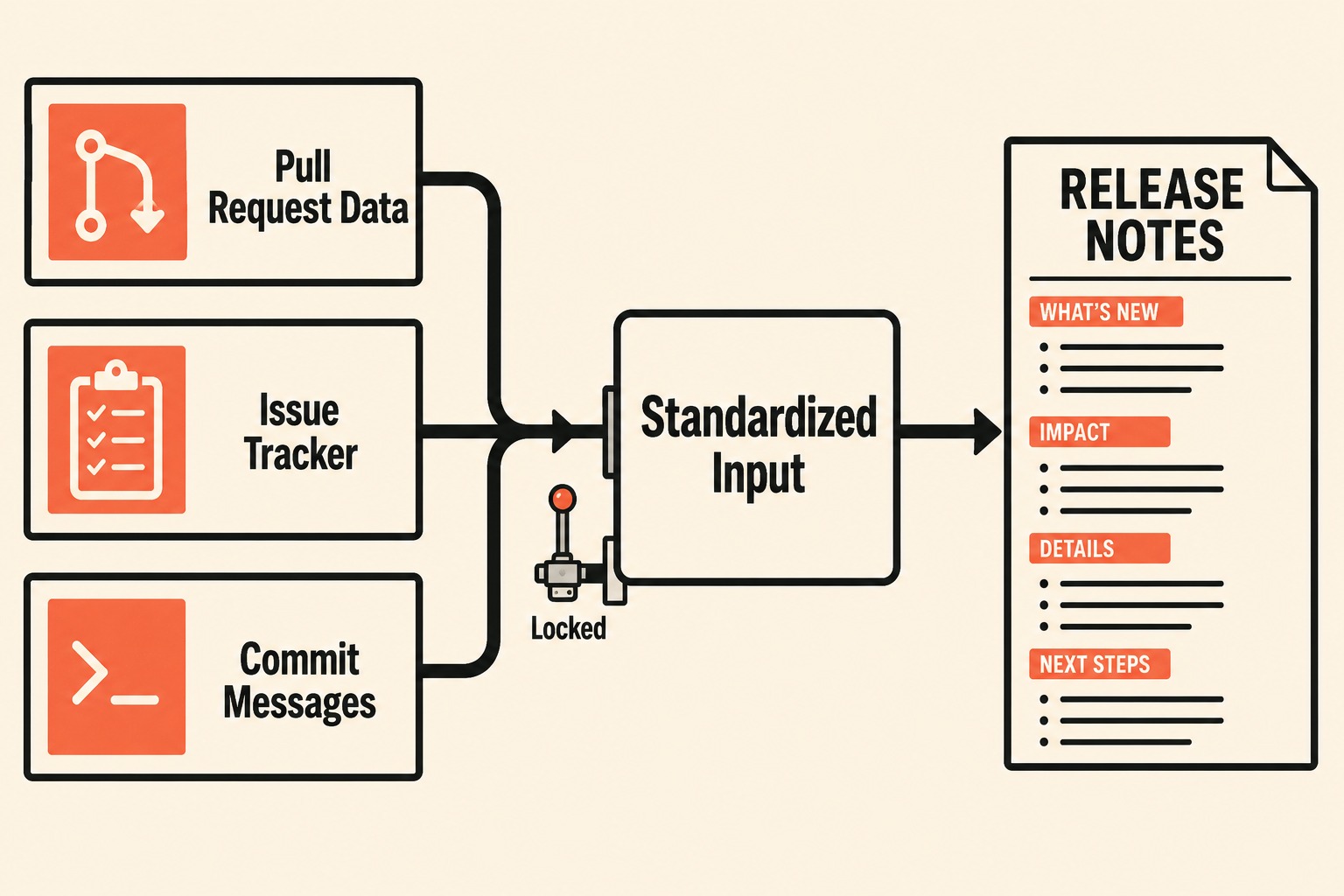
The structure is enforced by the system. The new owner does not skip a mandatory section because they did not know it existed. The template is locked in. This prevents accidental layout breaks and ensures that every release note looks like it belongs to the same company.
Quality checks become automated. If a new owner uses different phrasing for a core concept, terminology validation catches it. If a feature historically confused users and needs extra explanation, the system can flag it based on past support tickets. Missing context is highlighted before the notes ever reach review.
This does not mean human expertise is obsolete. Quite the opposite.
Automation handles the extraction, the formatting, and the baseline consistency. But human judgment is still required to decide if a breaking change needs a dedicated migration guide.
Human empathy is still needed to understand which customer segments care about specific features. Human strategic thinking is still necessary to recognize when a release is significant enough to warrant a full blog post instead of just a bullet point in the changelog.
These are the skills that are genuinely scarce and worth preserving. When you automate the mechanics of the process, you free up your senior owners to focus on the narrative and the strategy, rather than the formatting.
If your release notes depend on a specific person remembering a specific set of rules, your process is already broken. It just has not failed yet.
The goal is to build a structural backbone that survives team transitions, reorganizations, and the inevitable departure of key personnel. Instead of hoping the next person reads and follows the documentation about how to write documentation, give them a system where the process is the tool itself.
That is exactly what Doc Holiday does. It generates release notes, changelogs, and API updates directly from your engineering activity.
By pulling from the actual source of truth and enforcing structure through the platform, it ensures that your documentation quality does not walk out the door when your best writer does. It provides the operational continuity that lean teams need to scale, validate, and manage their output without having to rebuild their institutional memory from scratch every time the roster changes.