Why Multi-Region Deployments Break Your Release Notes


It is Tuesday morning in London. A customer reads an email from your marketing team announcing a new data export feature in version 2.4. They log in, click around, and find nothing.
They open a support ticket. Your support rep checks the central release notes page, confirms the feature is live, and tells the customer to clear their cache. The customer replies, slightly more annoyed, that clearing the cache did not work.
The support rep escalates to engineering. An engineer checks the deployment dashboard and sighs. The feature is indeed in version 2.4. But version 2.4 is currently only deployed to us-east-1. The eu-west-1 deployment isn't scheduled until Wednesday afternoon.
Your release notes lied. They treated a 72-hour staggered deployment across global infrastructure as a single atomic event.
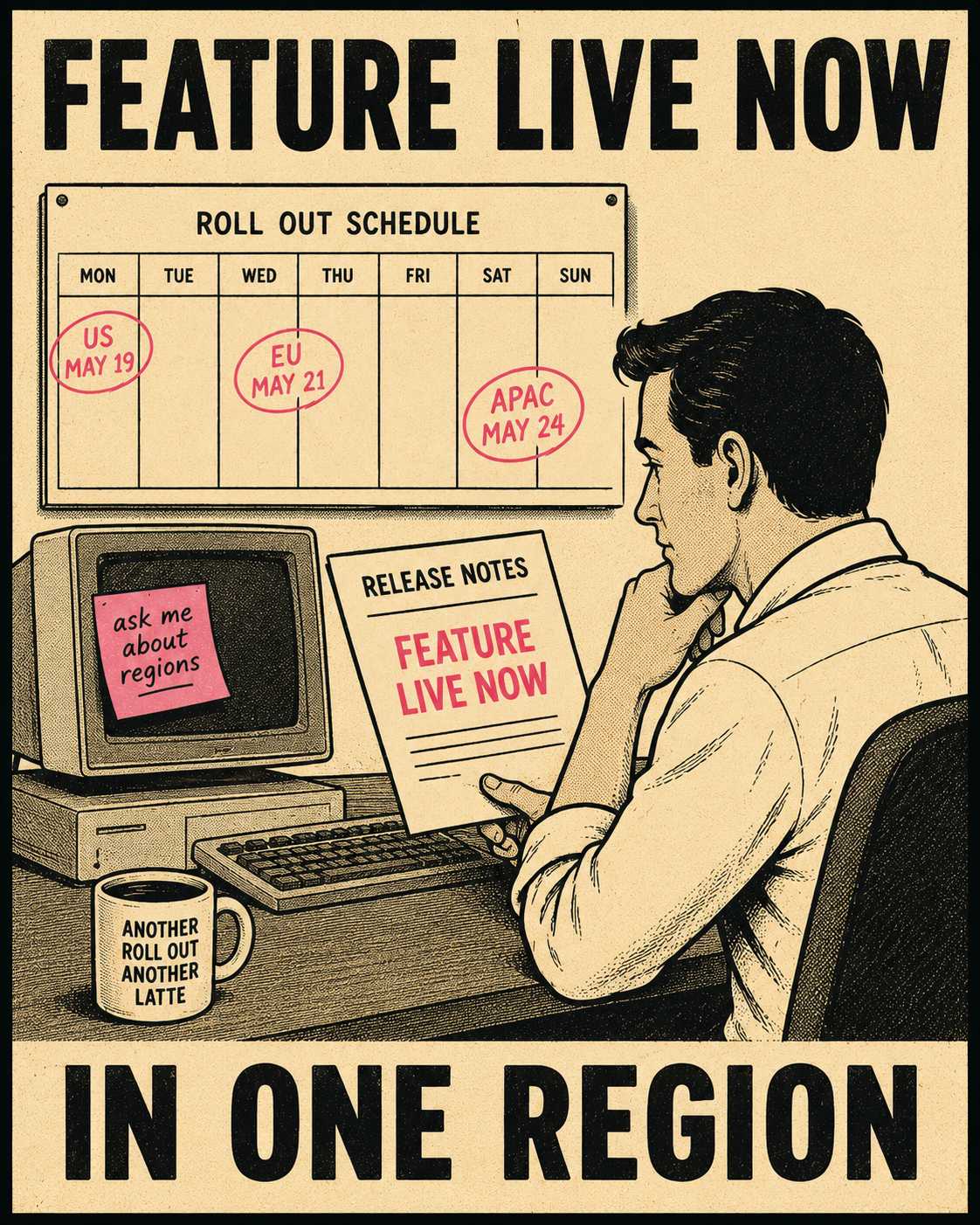
Most release notes templates assume a world that no longer exists. They assume a software release is a moment in time when a new version becomes universally available. But modern software delivery doesn't work that way. Teams decouple deployments from releases using feature flags, and they use progressive delivery techniques like canary launches and ring deployments to manage risk across infrastructure. A feature might go live in one region on Tuesday, another on Wednesday, and a third on Thursday.
When you ignore this reality, things break.
When the Documentation Lies to the Customer
The failure modes of treating distributed deployments as single events are predictable and painful.
Customer support gets flooded with tickets from users who don't see features you just announced. Sales teams promise functionality that isn't live in a prospect's region yet. Users in APAC read release notes written for a US audience that don't mention the features were already live for them three days ago.
The documentation becomes untrustworthy. And when users stop trusting the documentation, they stop reading it.
There is also a deeper, structural problem. Research shows that documentation drift — the gap between what the software does and what the documentation says it does — is often caused by engineers simply not telling technical writers about every change. A large-scale empirical study of 32,425 release notes found that producing them is a collaborative, time-consuming task that varies wildly depending on the stakeholders involved. When you add the complexity of multi-region rollouts and feature flags on top of that baseline difficulty, the gap widens into a chasm. Technical writers cannot manually track the state of every feature flag across every region.
The Three Ways Teams Try to Fix This
Engineering and product teams usually adopt one of three operational frameworks to handle this complexity. Which one fits depends on the nature of the deployment architecture and the compliance environment.
The first is region-specific release note pages. These pages only show what is live in a specific geography, using templating to pull from a central source of truth and filtering out features that haven't reached the user's region yet. This works well for companies with hard data sovereignty boundaries — organizations that must keep EU customer data on EU infrastructure, for example — but it requires significant content management overhead to maintain correctly.
The second approach uses explicit availability tables. The release notes include a matrix showing which features are live in which regions as of which date. This is the approach AWS takes for many of its services. It is transparent, but it puts the burden on the user to figure out if a feature applies to them.
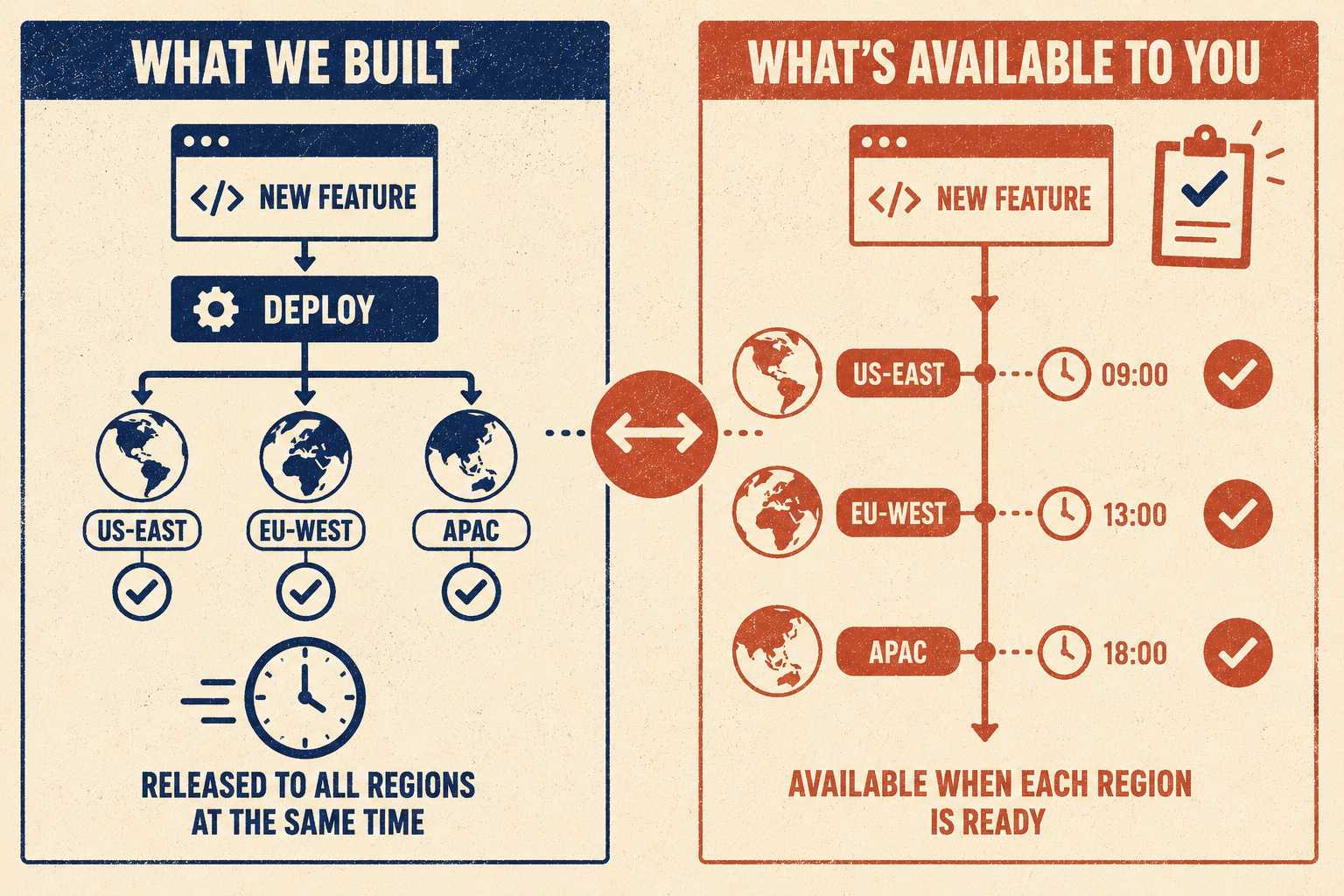
The third approach is decoupled release notes. Teams maintain one set of notes for "what we built" (engineering-facing, tied to the deployment) and another set for "what's available to you" (customer-facing, region-aware, tied to the feature release). This maps directly to the DevOps principle of separating deployment from release. It is the most accurate method, but it requires the most sophisticated infrastructure to execute.
The table below summarizes when each approach makes sense and what it costs to maintain.
Making the Documentation Aware of the Infrastructure
To generate region-aware release notes at scale, you have to tie the documentation directly to the deployment pipeline.
Manual processes collapse under this complexity. You cannot have a technical writer asking an engineer on Slack if the eu-central-1 deployment finished yet. Staggered deployments across progressive waves of infrastructure are designed to be automated and monitored by systems, not tracked by humans with spreadsheets.
The system needs to pull data from the tools that actually control the rollout. This means integrating release note generation with feature flag management systems and deployment orchestrators. Feature flags enable teams to control feature availability per region, per user cohort, or per environment. When a flag is toggled to "on" for a specific region, the system should automatically trigger an update to the customer-facing release notes for that region.
This requires maintaining a central registry of what is live where. It means treating documentation as a byproduct of the engineering workflow, rather than a separate administrative task that happens after the deployment is complete. Phased regional rollouts benefit from tooling that documents changes, communicates rollouts, and sets up staged releases with automatic scheduling — not from someone manually updating a wiki page at midnight.
The Compliance Problem You Didn't Know You Had
For regulated industries, this isn't just about customer experience. It is about compliance.
In financial services, healthcare, and other highly regulated sectors, release notes are compliance artifacts. Auditors expect comprehensive, consolidated documentation from request to deployment throughout the change management process. You need to be able to prove what features were available to which users at what specific time.
If a compliance feature ships to EU customers to satisfy a new GDPR requirement, but your release notes vaguely state it was part of "version 2.4," you have a problem. An auditor will want to see the exact timestamp when that feature became active for EU users — not a version number that was deployed to three different regions on three different days.
Your release notes must serve as an auditable record of regional rollout. They need version tracking, precise timestamps, and clear feature availability matrices. Automated evidence generation eliminates the manual collection of change records and audit trails, and compliance documentation becomes immediately exportable rather than something you scramble to reconstruct before an audit. If your documentation process relies on someone remembering to update a wiki page after a deployment finishes, you are carrying unnecessary compliance risk.
Lean teams manage this complexity without rebuilding the kind of headcount that used to handle documentation manually. They use systems that generate release notes directly from deployment workflows, producing region-specific output validated by the technical leads who actually understand the rollout strategy. Doc Holiday generates release notes directly from those deployment workflows and produces region-specific output, giving a lean team the structure to manage multi-region documentation complexity without recreating the manual processes that couldn't keep up in the first place.