What is Documentation Automation?


If you ran a mid-sized engineering organization, and a million Yale-educated technical writers showed up at your corporate headquarters offering you their services for $5.92 an hour, you would have four options. You could hire them all and document every single line of code ever written. You could hire a few of them to write the most critical user-facing guides. You could ignore them and keep forcing your developers to write their own release notes after every sprint. Or you could realize that the problem was never a shortage of writers.
The problem is infrastructure.
Documentation automation is the use of software systems to generate, update, and maintain technical documentation directly from source materials — code repositories, API schemas, release workflows, support ticket metadata — without requiring manual authoring for every change. The output looks like something a writer produced. The input is the same structured data your engineering team is already generating.
Anyway. We can all now deploy systems that read commit histories and produce readable release notes, and seem to be having trouble figuring out whether that's a tools problem or a process problem.
It's both.
How the Infrastructure Actually Works
The core of documentation automation is a pipeline, not a product. Structured engineering data flows in. Readable documentation flows out. The transformation happens through a combination of schema parsing, commit analysis, and language generation.
For API reference documentation, the source material is the API definition itself. Tools like Swagger UI and OpenAPI Generator parse OpenAPI specifications — the machine-readable contracts that describe what an API accepts and returns — and produce interactive documentation that updates whenever the spec changes. No writer needs to manually update a parameter table every time an endpoint changes its response shape. The spec is the source of truth, and the documentation is a rendering of it.
For release notes and changelogs, the source material is commit history. The Conventional Commits specification provides a structured commit message format — feat:, fix:, BREAKING CHANGE: — that maps directly to semantic versioning and changelog categories. Tools like semantic-release read those structured messages and automate the entire release workflow: version number determination, changelog generation, and package publishing, triggered by CI/CD pipelines (the automated build and deployment systems that run every time code is merged) without any human involvement in the mechanical parts.
Recent research has extended this further. A 2025 paper published at the ACM International Conference on the Foundations of Software Engineering introduced SmartNote, an LLM-based release note generator that aggregates commit, code, and pull request details to produce categorized, audience-aware release notes. In human evaluations, it outperformed conventional changelog tools on completeness and organization. A separate 2026 framework for AI-augmented release intelligence demonstrated how LLM summarization can be integrated directly into CI/CD promotion workflows, generating stakeholder-oriented reports that map each change to every pipeline it affects.
GitHub's own automatically generated release notes feature, now built into the platform, shows how far this has moved from experimental to default. Pull request labels, contributor lists, and full changelogs are assembled without a writer touching them.
The integration layer is where most of this gets practical. These systems connect to Git, Jira, Linear, and CI/CD pipelines to pull structured data — ticket metadata, PR descriptions, commit messages, deployment events — and transform it into documentation through configurable templates and language models. The writer's job shifts from authoring to governing the pipeline: setting the rules, reviewing the output, and handling the cases the system can't resolve automatically.
The Part Everyone Gets Wrong About the Business Case
Documentation debt accumulates when engineering moves faster than docs teams can document. A 2022 systematic mapping study covering 63 research papers on documentation in continuous software development found that the most consistent challenge across agile, lean, and DevOps teams is documentation falling out of sync with the software. The Agile Manifesto's emphasis on working software over comprehensive documentation created a structural incentive to deprioritize docs. The debt compounds quietly until a new engineer can't onboard, a customer can't integrate, or a support ticket reveals that the public-facing docs describe a feature that no longer works the way they say it does.
The traditional response is hiring more writers. That scales costs linearly with output volume. A team shipping two releases a month needs a certain number of writers. A team shipping ten releases a month needs five times as many. The economics only work if documentation volume is stable, which it rarely is.
Automation changes the ratio. A survey of 146 practitioners published at ICSE 2020 found that documentation issues perceived as most critical included insufficient content, obsolete information, and documentation that didn't match the actual code behavior. These are exactly the failure modes that automation addresses structurally: if the documentation is generated from the code, it can't describe behavior the code doesn't have.
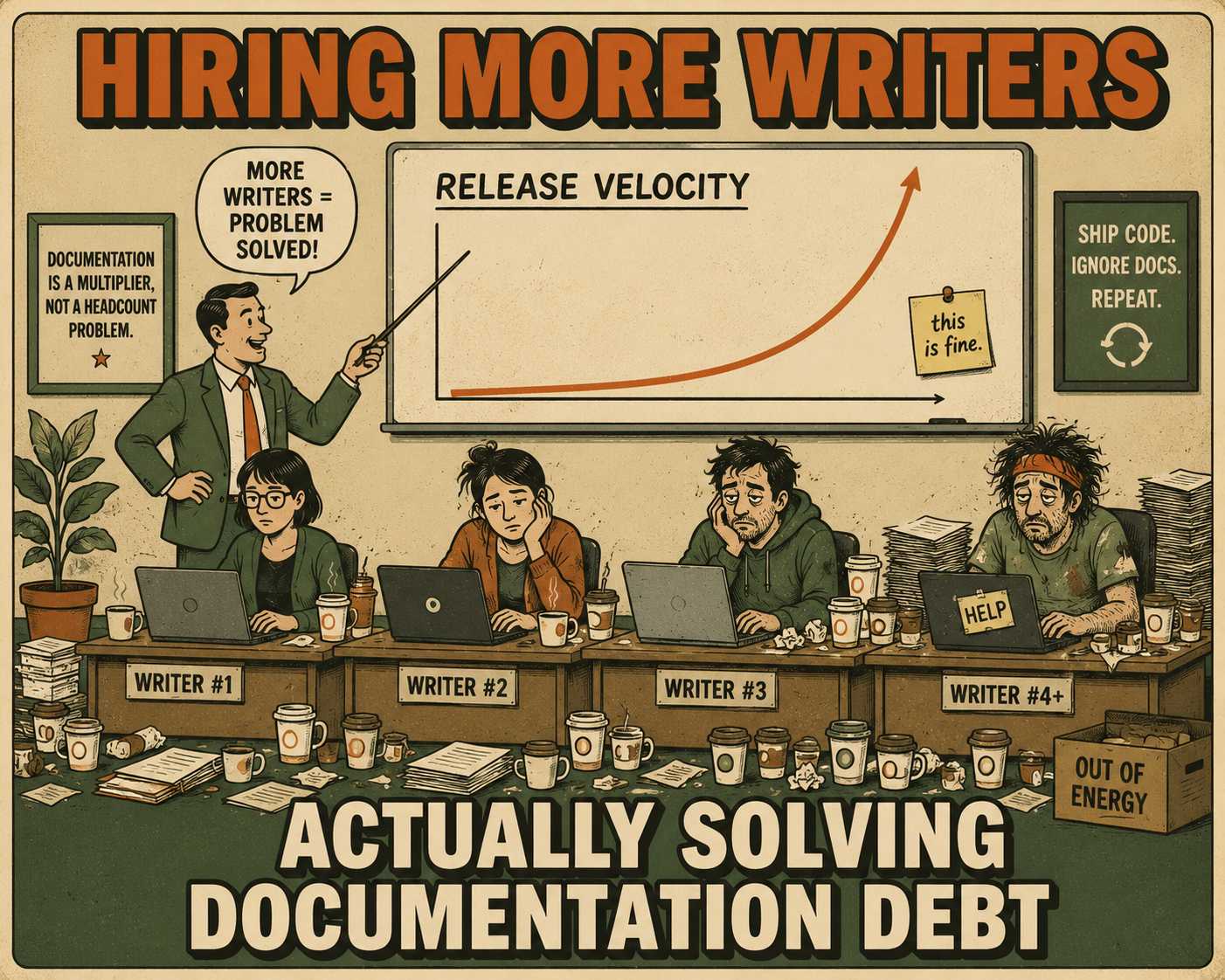
The economics work because the marginal cost of documenting an additional release drops significantly once the pipeline is in place. The fixed cost is building and maintaining the automation. The variable cost per release is the writer's review time, not the writer's authoring time. One skilled writer managing automated pipelines can produce more accurate, complete documentation than three writers authoring manually, because the bottleneck shifts from generation to validation.
I don't know if this is actually true in every organization, but the structural argument is sound: the teams that struggle most with documentation debt are the ones treating documentation as a separate, lagging discipline rather than a byproduct of the engineering process. As Google's engineering practices note, the most successful documentation efforts happen when documentation is treated like code and incorporated into the traditional engineering workflow, making it easier for engineers to write and maintain simple documents.
On one hand, this is a familiar argument — engineering teams are prone to automating everything; it's kind of their whole thing. On the other hand, there is at least one very notable difference between documentation automation and prior attempts to solve this problem. The structured data was always there. Commit messages, API specs, ticket metadata, PR descriptions. The missing piece was a system that could reliably transform that data into readable documentation without requiring a writer to reconstruct context from scratch for every change.
That piece now exists.

What the Writer Actually Does
The role doesn't disappear. It changes.
Automation excels at high-volume, structured content that changes frequently: API references, parameter tables, endpoint documentation, feature lists, release notes. These are the categories where the source material is machine-readable and the output format is well-defined. The docs-as-code approach, which treats documentation with the same version control, review, and CI/CD practices as software code, has made this pipeline more accessible to teams that previously lacked the tooling infrastructure to attempt it.
Human oversight adds the most value where context interpretation is required: explaining why a change matters, flagging breaking changes that need migration guides, connecting features to user workflows, and maintaining narrative consistency across a product's documentation surface. These are judgment calls, not generation tasks.
This creates a skillset shift. The technical writer's role evolves from primarily authoring to primarily validating, editing for clarity, managing content workflows, and governing AI output quality. Strong writers become more valuable in this model, because they can operate automation systems at scale. The feedback loop matters: the system improves as the writer identifies patterns in what the automation gets wrong, and the writer builds domain expertise in managing AI output rather than rebuilding context from scratch every sprint.
Most organizations start by automating their highest-volume, lowest-context documentation — changelogs and release notes — then expand to API docs and user-facing feature announcements. The pattern that works is consistent: automate generation, assign a writer to validate and refine output, publish through existing channels. The writer is not a bottleneck in this model. The writer is the quality layer.
Documentation as a Byproduct of Engineering
The broader shift is worth naming directly. Engineering organizations are moving away from documentation as a separate, lagging discipline and toward documentation as a byproduct of the engineering process itself. When documentation generation is embedded in the same workflows that produce code — triggered by the same commits, fed by the same ticket metadata, published through the same CI/CD pipelines — it stays current by default rather than through heroic manual effort.
This is what the research on continuous software development has been pointing toward for years. The Theunissen et al. mapping study recommended "modern tools and technologies to retrieve information and transform it into documentation" as the most promising path forward for teams that can't sustain manual documentation practices at scale. The IEEE research on user stories and documentation debt identified the structural causes of documentation debt in agile teams — the same causes that automation addresses by removing the manual authoring step from the critical path.
The organizations that figure this out first will have a structural advantage: documentation that's accurate because it can't drift from the code, and a writing team that's focused on quality and judgment rather than volume and speed.
Doc Holiday is a documentation engine that generates release notes, API references, and changelogs directly from engineering workflows. It gives lean teams the structure to validate, manage, and scale output without rebuilding headcount.