How to Stop Release Notes From Drifting Across Distributed Teams


It is 9:15 AM on a Tuesday in San Francisco, and a customer support manager is trying to figure out if a critical billing bug was fixed.
She checks the public changelog. Nothing.
She checks the internal wiki. A page was updated three weeks ago, but it only mentions "performance improvements."
She pings the Slack channel for the billing team in Bangalore. It is 10:45 PM there, so she will not get an answer until tomorrow. Meanwhile, the customer is still on hold.
This is what inconsistent release notes look like in practice. When different teams ship on different schedules, use different tools, and write in different styles, the resulting patchwork confuses customers, frustrates support, and makes the product look less mature than it actually is. It is an operational failure.
We keep trying to solve this systems problem by asking engineers to try harder.
How Things Actually Fall Apart
Distributed teams lack shared context by default. A team in London does not overhear the conversations a team in New York has about a feature's nuance.
When tooling defaults are permissive, and documentation happens at the end of a sprint when everyone is already moving on to the next ticket, the environment is perfectly set up for inconsistency.
It is rarely a case of people being careless. If engineers have to leave their primary workflow to document a change, they will defer it. If there is no clear owner for the final output, everyone assumes someone else will handle it.
Treating Documentation Like Code
Consistency starts with centralization and enforcement.
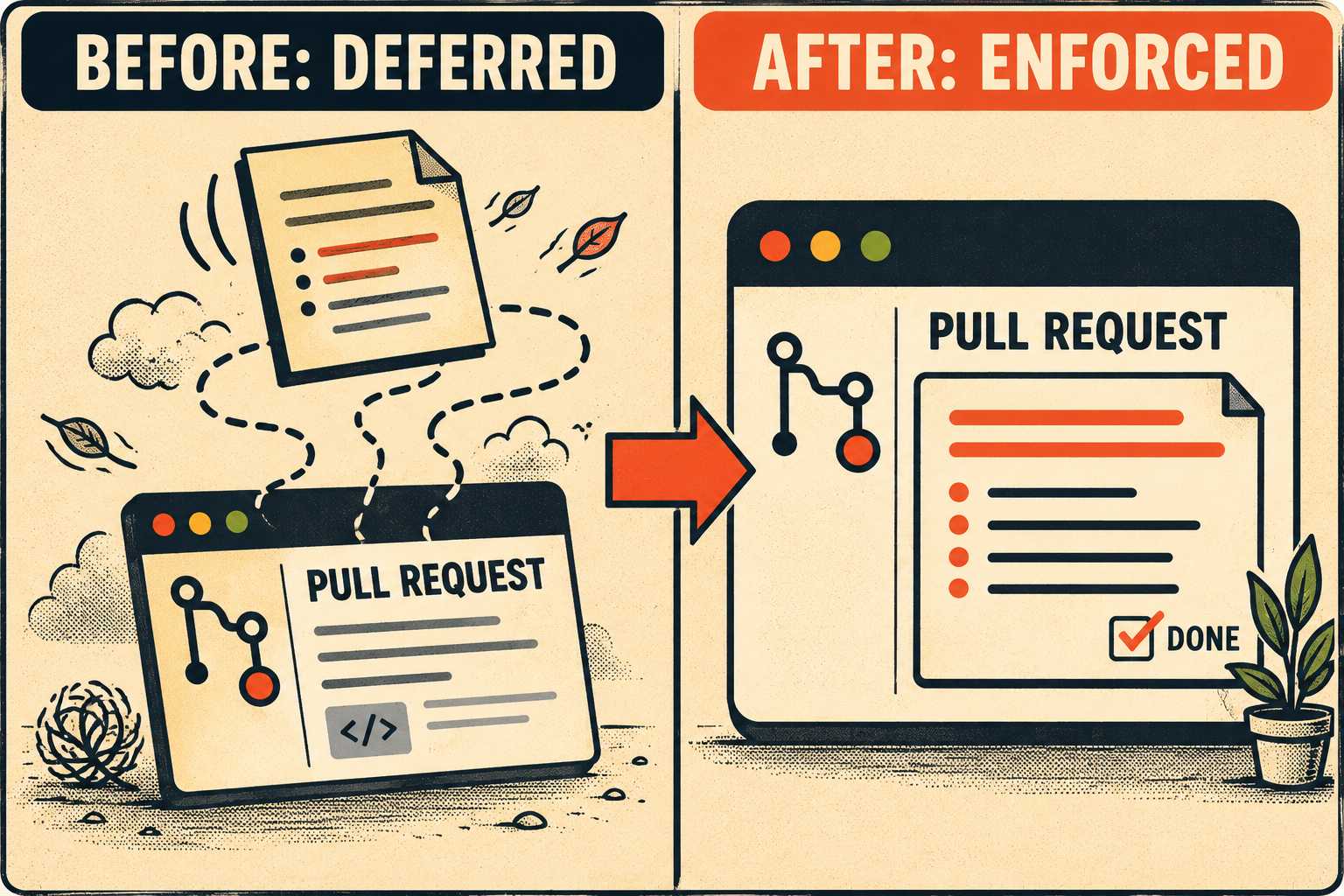
You need a single release notes template that travels with the ticket or the pull request. It cannot be a wiki page someone has to remember to check.
More importantly, there must be a defined owner. Not "the team," but a specific role responsible for the quality of the output.
This is where you implement a merge or ship gate. Releases should be blocked if they lack documentation. This treats release notes as a build-time constraint. If the code does not compile, it does not ship. If the documentation is missing, it does not ship.
The Path of Least Resistance
To make this work, you have to make writing release notes the easiest thing to do.
This means integrating documentation capture directly into the moment of work. Pull request templates, Jira hooks, and Linear automations are effective here. When an engineer opens a PR, the template should prompt them for the release note content right then and there.
If you ask them to log into a separate CMS or update a Google Doc three days later, you have already lost. The documentation must live where the code lives.
Assuming Good Intent
Because distributed teams operate across time zones, the review process must be async-first.
A tight async review cycle might look like this: a Slack channel where draft notes post automatically when a PR is merged. A rotating reviewer from product or support has 24 hours to flag issues. If no one objects, the system defaults to publication.
This assumes good intent but catches obvious gaps, like the engineer who wrote "fixed thing" instead of explaining that the billing API timeout issue was resolved. (We all know that engineer. Sometimes we are that engineer.)
Someone Has to Own the System
As the engineering organization grows, someone needs to own the system itself.
This is a leverage role, often filled by a technical writer or a product ops lead.
They do not write every release note. Instead, they audit for consistency, maintain the template, train new team members, and manage exceptions. One person can ensure quality across dozens of releases if the system is built correctly.
Things Will Still Go Wrong
A critical bug fix will ship at 11 PM on a Friday, and no one will document it. Two teams will ship overlapping features and describe them differently. A remote engineer will ignore the PR template because they are absolutely certain their code is self-documenting (it is not).
You need contingency procedures. When the 11 PM hotfix happens, the system should automatically flag the undocumented release for review on Monday morning. When descriptions overlap, the product ops lead steps in to reconcile them. The goal is not perfection; it is a system that catches its own errors.
Distributed teams are hard to synchronize. You cannot Slack someone twelve time zones away and expect an immediate answer. The documentation system has to be async-first, with clear defaults and a low failure cost.
This operational challenge is exactly what Doc Holiday was built to handle. It is a documentation engine that generates release notes directly from engineering workflows, enforcing structure at the source. It automates the capture and first-draft generation so your validation and governance layers can focus on edge cases and quality, not chasing down what shipped. For lean teams that need consistent output without rebuilding a massive headcount, it provides the infrastructure that makes this entire system feasible at scale.