Release Notes Best Practices for Developer Tools


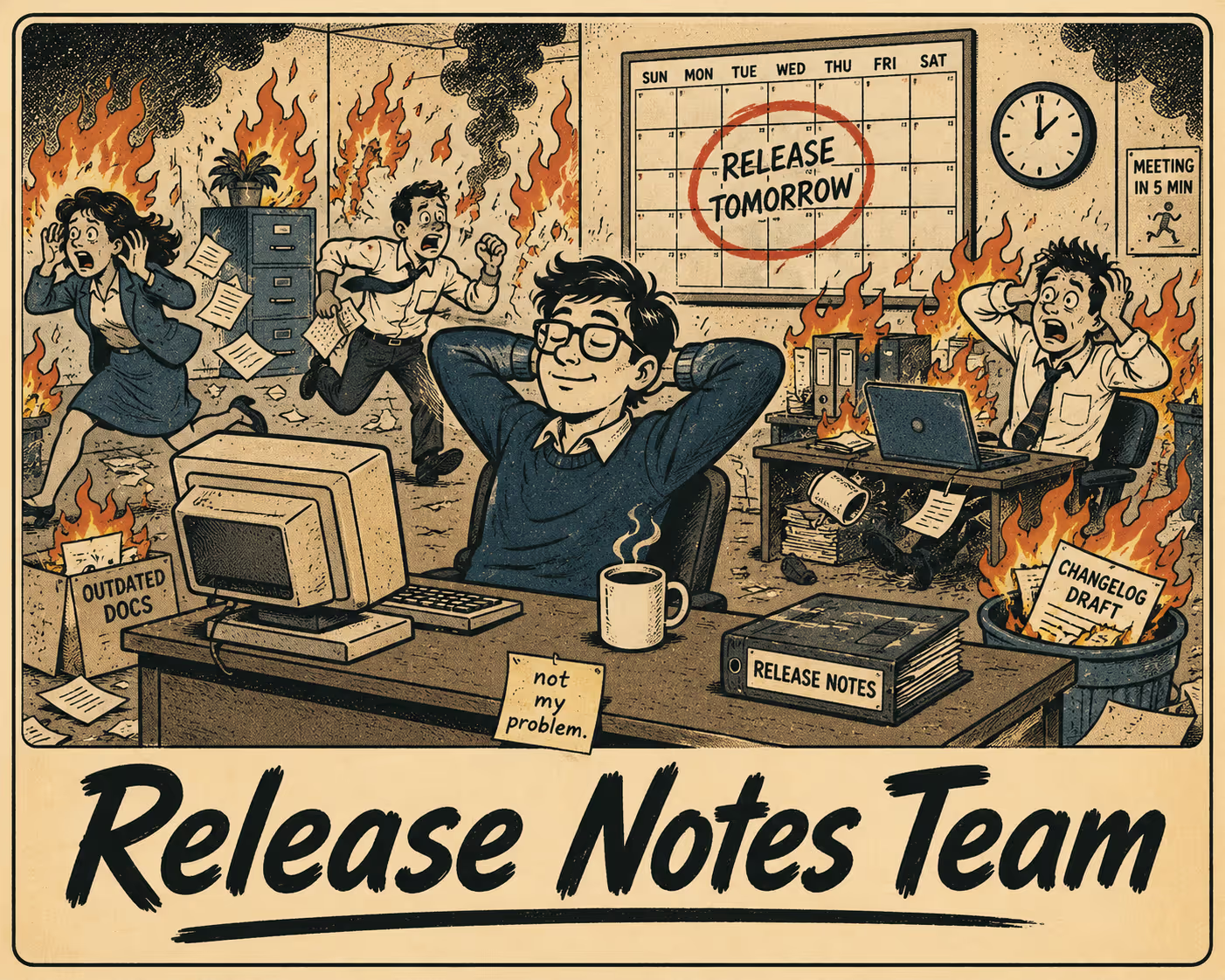
Your release is scheduled for tomorrow morning. Someone just pinged the engineering lead asking who is writing the release notes. Nobody has started. Nobody wants to. The person who did it last time is on vacation, and the person before them left the company six months ago along with the custom script they built to pull PR titles into a Google Doc.
This is the actual problem with release notes. Not that they're hard to write. It's that they require someone to stop what they're doing, sift through two weeks of merged pull requests, decide what matters to users versus what was an internal refactor, and produce something coherent before the release goes out. Documentation tasks consume roughly 11% of developers' work hours. When teams are shipping weekly, that's not a rounding error.
For consumer products, release notes are often an afterthought — a place for marketing spin or vague "bug fixes and performance improvements" messages. For developer tools, APIs, SDKs, and platforms, the stakes are entirely different. Developer audiences are technical, unforgiving, and expect precision. Bad release notes burn trust fast. Good ones become a competitive advantage — they signal reliability, respect for the user's time, and operational maturity. Developer documentation is one of the strongest predictors of adoption, support volume, and product satisfaction.
What Makes Developer Tool Release Notes Different
When a developer integrates your API or SDK, they are making a bet on your infrastructure. They are writing code that calls your endpoints, depending on your response shapes, and building business logic on top of your contracts. They need to know exactly what changed in the API contract, what will break, what is deprecated, what new capabilities are unlocked, and how to migrate. They don't need marketing spin. They need diffs, code samples, and migration paths.
Clarity and completeness are survival requirements in this context. A comprehensive analysis of 1,529 release note issues on GitHub found that producers are more likely to miss information than to include incorrect information, especially for breaking changes. When a breaking change is undocumented, it doesn't just cause a minor inconvenience — it breaks builds, takes down production systems, and triggers frantic late-night debugging sessions for your users.
This is the core tension that Hyrum's Law captures so well. Formulated by a software engineer at Google, the observation is blunt: "With a sufficient number of users of an API, it does not matter what you promise in the contract: all observable behaviors of your system will be depended on by somebody." Every change, no matter how small or seemingly internal, has the potential to break someone's integration. The implication for release notes is direct: if you change something, document it. All of it.
Consumer software can get away with vague notes because the consequences of a missed update are usually minor — a user might see a slightly different button placement or a new onboarding flow. For developer tools, the consequence of an undocumented change is a production incident. That asymmetry is why release notes for developer tools require a fundamentally different level of discipline.
The Anatomy of a High-Quality Release Note
Consistent structure is not bureaucracy — it is a form of respect for your users' time. Developers scan release notes quickly, looking for the specific information they need. A predictable format means they can find it without reading everything.
Every release note for a developer tool should anchor itself to a clear version number and release date. If you are using Semantic Versioning, the version number itself does communicative work: a major version bump signals breaking changes, a minor bump indicates new backward-compatible features, and a patch version covers backward-compatible bug fixes. The version number is a contract. Violating it — shipping breaking changes in a minor release, for instance — is one of the fastest ways to destroy developer trust.
Breaking changes deserve their own section, and that section should come first. Not buried at the bottom after the feature announcements. Explain what broke, why the change was necessary, and provide a clear, step-by-step migration path. If a developer needs to update their code to keep things working, they need to know immediately. The same principle applies to deprecations: announce them early, provide a timeline, and point developers to the recommended alternative. Lorna Mitchell, VP of Developer Experience at Redocly and a member of the OpenAPI Technical Steering Committee, puts it plainly: "API changes can be disruptive, difficult and painful, but they're a healthy part of the API lifecycle when they're well-managed and well-communicated."
New features and bug fixes should be specific. "Fixed an issue with authentication" tells a developer nothing. "Fixed an issue where OAuth tokens expired prematurely under heavy load when concurrent requests exceeded 50 per second" tells them exactly whether this fix is relevant to their situation. Specificity is not pedantry — it is the difference between a useful document and a useless one. The Keep a Changelog standard, widely adopted across the open-source ecosystem, formalizes this with a simple taxonomy: Added, Changed, Deprecated, Removed, Fixed, Security. The categories are not glamorous, but they work because developers know exactly where to look.
The final element that separates good release notes from great ones is context. A list of changes tells a developer what happened. Context tells them why, and why it matters to them. Stripe's redesigned developer changelog, launched in 2024, is a useful reference point: it provides step-by-step upgrade guidance, concise summaries of API and SDK updates, and filtering so developers can find changes relevant to their specific API version. The goal is not just to inform, but to help developers act.
The Automation Problem
The good news is that if your team uses GitHub, you already have the raw material to automate this process. The question is how much automation you actually want, because every approach involves a real trade-off.
GitHub's automatically generated release notes work by mapping pull request labels to categories, producing a structured bullet list of merged PRs and contributors. This is fine for an internal audit trail. It is not fine if your users are trying to understand what changed and why it matters to them. The output quality is entirely dependent on your team's PR discipline. If engineers are merging PRs titled "fix thing" or "update stuff," that is exactly what will appear in the release notes. The automation faithfully reproduces whatever input it gets.
Many teams outgrow the native approach and reach for tools like semantic-release or custom GitHub Actions workflows. The idea is to enforce a commit message convention — Conventional Commits is the standard, with feat:, fix:, and BREAKING CHANGE: prefixes that map directly to SemVer version bumps — and parse those messages automatically to generate a changelog. This works well when it works. The hidden cost is maintenance. These pipelines are usually built by one or two engineers who care about this stuff. When they leave, the team inherits a fragile web of YAML files and bash scripts that nobody fully understands.
The deeper issue is that even a well-maintained script still produces a list. It can group changes by type. It cannot explain that the authentication refactor in this release was the prerequisite for the SSO feature shipping next quarter. That context lives in the PR description, in the linked issue, in the conversation between the engineer and the product manager. Scripts don't read those. Research into practitioners' expectations found that release notes should draw on issues (29% of content), pull requests (32%), and commits (19%). All of that information is already in GitHub. The question is whether your team is disciplined enough to put it there, and whether your tooling is sophisticated enough to synthesize it.
Scaling Without Sacrificing Quality
The scaling problem is real. Teams shipping weekly or bi-weekly cannot afford to have a senior engineer or technical writer manually assemble release notes from scratch for every release. But the answer is not to lower the bar — it is to build a process that maintains the bar without requiring heroic effort on every cycle.
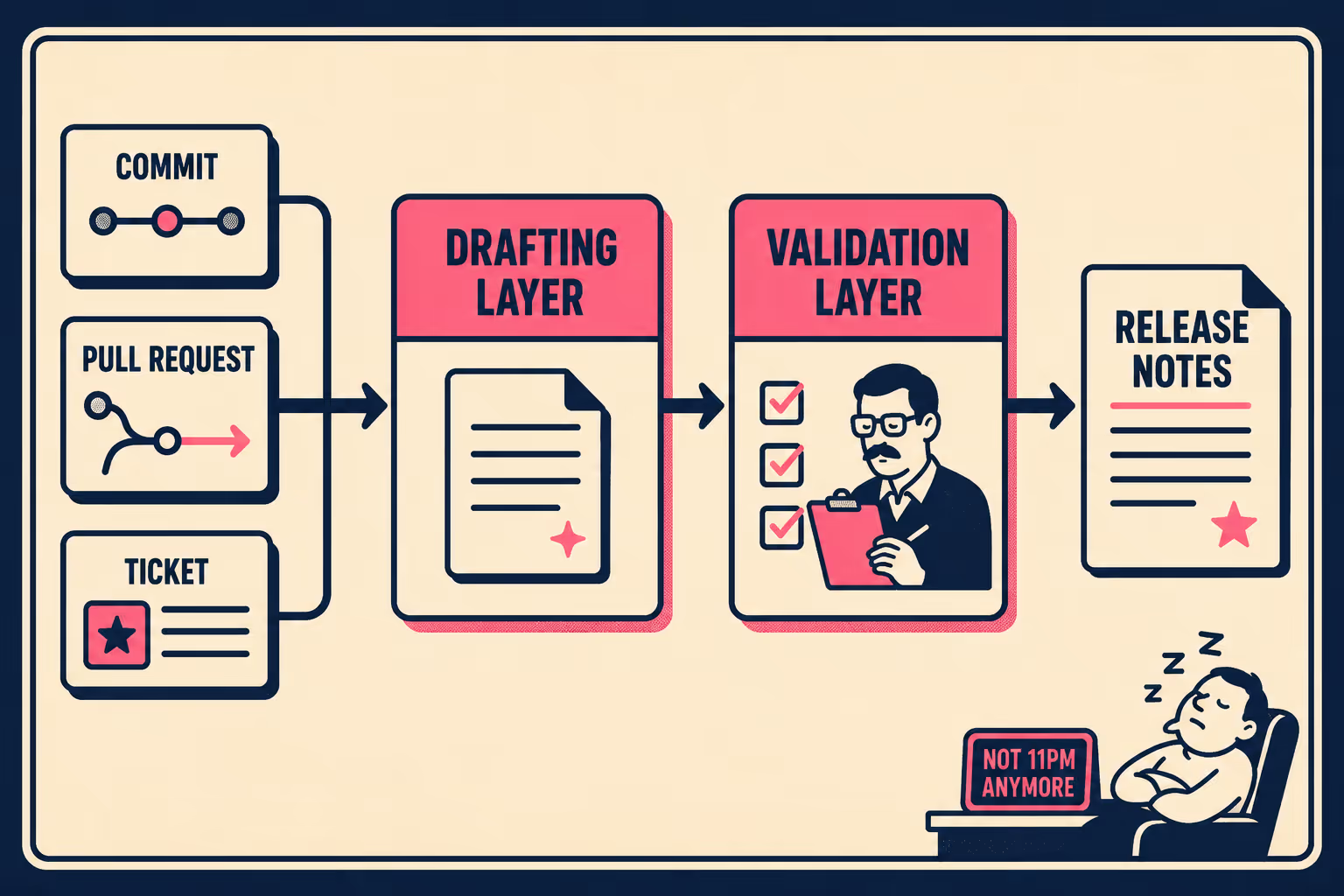
The right model has two layers: a drafting layer that generates structured content from engineering artifacts (commit messages, PR descriptions, ticket metadata), and a validation layer from someone who understands both the product and the audience. A technical lead reviewing a draft is doing editorial work. A technical lead hunting through two weeks of PRs at 11pm before a release is doing data entry. Those are not the same job, and only one of them is worth their time.
This is where Doc Holiday fits naturally. It generates release notes, API references, and changelogs directly from engineering workflows — pull requests, commits, ticket closures. It gives teams the structure to keep notes accurate, consistent, and shipped on time without requiring a technical writer on every release. A senior product or DevRel person validates the output and ensures it meets the standards described in this article. The blank page problem goes away. The editorial judgment stays exactly where it belongs.
Release notes are not an afterthought. For developer tools, they are a user experience surface as important as the product itself. A developer who cannot figure out what changed, what broke, or how to migrate is a developer who files a support ticket, posts a frustrated thread, or quietly starts evaluating alternatives. Getting release notes right consistently is a competitive signal. The teams that master this build trust, reduce support load, and make their tools genuinely easier to adopt — and that advantage compounds over time.