The Quiet Signal Senior Engineers Look for


If you are a director of engineering hiring for a staff-level role, you know the drill. You post the job, and the applications that come in are a mix of the unqualified, the overqualified, and the deeply strange. You eventually find three candidates who look great on paper. You put them through the gauntlet: the technical screen, the system design interview, the behavioral round, the chat with the founders. You make an offer to the best one.
They decline.
They decline because they took a look around during the process and decided they didn't want to work for you. You might assume it was compensation, or that they got a counter-offer from their current employer. You might even assume they just didn't vibe with the team.
But if you ask them, really ask them, off the record, they might tell you something different. They might tell you they looked at your API documentation, or your open-source repositories, or the way your team talked about onboarding, and they saw a red flag. They saw a company that doesn't respect its engineers' time.
They saw bad docs.
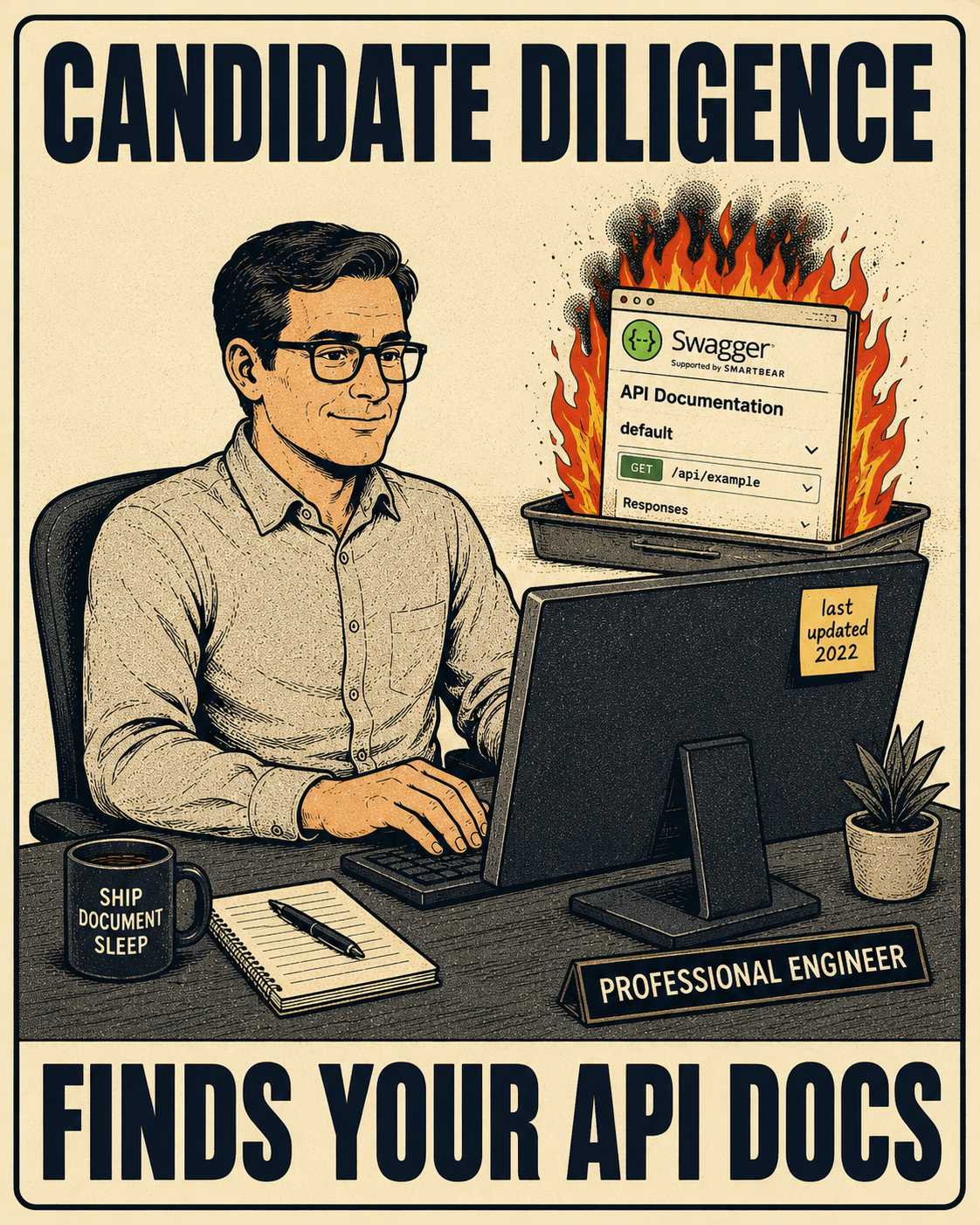
The premise here is simple, though perhaps uncomfortable for talent acquisition teams: candidates with options are reading your documentation during diligence, and what they see tells them things about the organization that Glassdoor reviews and interview processes cannot.
The Diligence Candidates Actually Do
It is easy to be skeptical of this. When we think about employer branding, we think about career pages, benefits packages, and the technical blog. We do not typically think about the internal wiki or the API reference.
But experienced engineers do. They have been burned before. They know that every company claims to have a great engineering culture during the interview. They also know that the truth is usually hidden in the artifacts the engineering team produces every day.
A candidate checks your API reference and sees that endpoints are fully documented with request/response examples, error codes are explained, and the last update timestamp is recent. That tells them something very different than finding a half-empty Swagger page last touched two years ago. The first signals a team that ships with discipline. The second signals a team that ships and forgets.
What does good documentation actually signal? The answer is not one thing. It is a cluster of things that experienced engineers have learned to read together, the way a doctor reads a set of vitals rather than a single number.
Well-maintained documentation suggests that engineering leadership values maintainability, institutional knowledge capture, and reducing cognitive overhead. Candidates see this as evidence that they won't be walking into a firefighting culture with no onboarding infrastructure. The 2023 DORA State of DevOps Report found that teams maintaining quality documentation achieve 25% higher team performance relative to those that don't. That is not a soft finding. That is a structural advantage.
Quality internal documentation, specifically runbooks, architecture decision records, and onboarding guides, also signals that the organization doesn't expect engineers to learn by oral tradition or repeatedly interrupt senior engineers. When an engineer sees that Architecture Decision Records (ADRs) are used to capture and explain significant architectural choices, they know the team values clarity over redundant debates. It is a small thing, but it is the kind of small thing that compounds. Every hour a new engineer doesn't spend hunting down context is an hour they spend building.
Consistent, up-to-date documentation also suggests that releases are structured, that there is a post-deployment communication discipline, and that the engineering org doesn't operate in permanent crisis mode. Candidates are assessing whether they'll spend their time building or constantly context-switching to put out fires. The absence of structured release notes and changelogs is itself a signal: it suggests that shipping is chaotic enough that no one has time to document what changed.
And then there is the investment question. Maintaining good docs requires either headcount or tooling investment. Either way, it signals that leadership allocates resources to making engineers more effective, not just to shipping features. Candidates notice when an organization treats developer experience as infrastructure rather than overhead. Atlassian's 2024 developer experience research found that 69% of developers lose eight or more hours per week to inefficiencies, with developers themselves most often attributing this time loss to tech debt or insufficient documentation. That is a full day of productivity, gone. Engineers know this. They are looking for employers who know it too.
The Tiebreaker Nobody Talks About
Some engineering organizations with terrible documentation still attract strong talent. They might offer exceptional compensation, have a massive brand name, or work on uniquely challenging problems. Bad documentation is not always disqualifying.
That is worth acknowledging directly, because it is true. If you are Google or OpenAI or a company paying at the 99th percentile, you will attract strong engineers despite your documentation. The brand and the compensation do a lot of work.
But that is not the situation most engineering leaders are in. Most are competing for senior talent against several other companies with comparable compensation, comparable problem spaces, and comparable reputations. In that context, the question isn't whether bad docs are a dealbreaker. The question is whether good docs become a tiebreaker when candidates are comparing similarly attractive offers, or whether they reduce time-to-yes during the decision process.
The candidate segments where this matters most are also the ones where the stakes are highest.
Senior engineers evaluating technical debt and maintenance burden are looking at your documentation as a window into the future. They are asking: if I join this team, will I spend my time building, or will I spend it reconstructing context that should have been written down? Staff-plus engineers assessing whether there's a culture of architectural clarity are looking for proof that decisions get made deliberately and recorded, not just inherited by whoever happens to be around. Engineers returning from sabbatical or considering role changes who want low-friction onboarding are looking for a promise that the organization will support them in getting up to speed, rather than expecting them to absorb institutional knowledge through osmosis.
These are often high-leverage hires where small perception differences compound. A staff engineer who joins convinced that the org is well-run will invest differently than one who joins skeptical.
There is also a hiring funnel economics argument here. Candidates who arrive at the offer stage already convinced that the engineering org is well-run are more likely to accept. They are also more likely to have done their diligence efficiently, without requiring extensive time from your senior engineers during the process. Good docs let candidates self-qualify or self-disqualify faster. Ashby found in their 2023 analysis of 230,000 applications that technical roles have a 73% average offer acceptance rate compared to 84% for business roles, a persistent gap that reflects how differently engineers evaluate and approach offers. Anything that closes that gap is worth taking seriously.
The Part That Actually Breaks Down
Here is the uncomfortable operational reality: documentation quality is easy to intend and hard to maintain.
Documentation often degrades because keeping it current competes with feature work. The people best positioned to write it are also the people most expensive to pull off the critical path. A senior engineer who knows the system deeply is also the senior engineer who is in every architecture review, every incident post-mortem, and every sprint planning session. Asking them to also maintain the runbooks and the API reference is asking them to do two jobs.
If documentation is seen as "extra work" that happens after the real work, it almost always goes stale. The 2023 State of DevOps Report found that investing in documentation accelerated improvements for high-performing teams, but the precondition is that documentation is embedded in the workflow, not appended to it. Teams that treat documentation as a separate workstream consistently fall behind. The docs that candidates read are the ones that were never updated after the last major refactor.
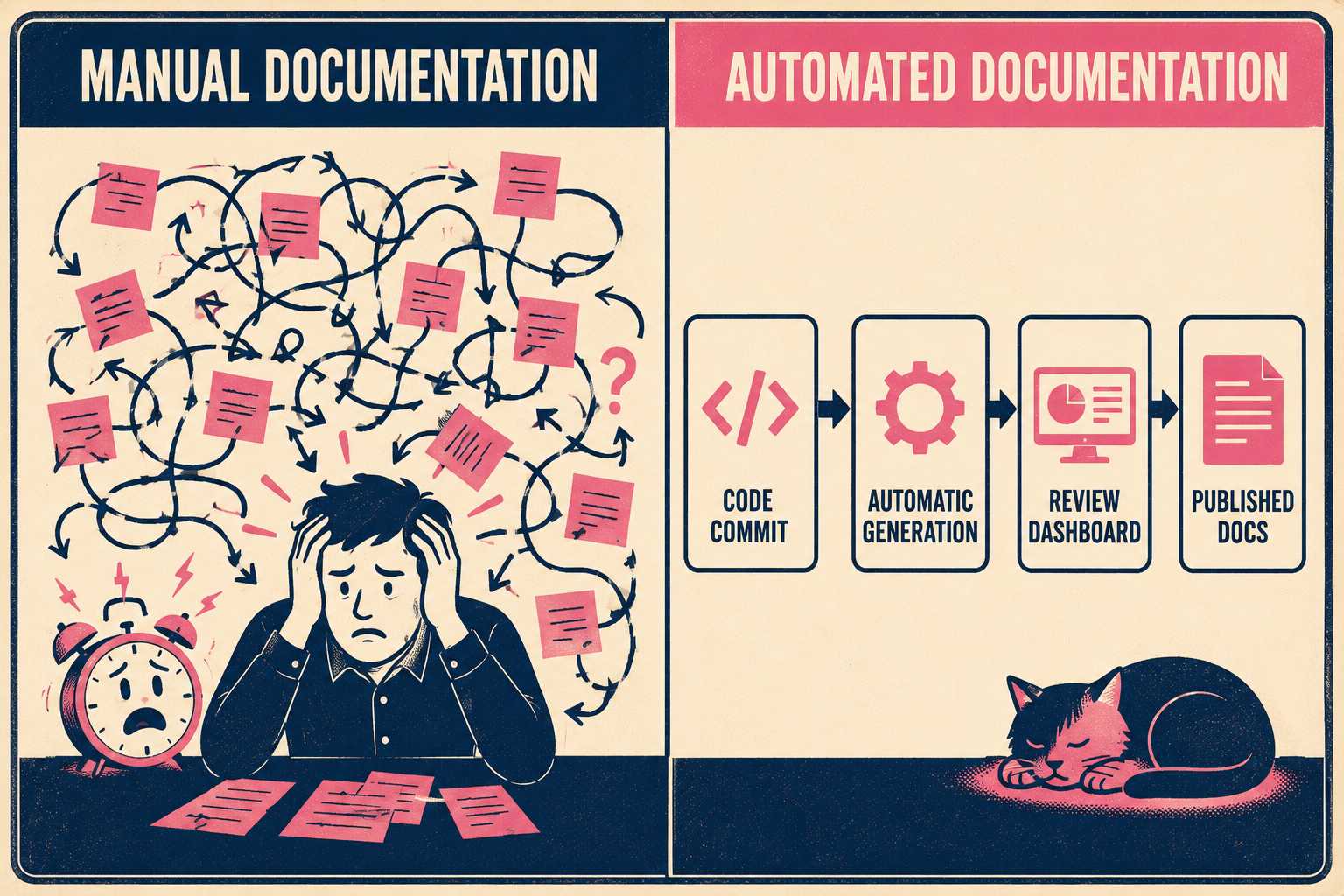
The teams that keep documentation current are the ones that have removed the manual step. Engineering teams that generate release notes, API documentation, and changelogs automatically from their existing workflows, not as a separate manual task, are the ones that keep documentation current without creating a maintenance burden that collapses under pressure.
Doc Holiday is built on exactly this premise. It generates documentation output directly from engineering workflows: pulling from code commits to draft release notes, API references, and changelogs. A senior writer or engineer reviews the draft in a dashboard, flags edge cases, and feeds patterns back into the system to strengthen pattern recognition over time. It gives lean teams the structure to validate, manage, and scale output without rebuilding a large headcount or pulling senior engineers into documentation sprints.
When documentation is generated from the source of truth rather than maintained as a secondary artifact, candidates can trust that what they're reading reflects the current state of the system. That is what makes the signal reliable. A half-empty Swagger page last touched two years ago signals chaos. An API reference that reflects last week's release signals a team that has its act together.
If you are competing for senior talent in a tight market, documentation quality is one of the few signals you control that speaks directly to the day-to-day engineering experience. It is not the only signal, but it is one of the most honest.
And candidates know it.