The Multi-Tier Deprecation Disaster (and How to Avoid It)


It usually happens on a Tuesday. The engineering team has finally decided to sunset the legacy API that costs too much to maintain and breaks every other weekend. The product manager drafts a polite, firm email. The VP of Engineering signs off. Someone hits send to the entire user base. They think the hard part is over.
Then the fallout arrives.
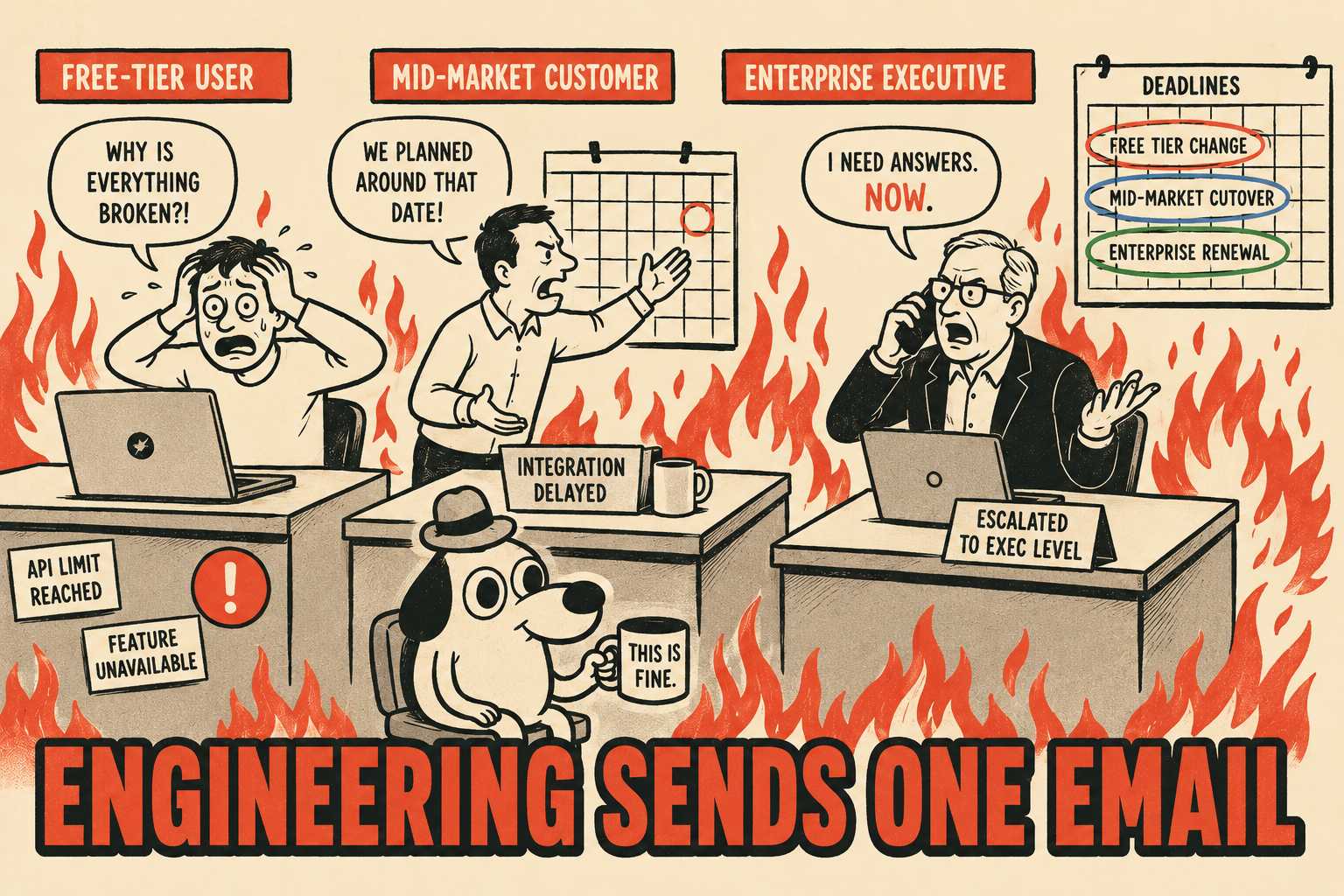
It comes in three distinct, contradictory waves. First, the free-tier users panic because the migration documentation assumes they understand the new architecture, which they don't. Then, the mid-market customers flood support tickets, furious that a 30-day notice doesn't align with their quarterly planning cycles. Finally, an enterprise account executive calls to inform you that a Fortune 500 client is threatening to churn over a breached SLA.
This is what happens when you treat deprecation as a single announcement.
Deprecation communication is not one message sent three times. It is three fundamentally different conversations happening on different timelines with different stakes. When your user base spans hobbyists on free plans and regulated enterprises with 18-month planning cycles, a uniform announcement fails catastrophically. The mistake is announcing uniformly and then firefighting the aftermath. The good news is that the failure mode is entirely predictable, which means it is entirely avoidable.
The Blast Radius of a Single Email
Most teams treat a service sunset as an engineering event. It is actually a complex communications event with a very specific blast radius.
When you send a single deprecation notice, you are asking every customer to absorb the same operational shock simultaneously. A startup can rewrite their integration over a weekend. A large enterprise might need six months just to get the budget approved for the migration work. The IETF's formalization of the Sunset HTTP header field captures this logic precisely: the sunset period is not a date, it is a window of time calibrated to the user's ability to migrate (RFC 8594). That window is not the same for everyone.
You cannot manage this with a spreadsheet and a generic banner. You have to segment your base by contract type, usage intensity, and support relationship. The segmentation is not optional. It is the entire strategy.
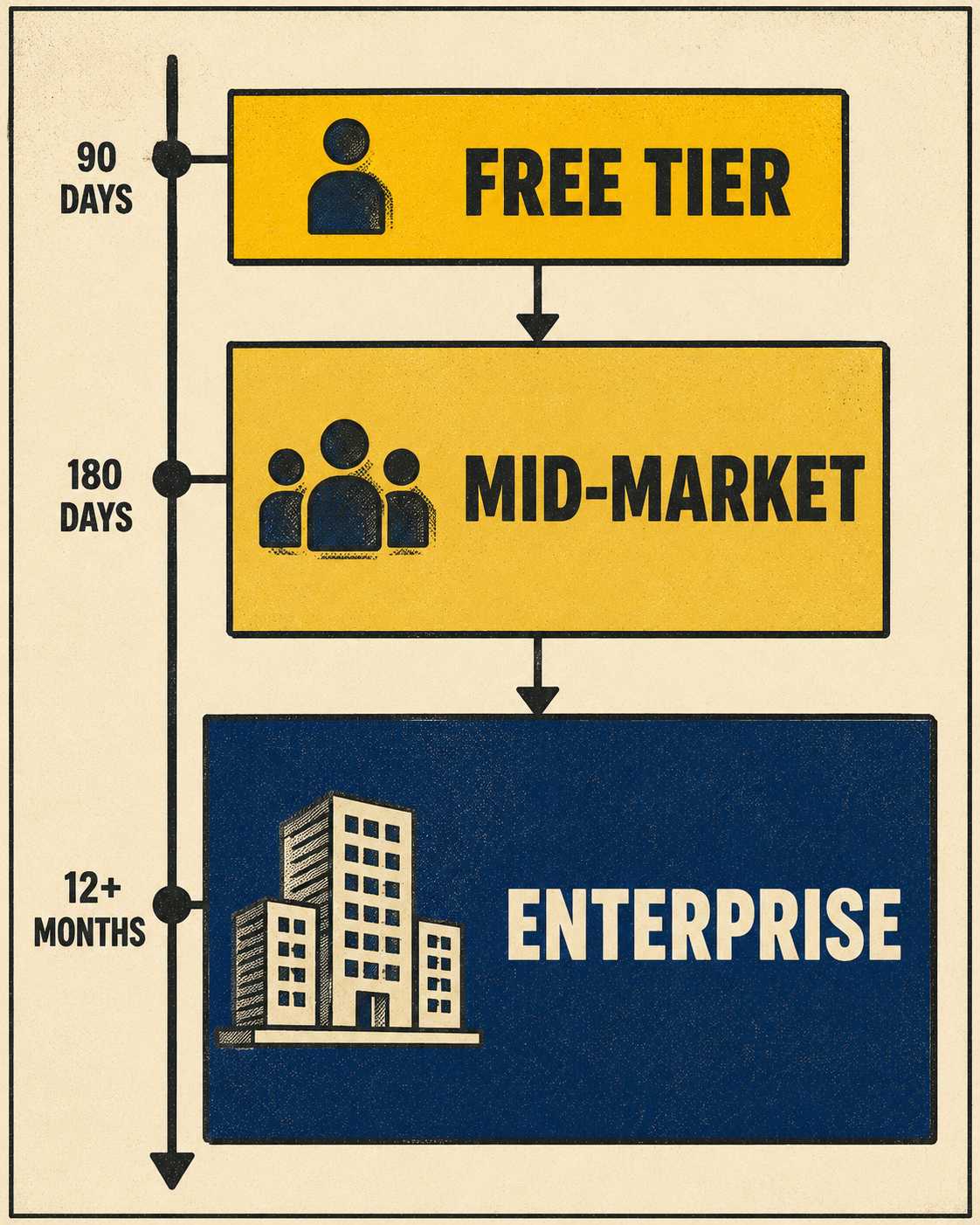
The three tiers are not arbitrary. They map to real differences in how customers make decisions, how they consume documentation, and what they are legally entitled to expect from you.
What Each Tier Actually Needs from You
Free and self-serve users can tolerate shorter timelines. What they cannot tolerate is ambiguity.
They will not read long emails. They will ignore your generic "Action Required" subject lines until their integration actually breaks. This is not a character flaw. It is a rational response to inbox volume. They need in-app warnings. They need a single-page migration guide. They need a working code example. Ideally, they need a script or API endpoint that automates the move for them. The communication sequence here is structural: in-app notifications at 90 days, email reminders at 60, 30, 14, and 7 days, then a hard cutoff. The message is helpful but firm. This is happening. Here is how to move.
Mid-market paid customers operate on a different rhythm. A 30-day notice to a mid-market customer is an insult. They need 90 to 180 days, and they should hear about the sunset from their account owner or CSM, not a generic banner. The framing shifts from a broadcast to a consultation. We are sunsetting this service. Let's build a migration plan together. They need a detailed runbook. If the migration touches infrastructure, they need architecture diagrams. They need a changelog explaining exactly what is different in the replacement service. They might need office hours or webinar support to get their engineering teams aligned. Many standard SaaS agreements allow unilateral modifications with advance notice in the 30-to-90-day range, but mid-market customers who have been with you for years have a reasonable expectation of more.
Enterprise gets the white-glove version. These customers may need 12 months or more. Some will have contractual language that requires negotiated extensions or carveouts. You need to know in advance which contracts have service-level commitments that cover the deprecated feature. Are you prepared to grant extensions? Offer discounts? Carve out legacy support? These are not hypothetical questions. They are decisions that need to be made before the announcement goes out, not after the first escalation call. Enterprise customers need early briefings from solutions engineering, a dedicated Slack channel or standing call, and flexibility on timelines if contractually required. They often require custom documentation reflecting their specific implementation, especially if they have built deep integrations or have compliance requirements that complicate the switch.
The Edge Cases That Will Consume the Most Time
Even with perfect communication, some customers will ignore everything.
Some mid-market customers will wait until the service actually breaks, then escalate aggressively. This is predictable. Build a fallback plan for late-stage migrations: either a brief grace period or a degraded-but-functional mode that gives stragglers time to move without rewarding procrastination. The key word is brief. A grace period that extends indefinitely is just a new deadline no one believes in.
Some enterprise customers will invoke contractual language to delay or block the deprecation entirely. This is also predictable, and it is the reason you need to audit your contract portfolio before the announcement, not after. A Stripe-style policy of never deprecating without an unavoidable requirement is one way to avoid this problem entirely, but most teams are not in a position to absorb that level of technical debt indefinitely. If you are going to deprecate, know your exposure before you announce.
There is also the compliance dimension. Regulated enterprises in healthcare, finance, or government may have internal change management processes that require months of internal approvals before they can even begin a migration. A 12-month notice that sounds generous to your product team may be genuinely tight for a customer whose security review board meets quarterly.
The Internal Alignment Problem
If your internal teams are not aligned, your customers will know immediately.
Engineering needs to maintain the deprecated service longer than they want to. Support needs talking points for each tier and clarity on when to route escalations to account management versus engineering. Customer success needs to be looped in early so they can prep their books and identify high-risk accounts. Product marketing may need to position the replacement service as an upgrade, not just a forced migration.
If these teams are not synchronized on timeline and messaging, customers will get conflicting information. An enterprise customer who hears one deadline from their CSM and a different one from a support ticket will not assume there was a miscommunication. They will assume you are disorganized, and they will be right.
The internal communication plan should precede the external one. Customer success should know about the deprecation before any customer does. Support should have their talking points before the first in-app notification goes live. Engineering should have a clear commitment on how long the deprecated service will remain operational, with a buffer built in for the stragglers.
Keeping the Story Straight at Scale
A team doing this manually will miss accounts. They will send inconsistent messages. They will burn time on repetitive updates. They will discover, three weeks before the cutoff date, that someone forgot to notify a mid-market customer who has been on a legacy contract since 2019.
A structured system can generate tier-specific timelines, trigger notifications based on customer segment, and maintain a single source of truth for migration instructions. That system should produce deprecation notices, API reference updates, and customer-facing changelogs that stay in sync as deadlines shift or exceptions are granted. The operational model that makes this work is one where documentation updates flow directly from engineering workflows: from commits, from changelog entries, from the same source of truth that engineers are already maintaining.
Before you hit send on that Tuesday email, work through this checklist:
- Segment your customer base by tier and contract type. Know which accounts have SLA commitments that cover the deprecated feature.
- Map deprecation timelines to each segment's tolerance and obligations. Free users get 90 days. Mid-market gets 90–180. Enterprise gets 12+ months, with negotiated flexibility where required.
- Draft tier-specific messaging and migration docs. Free users need a single-page guide and a working code example. Mid-market needs a runbook. Enterprise needs custom documentation.
- Brief internal teams before external communication goes out. Customer success, support, and engineering need to be aligned on timeline and talking points before the first notification fires.
- Build a fallback plan for late-stage stragglers. A grace period or degraded mode is not a failure. It is a planned contingency.
- Audit your contract portfolio for SLA exposure. Know your legal obligations before you announce, not after the first escalation.
That kind of operational complexity is exactly what Doc Holiday is designed to handle. It generates release notes, API reference updates, and customer-facing changelogs directly from engineering workflows, giving lean teams the structure to manage tier-specific documentation at scale without rebuilding a large headcount. When deadlines shift or exceptions get granted, the documentation stays in sync, because it is generated from the same source of truth as the code.