How to Keep Readme.io Documentation Up-to-Date After Releases


If you run a mid-sized engineering team, you have likely experienced a very specific, recurring Tuesday afternoon failure. You shipped a new feature. The code works. The deployment pipeline ran green. The release notes went out. And then, about three hours later, the support tickets start rolling in.
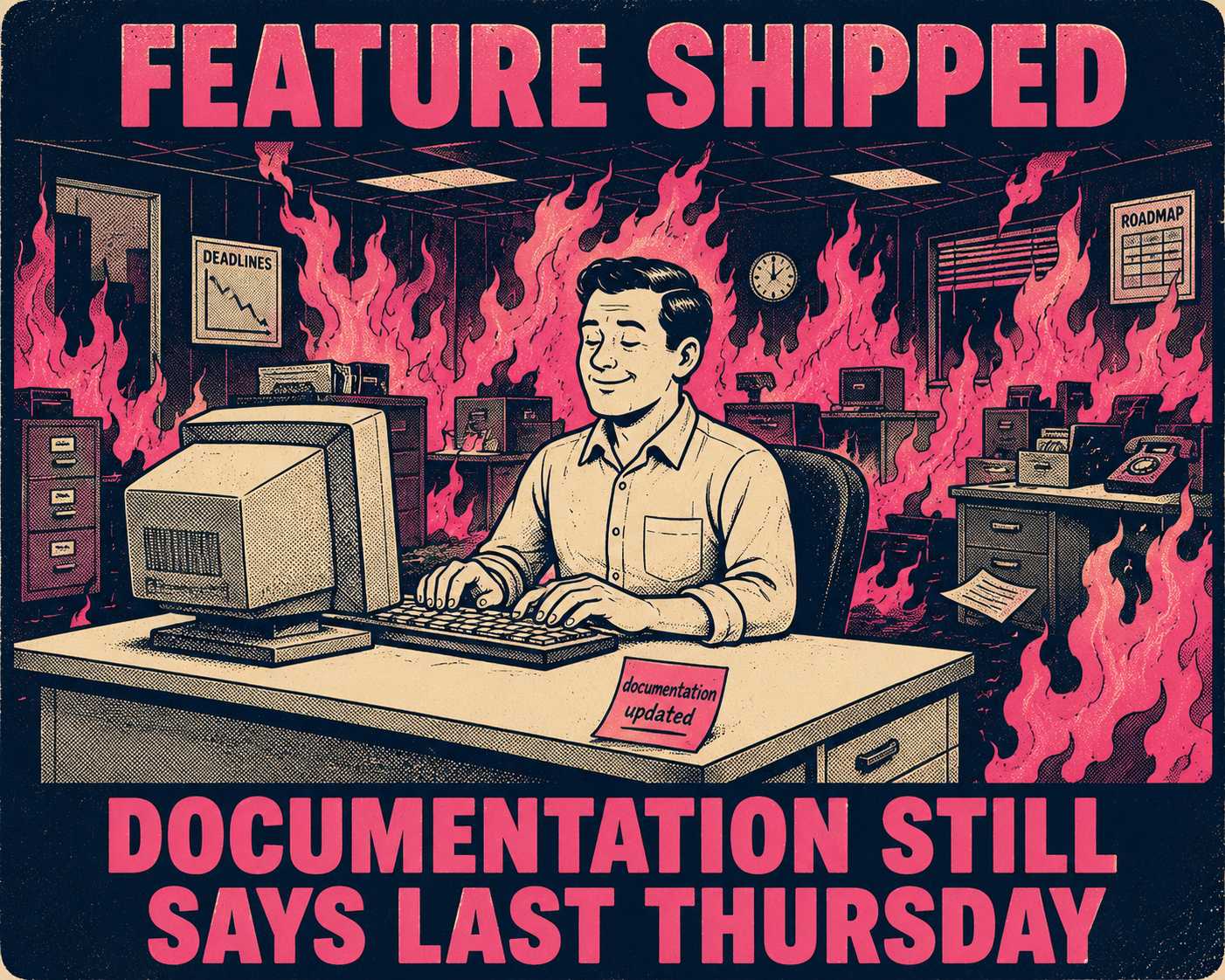
Customers cannot figure out how to use the new endpoint. The parameters in the dashboard do not match the parameters in the code. You log into your ReadMe.io portal and realize the documentation is still describing the system as it existed last Thursday. The code shipped, but the instructions did not.
The problem here is not ReadMe.io. It is a solid platform. It renders beautifully, handles API references well, and gives your users a clean place to read. But ReadMe.io is the distribution layer. It solves the publishing problem. It does not solve the generation problem.
If your documentation goes stale immediately after a release, it is because the update step is manual, deprioritized, and disconnected from the release workflow. The bottleneck is the process, not the tooling.
There is a way to fix this, but it requires treating documentation as a release artifact rather than an afterthought.
The Part Everyone Gets Wrong
We tend to treat documentation as a chore that happens after the real work is done. Engineers write the code, test it, review it, merge it, and deploy it. Then, if there is time, someone logs into the documentation portal to update the text.
There is never time.
In a fast-paced environment, the moment a feature ships, the team is already looking at the next sprint. The documentation update becomes technical debt. The cost of this debt is not theoretical. Documentation problems cost 15-25% of engineering capacity. That is a massive tax on your team's velocity.
When the update step relies on an engineer remembering to log into a portal and write prose, it will fail. It fails because it is disconnected from the tools where the work actually happens. The engineer is in GitHub or GitLab; the documentation is in ReadMe.io. The gap between those two systems is where accuracy goes to die.
How the Infrastructure Actually Works
The solution is to change the definition of done. A feature is not done when the code is merged. It is done when the code is merged and the documentation is updated.
But you cannot just mandate this and expect it to happen. You have to integrate the documentation into the release workflow.
This is the core idea behind Docs as Code. You treat your documentation the same way you treat your codebase. You version it, review it, and deploy it through a CI/CD pipeline. If a pull request modifies an API endpoint, the same pull request should include the documentation update for that endpoint.
This shifts the burden. Instead of writing docs after the fact, the documentation becomes a requirement for the release.
To make this work, you need an automated loop.
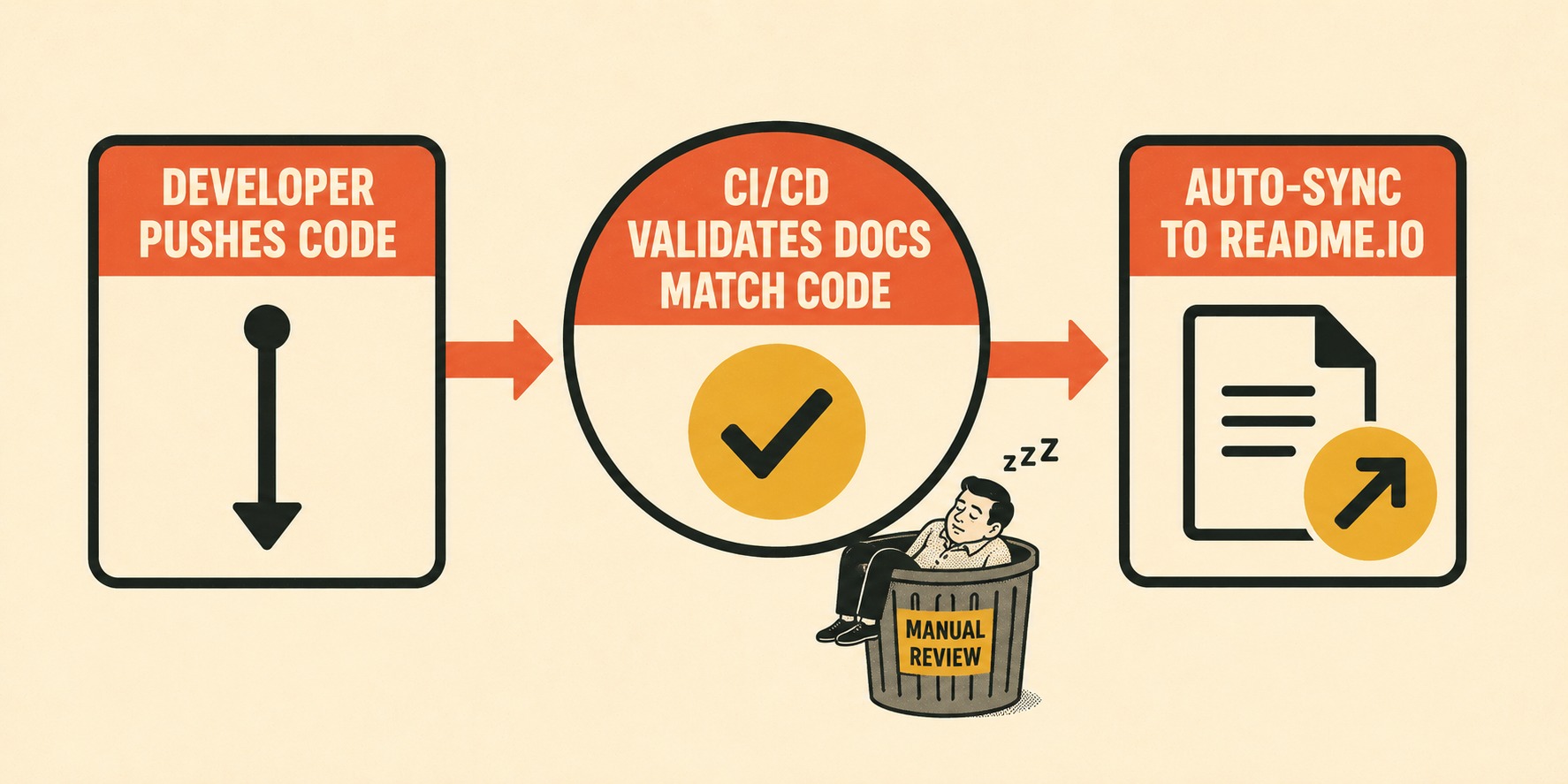
First, integrate documentation generation into your CI/CD pipeline. When a developer pushes code, the pipeline should validate that the documentation matches the code. If an endpoint changes but the OpenAPI spec does not, the build should fail.
Second, validate before merging. Just as you require passing tests and code reviews, require a documentation review. The documentation should be reviewed by someone with release authority—someone who understands both the technical implementation and the user experience.
Third, automate the push to ReadMe.io. You can use the rdme CLI or GitHub Actions to automatically sync your OpenAPI specs and Markdown files to your ReadMe project every time you merge to the main branch. This removes the manual publishing step entirely.
The Human Quality Multiplier
Automation handles the mechanics, but it does not handle the nuance.
If you rely entirely on automated generation, you get technically accurate but functionally useless documentation. An automated system can tell a user that a parameter is an integer. It cannot tell them why they should use that parameter or what edge cases to watch out for.
This is where the human element is required.
You need a technical owner—someone who cares about support tickets and user experience. This person does not write the documentation from scratch. The automated systems and AI tools generate the drafts based on code commits and release metadata. The human owner validates those drafts.
They catch the edge cases the system missed. They add the context that the code cannot provide. They turn a sterile API reference into a usable guide.
This is a different job than writing documentation. It is an editorial role. And it is the only way to scale documentation without building a massive technical writing team.
This is the workflow that actually works. You automate the generation step from the engineering activity, you assign a human to validate the output, and you use platforms like ReadMe.io to distribute it.
When you do this, you stop relying on engineers to remember to write docs after deploys. You build a system that produces documentation as a natural byproduct of shipping software.
This is exactly the operational model that Doc Holiday provides. It generates the first drafts directly from your release metadata and engineering activity. It gives your team the structure to validate those drafts, catch edge cases, and push the final updates into your distribution layer—whether that is ReadMe.io or anywhere else—without having to rebuild a full documentation team.