How to Write Release Notes for a Webhook Schema Change


Your payment webhook is changing on Friday. The status field is moving from a string to an integer. You need to tell every external developer who built against it, and you need to do it in a way that doesn't generate a hundred support tickets or break anyone's integration silently.
That is the actual problem. Not "how do I write documentation" in the abstract. How do you communicate this specific kind of change, to this specific audience, before this specific deadline.
Here is the short answer: webhook schema change release notes need to do something that most API documentation does not. They need to communicate operational risk to people who cannot test the change before it arrives at their endpoint.
Why Webhooks Make Documentation Harder Than You Think
With a REST API, a consumer controls when they upgrade. They call your endpoint, they see the error, they fix their code. The feedback loop is immediate and self-contained.
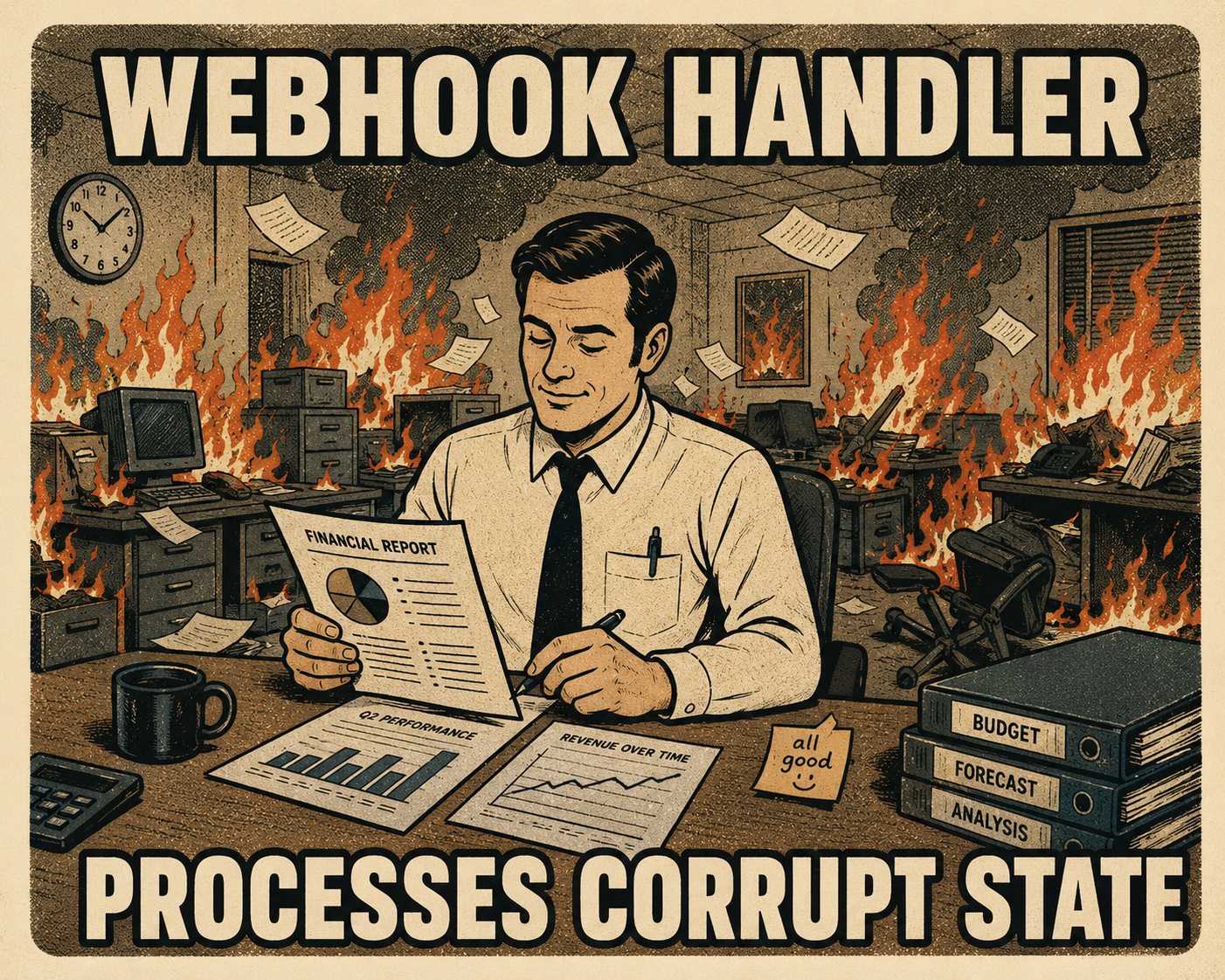
Webhooks reverse that. You push data to consumers, on your schedule, and they have to handle whatever shows up. When a REST API breaks a contract, the client gets an error response immediately. When a webhook breaks a contract, the consumer's handler either throws an exception and triggers retries, silently ignores the event and loses data, or processes corrupt state — that last outcome being the worst one, because it looks like success.
The feedback loop is also reversed in terms of timing. You ship the change, and consumers find out when their monitoring fires at 2 AM. That is the support nightmare you are trying to prevent.
This is why webhook release notes cannot just describe what is new. They have to explicitly detail what will break, when it will break, and exactly what the consumer must do before that date.
What Actually Belongs in the Document
Generic release note templates fail for webhook schema changes because they focus on the product narrative instead of the technical contract. A useful webhook release note is a checklist of impact.
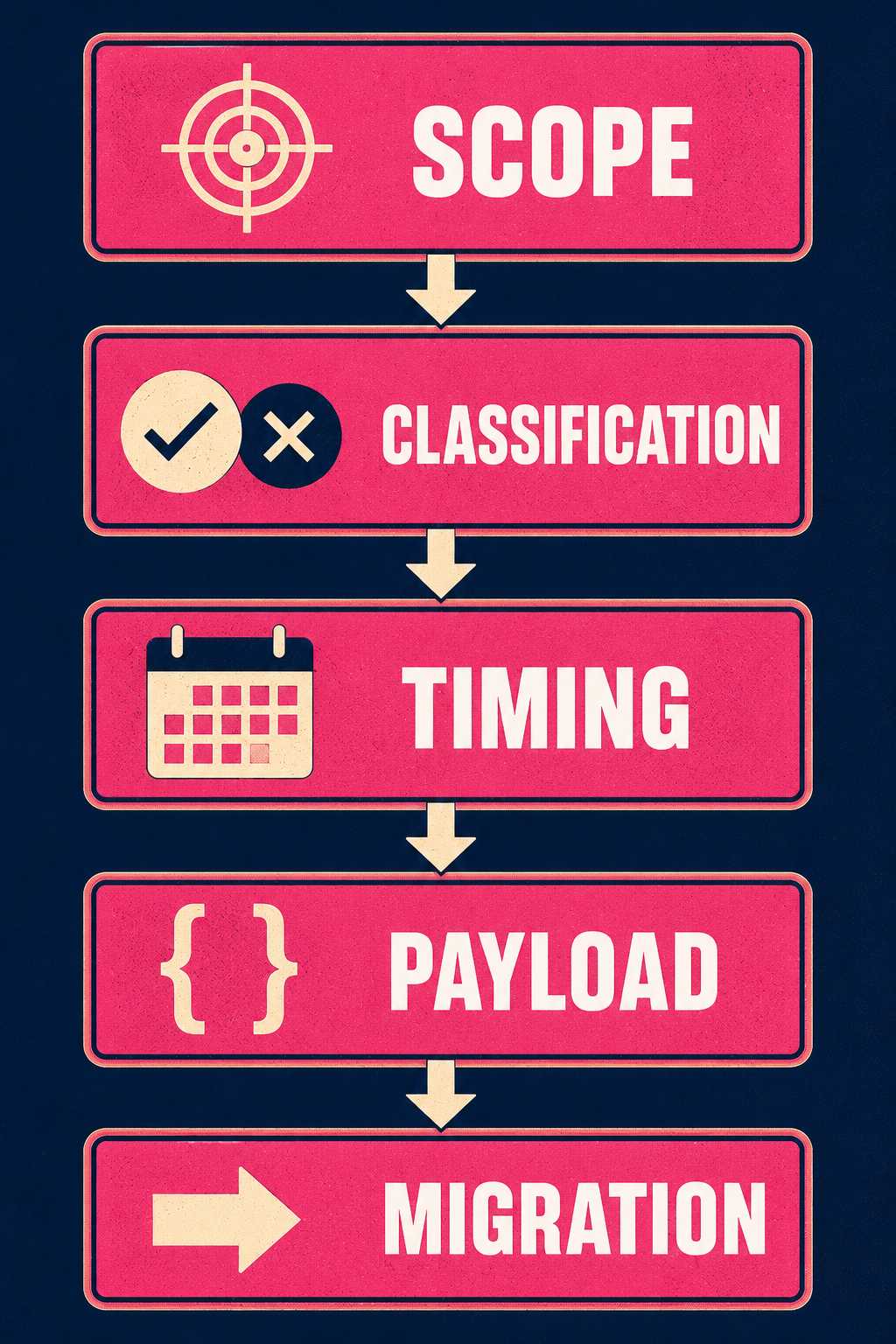
The document needs to answer five questions, in this order:
The first is scope: which specific event types and fields are affected? "We've updated the user object" is not scope. "user.legacy_id has been removed from all user.updated events" is scope. Developers need to know immediately whether they are affected at all.
The second is classification: is this change breaking or additive? Adding a new optional field is generally safe, provided consumers write tolerant parsers that ignore unknown fields. Removing a field, renaming a field, changing a type, or making a previously optional field required are all breaking. Enum additions are a landmine that looks safe until someone deploys a switch statement with an exhaustive case list. State the classification explicitly.
The third is timing: when exactly will the new schema start arriving at consumer endpoints? Not "soon." Not "in the coming weeks." A date.
The fourth is the payload comparison. Show the exact JSON before and after. This is the most critical part of the document. Developers need to visually verify the change without parsing paragraphs of text. Research on API documentation consistently shows that code examples are the primary resource developers use to understand changes. Do not make them infer the delta from prose.
The fifth is migration guidance: exactly what does the consumer need to change in their handler code? Show the old implementation and the new implementation. Link to updated reference documentation.
How to Frame the Change So Developers Can Act, Not Panic
The hardest part of writing breaking change documentation is calibrating the urgency. You need developers to take action, but you do not want them to assume the worst before they have read the details.
The framing that works is specificity. "This will break your integration" is catastrophic and vague. "This requires action if your handler reads data.failure_code" is bounded and actionable. The developer can immediately determine whether they are affected and how much work the fix will take.
Lead with the scope of impact. Then explain what changed. Then show the before and after. Then give the migration path.
If you are removing a deprecated field, state exactly which field and which object. Provide the replacement field. Show how the data maps from the old structure to the new one. If the values are equivalent (just renamed), say so explicitly. If the values have changed semantics, say that too.
The Microsoft FluidFramework team recommends explaining not just what changed but why it will ultimately benefit the consumer. This context helps developers understand the direction of the API and makes the migration feel worth the effort rather than arbitrary.
Versioning Strategy Determines What You Can Promise
How you communicate a webhook schema change depends heavily on your versioning model.
If you use global API versioning — the approach where consumers pin to a specific version and receive the new schema only when they explicitly upgrade — the release note is an upgrade guide. Consumers on the old version are safe until they choose to migrate. The document should explain the new schema, the migration path, and the sunset date for the old version.
If you use per-event-type versioning, where each event type carries its own version number in the payload, consumers can upgrade handlers incrementally. The release note should focus on the specific event types being versioned and give consumers the ability to test the new version before committing.
If you use additive-only evolution with no explicit versioning, you have committed to never removing or renaming fields. The moment you need a genuinely breaking change, you have no versioning infrastructure to soften the impact. This is the scenario that produces the worst release notes, because the only option is a hard cutover with a fixed date.
Klaviyo's public API versioning and deprecation policy is a useful reference: they provide two years between initial release and retirement, with a clear stable-to-deprecated-to-retired lifecycle, and they commit to 30 days advance notice for breaking changes within an existing revision. Whatever your timeline, the principle is the same: give developers a floor, not a vague threat.
The Audience Is Not Just Engineers
Webhook schema change release notes often get forwarded to customer success managers, account managers, and integration partners who need to understand the impact without reading code.
Write the summary statement and impact assessment in plain language. A non-technical stakeholder should be able to read the first two paragraphs and understand which integrations might break and how urgently they need to alert their engineering team. Keep the JSON payloads and migration code in clearly marked sections below the summary, so engineers can find what they need quickly without the non-technical readers having to wade through it.
This is not about dumbing down the document. It is about recognizing that the document will travel further than you expect, and the people who receive it will make decisions based on what they can understand.
What This Looks Like in Practice
Here is a complete release note for a realistic webhook schema change:
Action Required: payment.failed Webhook Schema Update
Effective Date: November 1, 2026
Summary
The payment.failed event is being updated to provide more detailed decline reasons. The failure_code string field is being replaced by a nested error_details object. This is a breaking change for any integration that reads data.failure_code.
What Changed
Removed: data.failure_code (string)
Added: data.error_details.code (string) and data.error_details.message (string)
Migration
Replace data.failure_code with data.error_details.code in your handler. The code values are unchanged. If you display the failure reason to users, data.error_details.message provides a human-readable string you can use directly.
Who Is Affected
Any integration that reads data.failure_code. Integrations that only read data.payment_id or data.amount are not affected.
That is the whole document. It answers the five questions in order. A developer can read it in two minutes and know exactly what they need to do.
The Scale Problem
Managing this communication manually becomes unsustainable as your API surface area grows. When multiple teams are shipping changes across dozens of event types, ensuring every release note follows this structure requires coordination that most engineering organizations do not have built in.
Doc Holiday accelerates documentation by extracting structural changes from code and generating draft release notes and API docs, which a senior writer then reviews and refines before publication. The human-in-the-loop workflow is the point — it is what keeps the output accurate and trustworthy as schema changes accumulate faster than any single writer can track from scratch.