How to Use Release Notes to Drive Feature Adoption


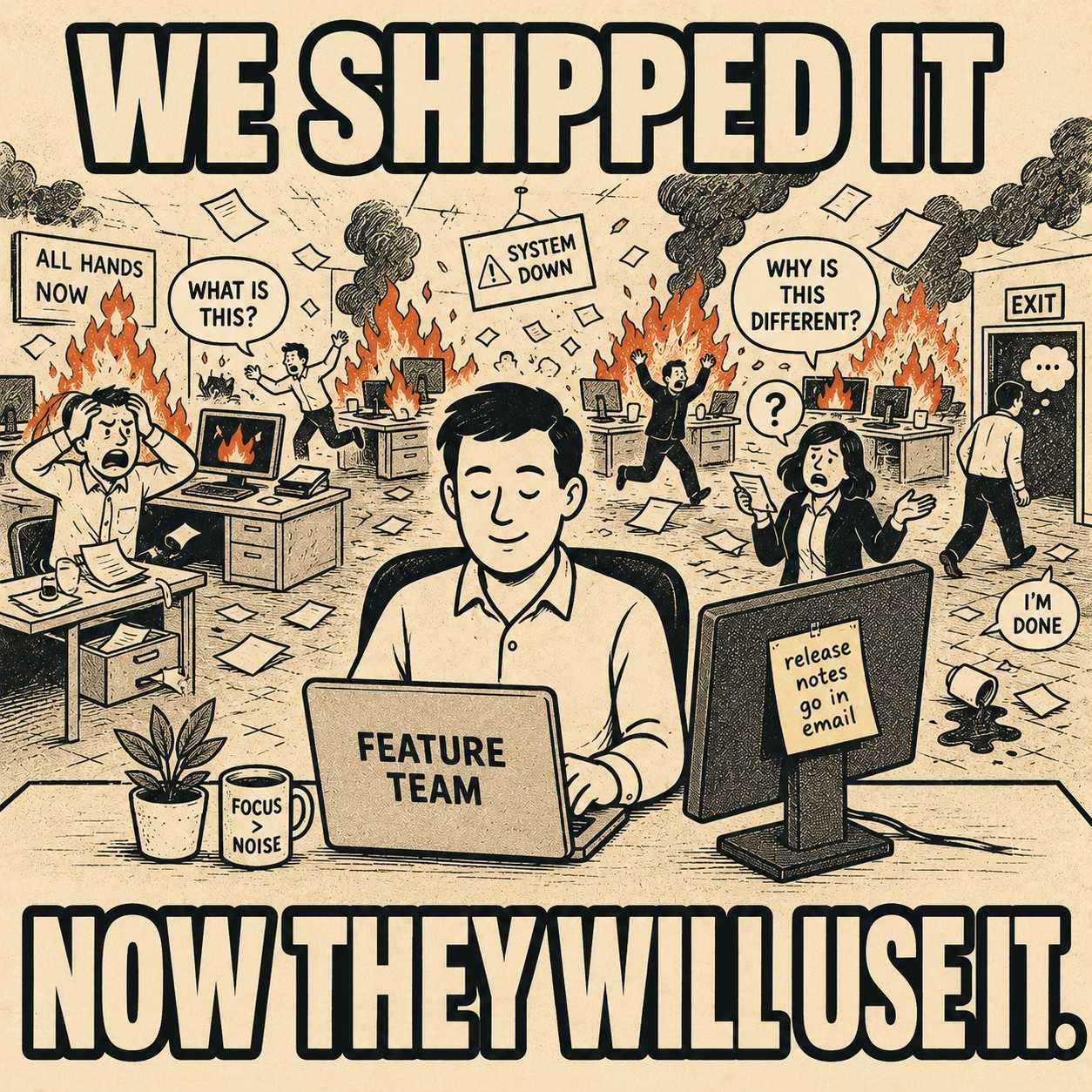
Your team just shipped something. It took three sprints, two design reviews, and a heated argument about the button label. The PM writes the release note. It says: "We've added support for bulk export."
Nobody uses it.
This is not a feature problem. It's a distribution problem disguised as a documentation problem. And the fix isn't more features — it's treating release notes as a conversion surface instead of a compliance artifact.
The answer to "how do you use release notes to drive feature adoption" is actually pretty direct: you write them for the person who has the problem, not for the person who built the solution. You show them what the feature does in three seconds. You give them one specific thing to click. And you do all of this before they close the email or dismiss the in-app notification. Everything else is execution.
Why the Changelog Entry Doesn't Count as a Launch
Most release notes are written at the end of a sprint, assembled from commit messages and Jira tickets, and published by whoever has five minutes before the release goes out. The result reads like it was written for the engineering team, not by them for users. Technical language, passive voice, no context for why any of it matters.
Research on release note production in practice found that development teams consistently treat release notes as a technical artifact rather than a communication tool — a "compliance requirement" rather than a bridge between the team and its users. The consequence is predictable: features ship, notes go unread, and adoption stays flat.
The industry average feature adoption rate sits around 24.5%. That means roughly three-quarters of the users who could be using any given feature aren't. Some of that is product-market fit. A lot of it is that users simply don't know the feature exists, or don't understand what it does for them. A study of over 370 users found that 83.6% of users do read release notes — they just want to understand what changed and why they should care. The notes aren't being ignored. They're being read and found useless.
The problem compounds quickly. Research on feature adoption and churn shows that users who don't adopt features don't see value, and users who don't see value leave. Low adoption isn't just a product metric — it's a leading indicator of churn. Every feature that ships without driving adoption is engineering time that didn't contribute to retention.
The changelog entry doesn't count as a launch. It counts as a timestamp.
What a Release Note That Actually Moves the Needle Looks Like
The first sentence of a release note should articulate the pain point the feature solves, in language the user already uses to describe their frustration. Not "We've added bulk export." Something closer to: "Tired of downloading reports one at a time? Now you can export everything at once." The difference is the frame. One describes what the team did. The other describes what the user gets.
This requires actual research. What language appears in support tickets? What do sales calls surface? What words do users use in feature requests? Mirror that language back. Users recognize their own frustration when they see it named correctly, and recognition is the first step toward activation.
Visuals matter more than most teams think. Adoption rates for features with visual walkthroughs are measurably higher than text-only announcements. A screenshot, a GIF, a short screen recording — the visual should answer "what will I see when I use this" in three seconds. If design resources aren't available, a screen recording tool with annotations does the job. The bar isn't production quality. The bar is "does this show me what to expect."
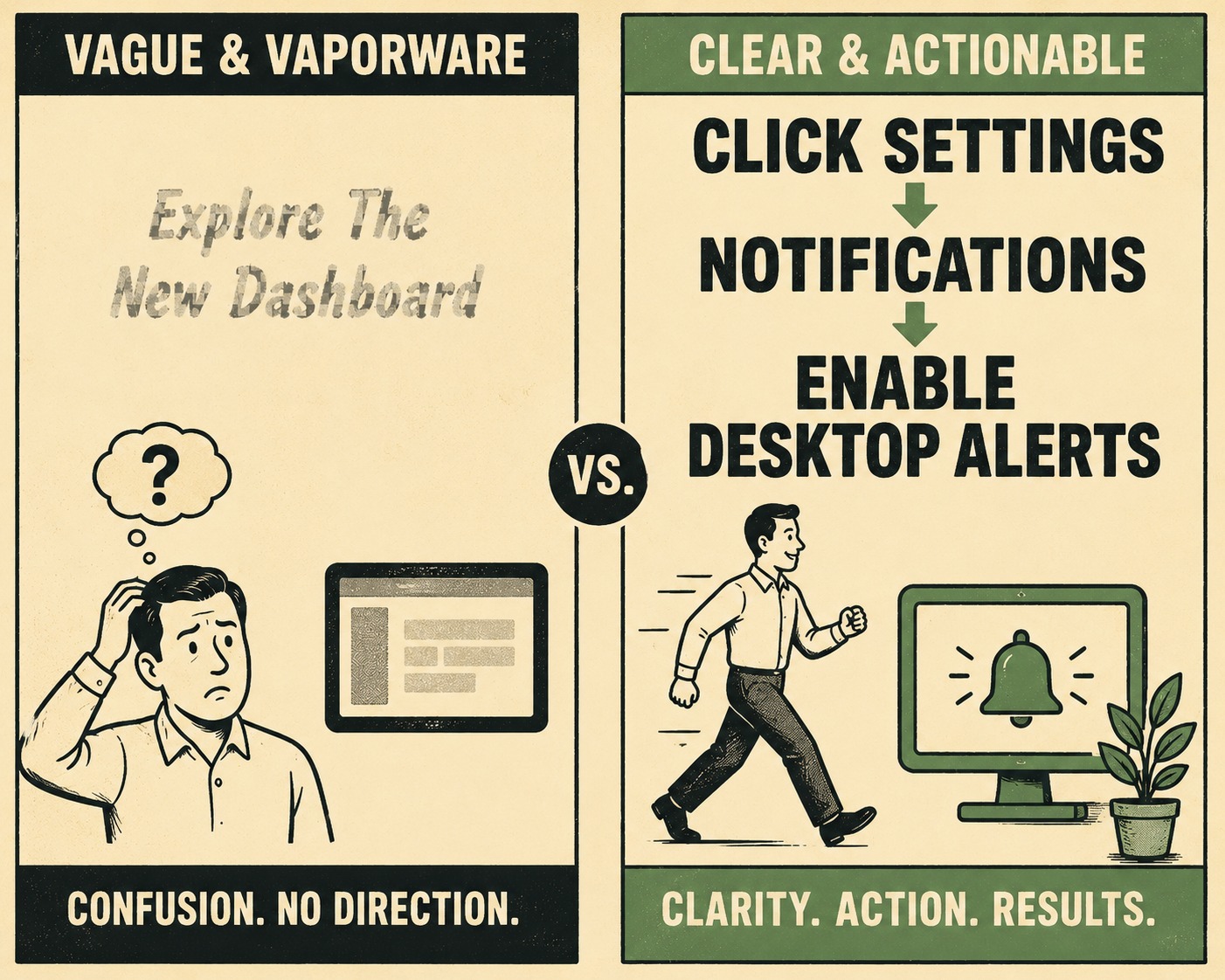
The call to action needs to be specific enough to be trivial. "Explore the new dashboard" is paralyzing. "Click Settings > Notifications > Enable Desktop Alerts" is actionable. The easier the first step, the higher the activation rate. Users aren't lazy — they're busy, and they need the path of least resistance to be obvious.
Urgency helps, and it doesn't require hype. "Available to Pro users this week," "Early access ends Friday," "Limited beta slots" — these are specific, time-bound, and honest. The goal is to get the user to try the feature now, while the release note has their attention, not someday when they remember it exists.
One more thing that consistently gets skipped: the feedback loop. End every feature-focused release note with a way to respond. A direct link to a feedback form, a support channel, a PM's email. Users who give feedback on a new feature adopt it at higher rates. The act of responding creates investment. It's also the fastest way to find out whether the feature is actually solving the problem it was built to solve.
| Release note element | What most teams write | What drives adoption |
|---|---|---|
| Opening line | "We've added support for X" | The pain point the feature solves, in the user's language |
| Visual | None, or a product screenshot with no annotation | A GIF or short recording showing the feature in action |
| Call to action | "Learn more" or "Explore the feature" | A single, specific step the user can complete in under 60 seconds |
| Urgency | None | A time-bound or access-limited offer that creates reason to act now |
| Audience | All users, regardless of relevance | Segmented to users who will actually use the feature |
| Feedback mechanism | None | A direct link to respond, creating investment in the feature |
The Workflow Problem Nobody Wants to Talk About
Here's the part that doesn't get fixed by writing better release notes: the process that produces them.
Most teams generate release notes after the sprint ends, from whatever artifacts are lying around. Commit messages. Ticket titles. A Slack thread from three weeks ago. The person writing them wasn't in the design review. They don't remember what user problem the feature was supposed to solve. They write what they can reconstruct, which is usually a description of what changed technically, not why it matters to anyone.
The fix is to write the release note earlier — ideally during planning or design, when the team still remembers what problem they're solving. Treat the release note draft as part of the feature spec. If you can't write a clear, user-focused release note for a feature during planning, that's a signal worth paying attention to. Features that can't be described in user terms during planning often can't be described in user terms after shipping, either.
The resourcing reality is that most engineering teams don't have someone dedicated to turning technical changes into user-facing narratives. The PM is buried in the next sprint. The engineers are shipping. The technical writer, if there is one, is three sprints behind. This is where automation changes the math. Doc Holiday generates structured release notes directly from pull requests, commit messages, and issue tracker metadata — giving a PM or writer a solid first draft to work from rather than a blank page. Fifteen minutes of reframing for user impact, adding the screenshot, and inserting the CTA gets you something you can actually send to users. The speed comes from automation. The conversion focus comes from the human edit.
Users who understand what's new and why it matters stay longer. The release note is the moment between shipping and adopting — and most teams are leaving it on the floor.