How to Document AI-Generated Content in Your Product for Compliance


If you build software today, there is a very good chance you are shipping AI features. And if you are shipping AI features, there is an equally good chance that someone from legal, compliance, or security has recently knocked on your door. They are not asking how the feature works. They are asking for a clear record of what content is AI-generated, what models produced it, and how you validate those outputs before they reach a user.
This is not some abstract future regulation we are talking about. Teams building chatbots, content generators, automated summaries, and AI assistants are facing this question right now.
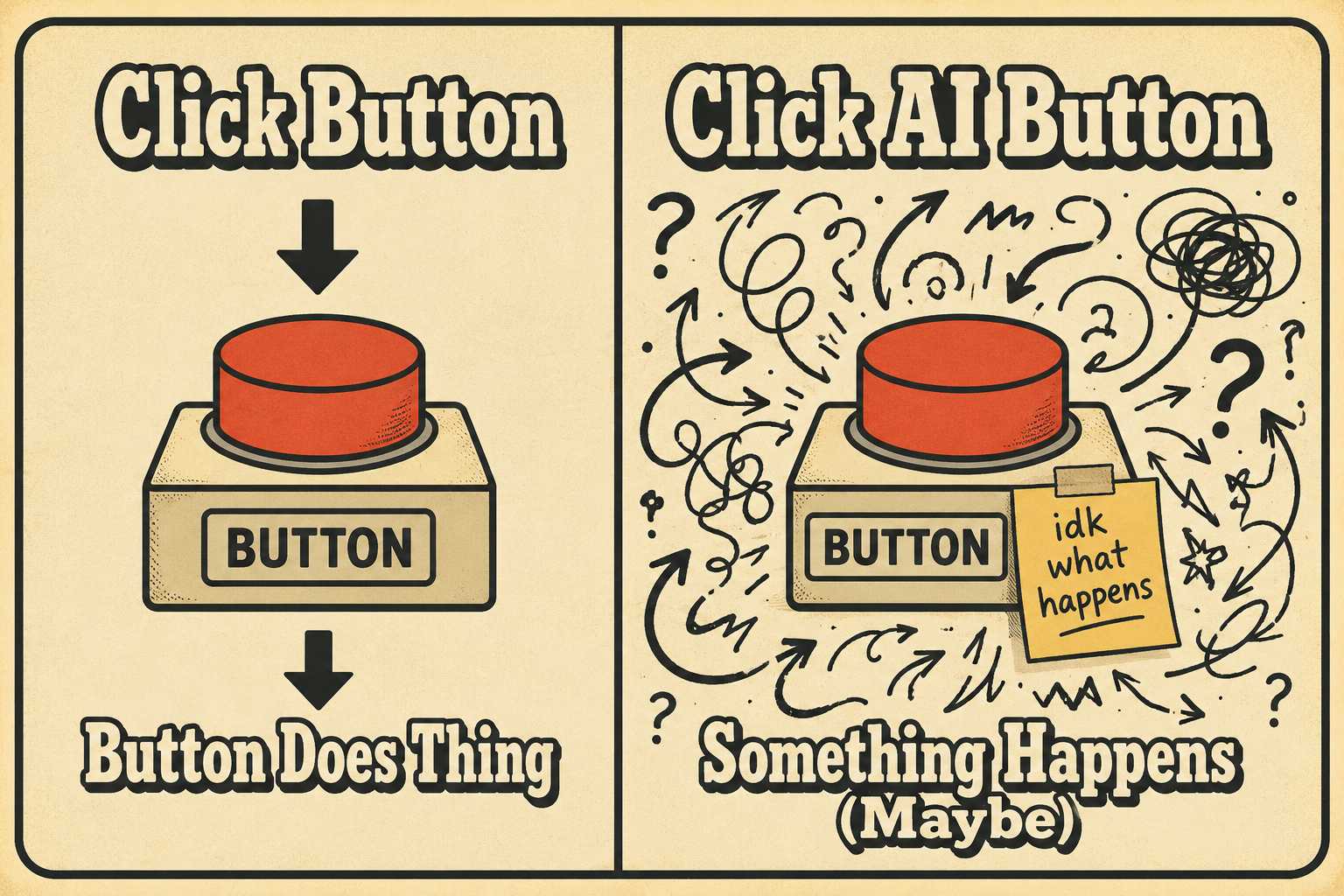
Most product documentation was designed for deterministic features with predictable outputs. You build a button, you document what the button does, and the button does exactly that thing every time someone clicks it. AI features do not work like that. They generate content dynamically, often from models your team does not control, and the output varies wildly by user, context, and prompt. Standard documentation practices simply do not capture what compliance teams actually need to know. They need to know the provenance of the content, the validation steps it went through, the known failure modes, and the oversight mechanisms you have in place.
A Release Note Cannot Answer the Important Questions
Compliance teams are starting to require a very specific set of documentation artifacts.
They want model inventories. They need to know exactly which AI models are used where in the product, including third-party APIs and embedded models. They want to know what these models generate, what data they access, and who owns them.
They are asking for output validation protocols. How is AI-generated content reviewed before it reaches users? Is there human-in-the-loop oversight? Are there automated checks? What exactly triggers a manual review?
They need to see your disclosure mechanisms. They want to know how and where users are informed that the content they are looking at is AI-generated. This matters immensely for transparency regulations and maintaining user trust.
They expect failure mode documentation. They want a list of known cases where the AI produces incorrect, biased, or inappropriate output, and they want to know what guardrails exist to catch those cases before they cause a problem.
They are asking about data lineage. What training data or retrieval sources inform the AI's output? This is especially critical if your product uses RAG or fine-tuned models on proprietary data.
And they need version control for models. When models are updated or swapped out, how is that change tracked and communicated to users and internal stakeholders?
This pressure is coming from real regulatory movement. The EU AI Act’s high-risk regime requires technical documentation and meaningful information for deployers, including instructions that support human oversight. Separately, the Commission’s Article 50 guidance says relevant providers must make direct interaction with AI explicit and add machine-readable marks that enable AI-generated or manipulated content to be detected.
Finance and healthcare are moving through their own regulatory channels. FINRA’s GenAI guidance treats supervision, communications, recordkeeping, and fair dealing as obligations that can apply to generative AI. In certified health IT, the HTI-1 Final Rule requires a consistent baseline of information about AI and other predictive algorithms so clinical users can assess their fairness, appropriateness, validity, effectiveness, and safety. Neither framework makes every AI output interchangeable, which is precisely the point: teams need records that show what was generated, how it was checked, and what a user was told.
There are already examples of companies learning this in public. After errors surfaced in its AI-assisted financial explainers, CNET changed its bylines and disclosures so readers could see the technology’s role without hovering over an attribution. The Sports Illustrated controversy produced a parallel lesson: the publisher removed disputed content and ended a vendor relationship after questions about unexplained bylines and AI-generated author images became public in reporting on the episode. These are not reasons to panic. They are reminders that legal teams are already navigating a live operating problem.
The Record Needs to Follow the Feature
The problem is that traditional documentation workflows break under this pressure because they were not built for it.
Most release notes describe new features and bug fixes. They do not systematically track which outputs come from which model version. They do not document the oversight structure around dynamic content. Engineering teams ship AI features fast, often much faster than documentation can keep up. The gap between "feature shipped" and "feature documented for compliance" creates massive risk.
The solution is structural. You have to treat AI-generated content documentation as a parallel stream that runs alongside your standard feature documentation. It should be automatically generated from the same engineering artifacts that define the AI feature. If you pull it from model configs, prompt templates, and validation rules, it stays synchronized with what is actually deployed in production. That approach also matches NIST’s recommendation to document content provenance for generative AI systems.
This parallel stream needs to contain a few specific things.
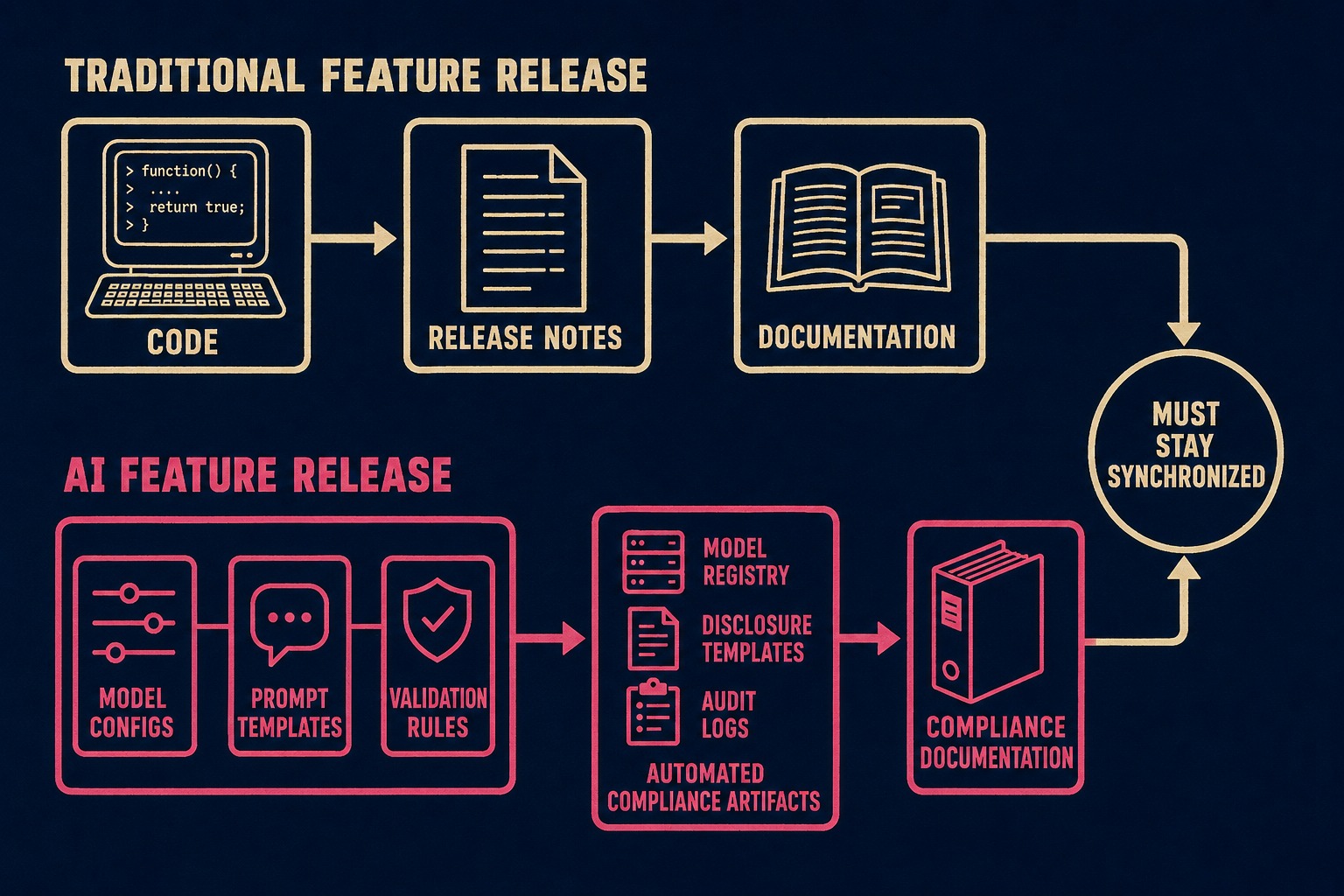
You need a machine-readable model registry that lists every AI component in the product, the content types it generates, and the validation applied to its output. You need automated capture of model version changes tied directly to release notes, so compliance teams can see exactly when a model was swapped and what changed in its output behavior. You need structured disclosure templates that flow into user-facing documentation, ensuring consistency in how AI content is labeled across the entire product.
You also need audit logs that connect specific user interactions with AI-generated outputs back to the model version and validation steps that produced them. And you need validation scorecards that summarize how much AI-generated content went through human review, automated filtering, or was released without oversight.
Someone Has to Own the Handoff
The problem is that most product teams do not have someone whose job is to maintain this specific type of documentation. Technical writers document features, but they are not usually tracking model metadata or compliance artifacts. Engineering teams build the AI features, but they do not naturally think in terms of disclosure requirements. Legal and compliance teams desperately need this information, but they have no idea how to extract it from engineering workflows.
The realistic operational model is to assign one senior technical writer or product operations lead to own AI content documentation as a defined responsibility. Give them access to the engineering systems where model configs and validation rules live. Establish a lightweight review process where every AI feature release triggers a compliance documentation check before it goes live.
The real advantage here comes from automation. The right documentation system generates compliance artifacts directly from the engineering workflow. It builds model registries from deployment configs, validation reports from CI/CD pipelines, and disclosure language from feature flags. This removes the manual tracking burden and ensures the documentation always reflects what is actually running in production. Doc Holiday generates API references, changelogs, and release notes directly from engineering workflows. The exact same approach applies to AI compliance documentation. It gives lean teams the structure to validate, manage, and scale their output without needing to rebuild a massive headcount.