How to Communicate API Deprecations Without Losing Developer Trust


On March 13, 2013, a developer building an RSS reader application went to sleep with a functional product and a growing user base. On March 14, they woke up to a blog post from Google announcing that Google Reader was shutting down—and by extension, the API their entire business relied on. They had just over 100 days to rewrite their core infrastructure or watch their product die.
That is the fastest way to burn developer trust.

Developers remember platforms that blindsided them. They remember the scrambled weekends spent rewriting integrations because an endpoint disappeared without warning. And they remember the platforms that handled deprecation like adults, giving them the tools, the time, and the transparency to migrate gracefully.
This is not about avoiding hard decisions. APIs are products, and products evolve. Security vulnerabilities emerge, architectures shift, and maintaining legacy endpoints becomes too expensive. Deprecation is inevitable. But how you communicate it is the difference between a minor annoyance and a relationship-ending event.
The Mechanics of Advance Notice
Good advance notice is not a casual mention in a changelog. It is a coordinated, multi-channel campaign.
The timeline depends on the severity of the change. A minor field removal might need three to six months. A major version sunset or endpoint removal requires twelve to eighteen months. Security fixes are the exception, but even then, thirty to ninety days is standard.
But the clock doesn't start when you decide to deprecate. It starts when the developer actually receives the message.
If you rely solely on your company blog or an email blast, you are assuming developers read your marketing materials. They don't. They are busy building their own products.
This means using the HTTP Deprecation header (RFC 9745) to signal that a resource is deprecated, and the Sunset header (RFC 8594) to indicate exactly when it will become unresponsive. When a developer makes a request to an endpoint that is on its way out, their logging systems should light up with the deprecation notice. The Link header can point directly to the migration guide.
This runtime warning is the safety net. It catches the developers who missed the email, ignored the blog post, and haven't looked at your documentation in two years—which is most of them.
The initial announcement needs to contain four things from day one: the sunset date, the migration path, the reason for the change, and a contact for questions. Anything less is incomplete. A deprecation notice without a migration path is not a notice; it is a warning shot.
| Change Type | Minimum Notice | Recommended Notice |
|---|---|---|
| Minor field removal | 3 months | 6 months |
| Endpoint removal | 6 months | 12 months |
| Major version sunset | 12 months | 18–24 months |
| Security-related change | 30 days | 90 days |
Showing the Translation Layer
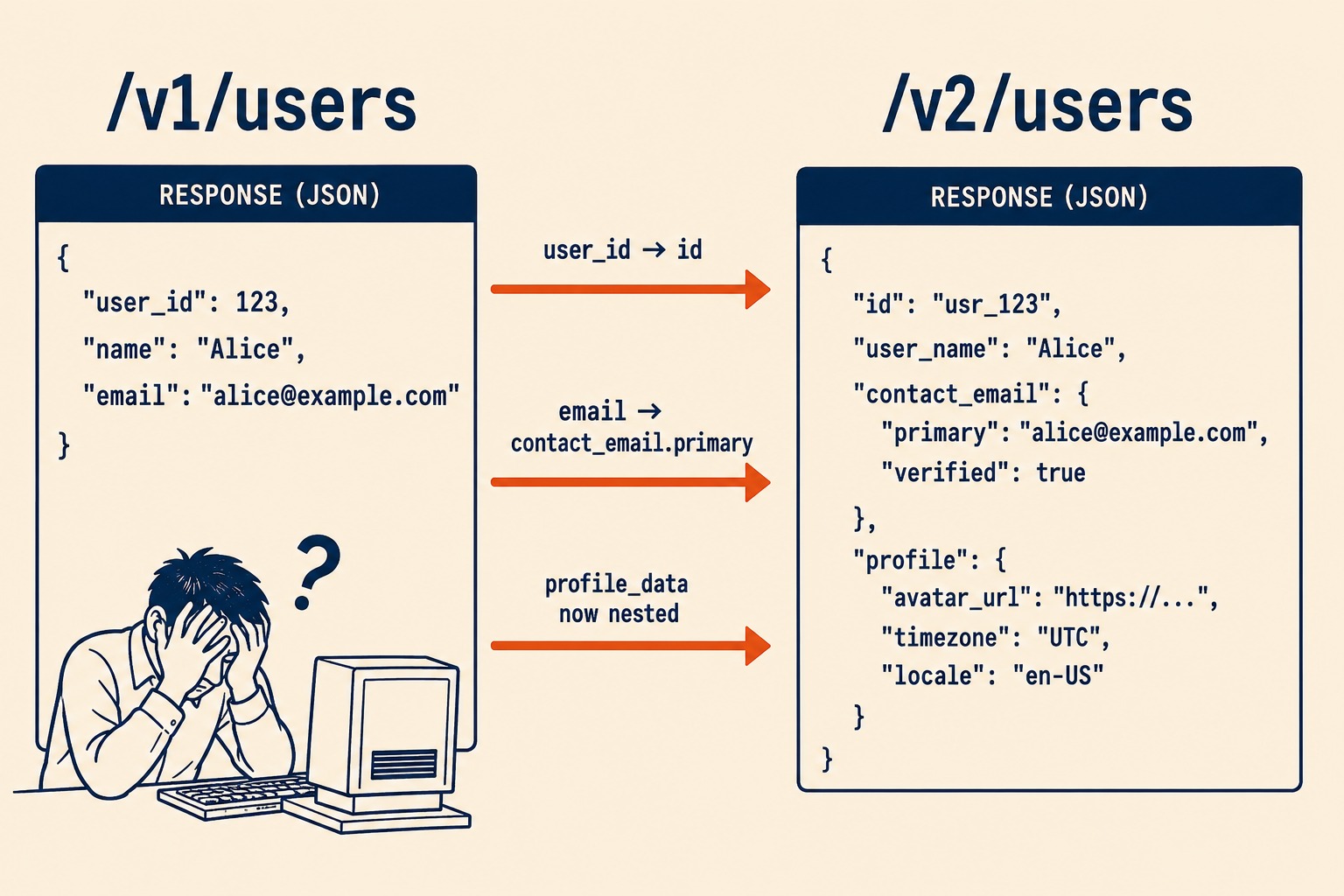
"We're deprecating /v1/users, please use /v2/users instead."
This is a common deprecation notice. It is also useless.
A developer looking at that notice has no idea what has actually changed. Did the authentication method change? Are the fields named differently? Is the pagination logic new?
A migration guide is not a suggestion. It is a requirement.
Developers need side-by-side endpoint comparisons, code samples in their languages showing the old way versus the new way, and explicit field mappings—how user_id maps to id, how a flat structure becomes a nested object. This is the translation layer, and without it, you are asking every single one of your consumers to independently reverse-engineer the differences between your old API and your new one.
That is a massive transfer of labor from your team to theirs.
The edge cases matter too. When a field in v1 splits into two fields in v2, or when a concept in the old API has no direct equivalent in the new one, you have to document that explicitly. "This use case is not supported in v2; here is the recommended workaround" is a complete sentence. Leaving it undocumented is not.
If the replacement API ships incomplete on launch day, the migration guide is fiction. Developers will start the migration, hit the missing feature, and file a support ticket. Or they will just stay on the old endpoint and wait. This is one of the most reliable ways to ensure your sunset date becomes a disaster.
Holding the Line
A firm timeline builds trust because it allows developers to plan. If you say an endpoint will be sunset on August 1st, a developer can schedule the migration work for July. They can allocate engineering resources. They can plan around it.
If you are vague ("we'll deprecate this eventually") or if you constantly push the deadline back because a few loud customers complain, you train your developers to ignore your warnings. You become the platform crying wolf. And when the endpoint finally does go dark, nobody will have migrated because nobody believed the deadline was real.
That said, holding the line requires that the replacement API is actually ready.
If the new API isn't ready, the sunset date has to move. But when you move it, you have to communicate exactly why, and what the new timeline is. You don't quietly update the date on a documentation page and hope nobody notices.
As the sunset date approaches, the communication cadence should increase. A brownout strategy—where the deprecated endpoint is briefly made unavailable for short windows during business hours—is an effective way to force stragglers to take action without permanently breaking their integrations. It is uncomfortable for developers, but it is far less uncomfortable than a surprise hard cutoff.
Usage analytics on deprecated endpoints are not optional. You need to know which developers are still on the old endpoint, and you need to be able to reach them directly. Large customers with complex systems are often the last to migrate, and they sometimes need a direct conversation rather than a mass email. A self-service usage dashboard, where developers can see their own traffic to deprecated endpoints, reduces the "I didn't know I was still using it" problem without requiring a support ticket.
The Documentation Drift Problem
Manual deprecation communication fails at scale.
Someone has to remember to update the OpenAPI specification, write the changelog entry, draft the email, update the API reference to add the "Deprecated" badges, and scrub the old endpoints from the getting-started tutorials. If they miss one, documentation drift sets in—the condition where your published documentation diverges from what the API actually does.
This is how you end up with new developers signing up, reading a tutorial, and building a brand new integration on an endpoint that is scheduled to be deleted in three weeks.
The old tutorials keep circulating. The deprecated code stays in the examples. The documentation tells them to use one thing, while the API response headers tell them it's deprecated. This inconsistency destroys confidence. If a developer can't trust your documentation to tell them which endpoints are actually supported, they can't trust your platform.
The documentation layer has a specific update sequence. When deprecation is announced, the API reference gets the "Deprecated" badge and the sunset date. Integration guides get banner warnings. When the sunset date arrives, the endpoint gets a 410 Gone response with an informative error message pointing to the replacement. Old tutorials that can't be updated should be archived or removed, not left to circulate with deprecated code.
Many APIs fail because they treat deprecation as a symbolic label rather than a managed process. The label goes on the documentation, but the communication, the migration support, and the documentation cleanup don't follow.
This is an operational problem. It requires a structural solution.
Doc Holiday is built around this workflow. Release notes, API references, and migration guide drafts are informed by the same engineering process that tracks the deprecation—surfaced for human review and sign-off before anything is published. When an endpoint is marked for deprecation in the codebase, that signal flows into the documentation pipeline, where reviewers can ensure every communication surface stays consistent from the first warning header to the final sunset date. The validation layer works the same way: migration paths are flagged for review before an endpoint can be sunsetted, which closes the gap between "we deprecated it" and "we actually told anyone how to migrate."