How to Evaluate Technical Writing Job Descriptions in the AI Era


It is a Tuesday afternoon, and you are staring at a job description.
The salary range is decent. The company has funding. But the responsibilities section is making you nervous. It asks you to "support documentation efforts," "work with AI tools to produce content," and "contribute to the team."
You are trying to figure out if this is a real job. Or, more accurately, you are trying to figure out if this is a trap.
You know the market has changed. The Bureau of Labor Statistics is projecting only 1 percent growth for technical writers over the next decade, and the agency explicitly notes that AI tools may slow employment growth by increasing productivity. You know that AI can draft release notes in seconds.
What you want to know is whether this specific company is hiring you to build a documentation system, or hiring you to babysit a machine they don't know how to manage, right up until they decide they don't need you anymore.
The difference between a job that will waste your career capital and a job that has a future comes down to language. It comes down to whether the company views documentation as infrastructure or overhead.
Here is how to tell the difference.
When the Job Is a Dead End
The most dangerous job descriptions are the ones that sound like they were written by someone who has never actually used the product.
They use vague ownership language. They ask you to "support" or "contribute to" documentation projects. They do not ask you to own the technical content strategy. They do not ask you to build the API documentation for the developer platform. They ask you to be a service layer, and a service layer is the first thing a company tries to automate.
They list tools as requirements rather than as part of a broader system. If the job description is just a list of software names — if it says you must know how to use a specific LLM or a specific authoring tool, but says nothing about how those tools fit into a workflow — they are hiring a button-pusher.
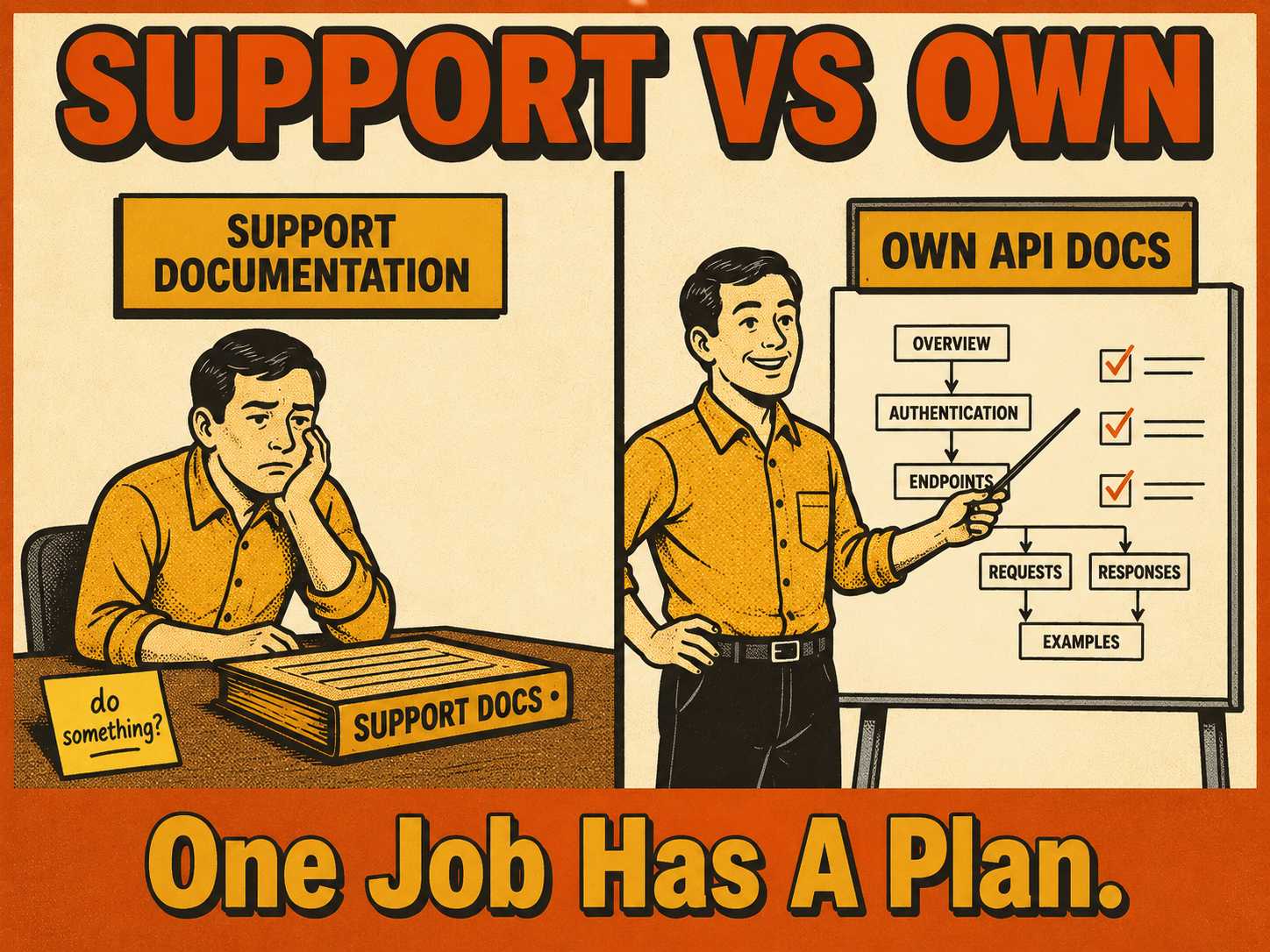
They mention AI, but they do not mention validation. A job description that says "work with AI tools to produce documentation" without mentioning editorial standards, governance, or review processes is a warning sign. It means they want someone to copy-paste AI output without a quality framework. They think the AI does the work, and you are just there to move the text from one window to another. AI hallucinations in technical documentation are a well-documented operational risk, and a company that doesn't mention how it handles them doesn't have a plan.
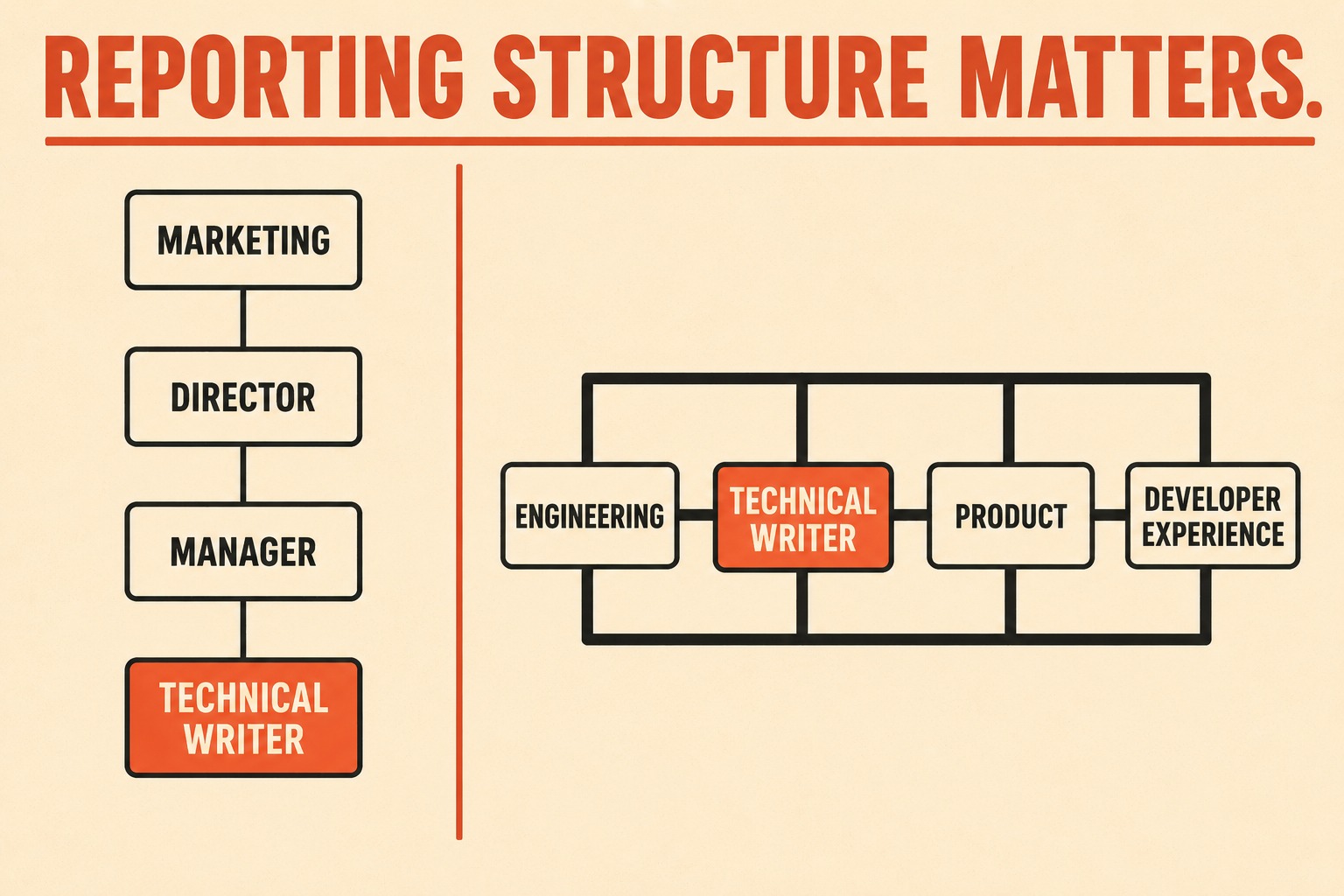
The reporting structure makes no sense. The job reports to marketing, or to someone three layers removed from the product. Documentation that reports to marketing is rarely strategic — it gets treated as collateral, not as part of the developer experience. The Write the Docs community's job search guide notes that candidates who understand the reporting structure can gauge seniority and potential career progression far more accurately than from the job title alone.
The salary range is significantly below market for the experience level requested. This is the clearest signal of all. The median annual wage for technical writers is $91,670, with senior roles ranging from $105,000 to $150,000 depending on domain and company size. A posting that asks for five years of API documentation experience and offers $65,000 is not a senior role. It is a junior hire with an AI subscription.
If they cannot articulate what makes their documentation hard, they do not value the skill required to do it well.
What a Job with a Future Looks Like
A job with a future treats documentation as a product.
The ownership is clear. "You will own all API documentation for our developer platform." That is a sentence written by a company that understands what is at stake. It is a different sentence from "contribute to documentation projects," and the difference is not semantic.
The reporting structure aligns with the product. The role reports to a director of engineering, a VP of product, or a head of developer experience. The company explicitly mentions working with engineering and product as a peer function, not as a downstream service.
Tooling is described as a system. They mention what you will use AI tools to accomplish, not just that the tools exist. There is a difference between "you'll use AI tools to generate documentation" and "you'll use AI tools to maintain coverage across 200 API endpoints while establishing the review process that catches errors before they ship."
They talk about validation and governance. They understand that unmanaged AI output requires human oversight to maintain accuracy and architectural coherence. A job description that says "establish guidelines for AI-assisted documentation and validate output" is a green flag. That is a company hiring a writer to run the system.
They describe documentation as a competitive advantage. They use language like "documentation is core to our developer experience." They understand that good API docs cut onboarding time and determine whether developers adopt your API or flee to competitors. As Fern's analysis of the documentation market puts it: the companies that treat docs as a strategic asset will be the ones who win developer trust, adoption, and market share.
The salary is at or above market. They are treating this as a skilled role. They know that managing an automated documentation pipeline requires more architectural thinking than writing everything from scratch.
They offer a career path. "This role will grow into leadership of our technical content function." They are looking for someone to build the standards that scale with the product.
A quick checklist for evaluating any posting:
- Does the job use ownership language ("own," "lead," "build") or service language ("support," "assist," "contribute")?
- Is the reporting structure named, and does it make sense for a technical role?
- Does the job description mention AI and mention validation, governance, or editorial standards?
- Is the salary at or above market for the experience level requested?
- Does the company describe what makes their documentation complex, or do they just list tools?
If you get three or more "no" answers, keep looking.
The Part Everyone Gets Wrong About 2025
The best technical writing roles now include "manage AI documentation tools" as a responsibility.
That is not a threat. It is the job evolving into something more durable.
If a job description mentions AI, but also mentions editorial oversight, validation standards, and content strategy, that is a company that gets it. They understand that the work has shifted from content creation to content architecture. Practitioners who have been tracking this shift note that writers will need to focus more on content strategy, information architecture, and tooling, and less on raw writing output — while being expected to operate AI tools as qualified system operators, not passive users.
Roles that combine writing with knowledge management, information architecture, or developer experience are safer bets than pure production roles. The job descriptions worth pursuing are the ones that talk about building systems rather than creating content. Shopify's engineering blog describes documentation as an operational tool that allows a company to scale — and the companies that have internalized that idea write job descriptions that reflect it.
The cyborg model of technical writing — humans and AI working in close collaboration, with the writer steering, reviewing, and verifying — is the model that describes reality in 2025. The writer is not being replaced. The writer is being asked to operate a more powerful system. The question is whether the company you are evaluating understands that distinction.
If you are looking at a role that involves managing AI-generated documentation at scale — release notes, API references, changelogs — look for language that treats you as the system operator, not the system output. Unmanaged AI produces drift, hallucinations, and broken trust. Managed AI scales.
The companies hiring writers to validate and govern tools like Doc Holiday are the ones building documentation teams for the next decade, not dismantling them. They understand that AI generates the first draft from the code commit, but it takes a skilled operator to review it, catch the edge cases, and maintain architectural coherence. That is the workflow worth joining.