A Documentation Triage System That Actually Works

The Triage of the Infinite Backlog
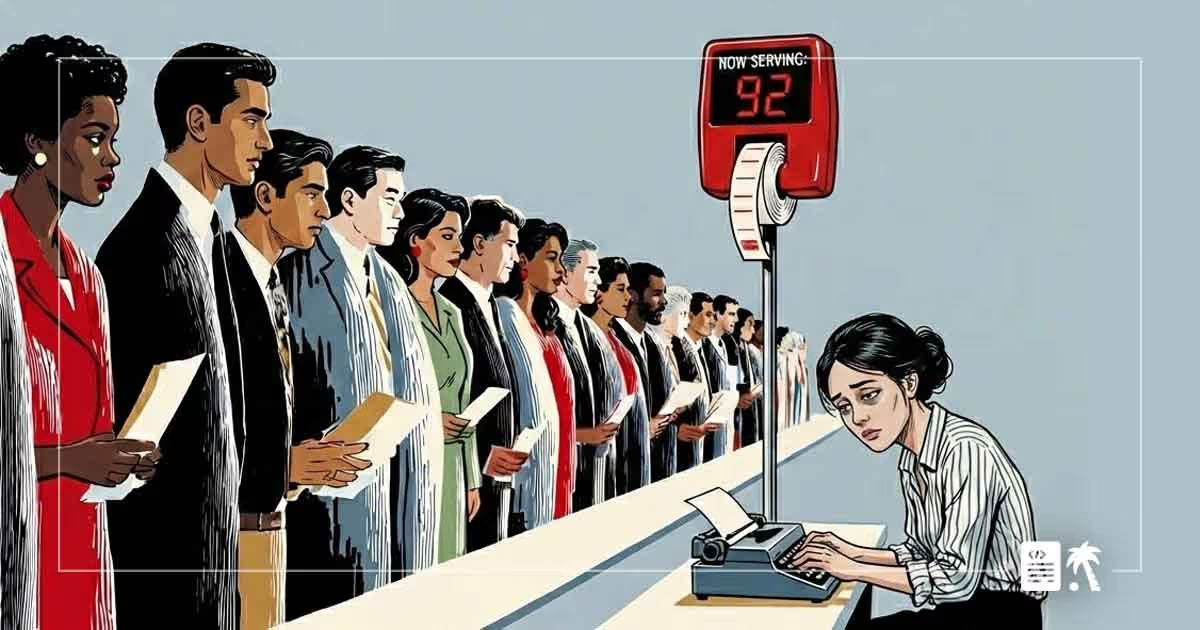
There is a specific kind of guilt that lives in the inbox of every technical writer. It is not the sharp panic of a server outage. It is a dull, low-grade ache. It is the Documentation Backlog.
It is a list of things you swore you would do. The API reference that is three versions out of date. The "Quick Start" guide that takes four hours to read. The request from the sales team to document a feature that doesn't actually exist yet. Everyone tells you their request is urgent. Everyone is lying.
When everything is a priority, nothing is. You end up in a state of paralysis, staring at a Jira board that looks less like a to-do list and more like a graveyard of good intentions. You spend your days fighting fires with a squirt gun, knowing that the actual house is burning down somewhere behind you.
We need to stop pretending that we can do it all. We need to stop acting like librarians and start acting like trauma surgeons. We need triage.
The Ruthless Math of the ER
In an emergency room, triage is not about fairness. It is about survival. You do not treat the guy with the sprained ankle before the guy with the arrow in his chest, even if the guy with the ankle has been waiting longer.
We are squeamish about applying this logic to our work. We want to be helpful. We want to say "yes." But in a world of finite resources—and your time is the most finite resource of all—saying "yes" to the wrong thing is the same as saying "no" to the right thing.
A functional documentation strategy requires you to look a stakeholder in the eye and tell them that their problem does not matter right now. It requires a system that is colder and more objective than your desire to be liked.
The Lawyer’s Veto
The first cut is the easiest. It is the stuff that will get you sued, fired, or arrested. This is the "Non-Negotiable" tier.
If you are building a medical device, you have to write the safety warnings before you write the blog post about how cool the team culture is. If you are handling European user data, you have to document GDPR compliance before you fix the typo in the footer.
This work is not fun. It is not creative. It is the tax you pay for existing. But it is the only true "P0." Everything else is optional. If the building is on fire, you save the cat, then you save the photo albums. This tier is the cat.
The Quadrant of Guesswork
Once the lawyers are satisfied, you enter the messy middle. This is where the fighting happens. You have a hundred tasks that all claim to drive revenue. How do you choose?
Consultants love the Impact/Effort Matrix. It is a simple 2x2 grid. You plot tasks based on how hard they are and how much they matter. In theory, you do the high-impact, low-effort stuff first.
In practice, this is mostly theater. We are terrible at estimating effort, and we are even worse at estimating impact. But the exercise forces you to be honest. It forces you to admit that rewriting the entire onboarding flow is a three-month project, and maybe fixing the broken link on the pricing page is a ten-minute job that will actually make money today.
The goal isn't to be perfect. The goal is to find the "Quick Wins"—the tasks that make you look like a magician because you fixed a major pain point before lunch. And it is to identify the "Time Wasters," the low-impact, high-effort black holes that swallow weeks of engineering time for zero gain.
The Minimum Viable Truth
The final tier is the most dangerous because it feels the most urgent. It is the "Foundation." It is the basic "how-to" guides, the glossaries, the installation instructions.
We tend to over-engineer this. We want to write the definitive encyclopedia of our product. But nobody reads encyclopedias. They read the entry for the thing they are trying to do, and then they leave.
You need "Minimum Viable Documentation". You need enough to get a user from zero to "hello world." You do not need to document every edge case of every function. You need to pave the main road and put up a sign that says "Here Be Dragons" for the rest.
The Automated Resident
This is where the math changes. The problem with the Impact/Effort matrix is that writing documentation is inherently high-effort. It is slow, manual labor. It drags everything into the "hard to do" quadrants.
But what if you could cheat?
This is why we built Doc Holiday. We wanted to break the matrix. Doc Holiday acts like a hyper-caffeinated resident in your ER. It takes the routine, high-volume cases—the API updates, the basic how-to guides, the release notes—and it handles them automatically.
It lowers the "effort" axis across the board. Suddenly, tasks that were "High Impact, High Effort" become "High Impact, Low Effort." You don't have to spend your week documenting the new feature; the AI does a first pass, you review it, and you ship it.
You can stop stitching up minor cuts and start performing surgery. You can focus on the strategic work—the high-level architecture docs, the complex integration guides—that actually requires a human brain.
The backlog will never hit zero. That is a fantasy. But with a little ruthlessness and the right tools, you can at least make sure you aren't drowning in it.