How to Document OAuth Scope Changes Without Breaking Integrations


During a routine access review, a security analyst discovers an OAuth application called "Campaign Analytics Pro" with full read/write access to Google Drive. Nobody on the current team recognizes it. The authorization date is from 2021. The authorizing user departed 18 months ago. The company behind the app was acquired, then shuttered.
For three years, this orphaned application has maintained the ability to read and modify every file in the company's Drive. Obsidian Security documents how routinely this happens.
This scenario plays out across enterprises daily. OAuth scopes granted once persist until explicitly revoked. Most organizations don't know what scopes they've approved, which applications hold dangerous permissions, or how these authorizations create invisible attack paths that bypass traditional controls.
When security teams finally notice this, the immediate reaction is to lock things down. They demand scope reductions. Product teams promise backward compatibility. And someone has to figure out how to document the change so that third-party integrations don't silently fail in production.
Documenting OAuth scope changes without breaking integrations requires a specific operational motion: audit actual usage, structure deprecation notices with hard dates, map the before-and-after states clearly, and treat the reference documentation update as part of the release cycle itself. Not as a follow-up task. Part of the release.
We are all trying to clean up our permissions, and we seem to be having trouble figuring out how to tell developers about it.
The Blast Radius Problem
OAuth scopes define the blast radius of any compromise. If an application with full Drive access is breached, attackers inherit the ability to read, modify, and delete every file the authorizing user can access. The scope determines the capability. The compromise just determines whether that capability becomes weaponized.
Developers request broad permissions because it is easier than determining the minimum required access. Users approve them because they trust the vendor. The result is that applications maintain administrative access they may never use, and those grants persist indefinitely.
When you decide to fix this, you are almost always creating a breaking change. The four scope change patterns that generate the most documentation debt are worth naming directly:
- Splitting a broad scope into granular permissions. A single write:all scope becomes write:users, write:billing, and write:content. Every integration that used write:all needs to re-authorize with the new set.
- Deprecating a legacy scope in favor of a new standard. The OAuth 2.1 draft, for example, removes the implicit flow entirely and makes PKCE mandatory for all client types. These are hard requirements, not suggestions.
- Requiring additional scopes for compliance reasons. A new privacy regulation means that a scope previously bundled with read access now requires explicit separate consent.
- Consolidating overlapping scopes to reduce token size. Three scopes that covered similar territory get merged into one, and existing tokens using the old strings stop working.
Each of these patterns has a different documentation shape. Splitting requires a mapping table. Deprecation requires a sunset date. Compliance additions require a rationale. Consolidation requires a clear before-and-after. None of them can be handled with a single changelog entry that says "Updated authentication flow."

What You Actually Need to Tell Developers
A useful deprecation notice for a scope change has three components.
First, it names the exact scope string being deprecated. Not "the old broad access method." The actual string: mail.readwrite, drive.file, write:all. Developers need to search their codebase for the exact value.
Second, it provides a specific date or version when the old scope stops working. "A future release" gives developers no date to put on their sprint board. Twilio commits to a minimum of one full year's notice before removing any API version. Atlassian gave developers a six-month window when they migrated Jira and Confluence apps to granular scopes, with old scopes supported throughout the entire deprecation period.
Third, it links to a migration guide that shows the actual before-and-after scope mappings, code examples of token refresh with the new scopes, and a testing environment where integrations can validate changes before production. The changelog entry is a navigation point. The migration guide is the destination.
When Google updated their OAuth flows to handle granular permissions, they had to explicitly document how applications should check which specific scopes a user actually granted, rather than assuming an all-or-nothing approval. They provided code samples in multiple languages showing how to handle partial grants. That is the bar.
The table above is not exhaustive. It is a starting point for the conversation between the engineer shipping the change and the person writing the guide.
The Part Where Documentation Usually Fails
Mixing breaking changes with additive ones is the most common structural failure in API changelogs.
Breaking changes require the developer to modify their integration before it will continue to work. Additive changes can be safely ignored. Burying both types in a single chronological list puts the burden on developers to read every entry to find the ones that actually require action.
Stripe handles this by separating them explicitly. Monthly releases are non-breaking by design. Dated releases that include breaking changes are flagged separately, with each release shipping alongside updated SDK versions and reference documentation. A developer scanning for action items doesn't have to read the whole changelog to find them.
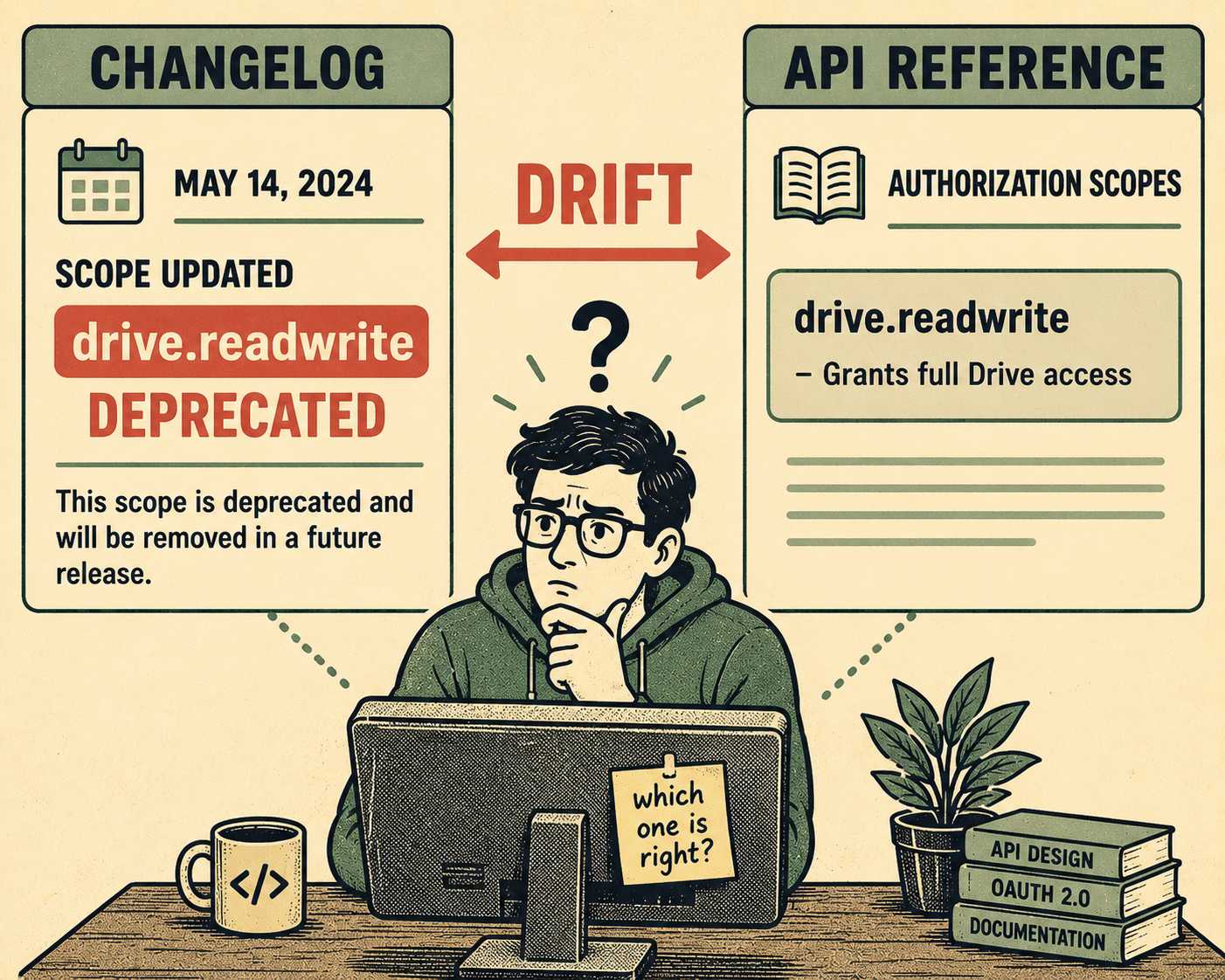
The mechanical failure happens when an engineer ships a scope change and writes a changelog entry, but the technical writer who owns the reference page wasn't in the pull request review. The update goes on the backlog. The next developer to read the reference page encounters contradictory information. The changelog says one thing, the reference page says another. One of them is wrong and the developer doesn't know which.
Research on API deprecation in open-source Java frameworks found that the classic deprecate-replace-remove cycle is often ignored entirely, with many APIs removed without prior deprecation warnings, and removed APIs even resurrected with surprising frequency. The same pattern holds in OAuth scope management. Scope inventory shows what permissions were granted. Scope monitoring shows how those permissions are actually used. The two are not the same thing, and teams that only maintain the inventory tend to miss drift, dormant access, and over-entitled integrations until users report damage.
Before you write a single deprecation notice, you need to know which scopes are actually in use versus theoretically supported. Runtime telemetry and token inspection logs tell you this. Customer interviews confirm it. Without that audit, you risk deprecating a scope that a hundred integrations quietly depend on.
A scope migration checklist for the documentation team:
- Audit token logs to identify which scopes are actively used in production
- Map every deprecated scope to its replacement with exact string values
- Set a hard sunset date and communicate it in the changelog, developer portal, and by email
- Publish a migration guide with code examples in every supported language
- Open a dual-scope acceptance window so existing tokens don't break immediately
- Document the rollback procedure if the change causes more breakage than expected
- Update the API reference page in the same release cycle as the changelog entry
The last item is the one that gets skipped. The Postman 2024 State of the API report found that 68% of developers cite outdated documentation as their top frustration when working with APIs, and 44% dig through source code to understand an API because the documentation doesn't match what the product actually does. Those developers had documentation available. It described a previous state of the product.
The Operational Reality of Scope Changes
Scope changes often ship on short timelines. Security patches, compliance deadlines, and breaking dependency upgrades do not wait for the documentation team to catch up.
The documentation process needs to move fast without cutting corners. This is where lean teams struggle. They know what needs to be written. The speed of shipping outpaces their capacity to write it. If the docs are incomplete or published too late, customer-facing teams cannot prepare. Integrations break in production. Support tickets arrive weeks after deployment, from customers who had no idea the change was coming.
The security research is not encouraging. A large-scale analysis of 100 publicly deployed OAuth identity providers found that, on average, an IdP does not implement 34% of the security specifications present in the OAuth standards, and 97 out of 100 IdPs leave one or more threats completely unmitigated. Scope changes made under pressure, without thorough documentation, compound this problem.
Documentation becomes the artifact that aligns security, backend engineering, developer relations, and support. If it is incomplete, each team operates on different assumptions. If it ships late, customer-facing teams cannot prepare. If the scope descriptions don't explain blast radius alongside permission semantics, developers make security-unconscious decisions about which scopes to request.
This is an operational bottleneck. It requires a system that ties the documentation output directly to the engineering workflow, so that the changelog entry, the reference page update, and the migration guide ship together, not in sequence.
Doc Holiday is a documentation engine built for this exact reality. A senior writer uses it to draft release notes, API reference updates, and changelog entries directly from code commits — then reviews and refines them in a structured dashboard before they ship. It gives technical leaders the structure to validate and scale high-risk documentation work, like OAuth scope migrations, without having to rebuild a full documentation team to do it.