How to Document Kubernetes Deployment Changes for App Teams


A platform team merges a change to a NetworkPolicy. The GitOps controller reconciles it a few minutes later. From the platform side, the deployment looks clean.
From an application team’s side, a service that could reach Redis that morning now times out.
Both teams are looking at the same change. Only one can see the cluster state that caused it.
That is why Kubernetes deployment changes need to be documented as small, structured releases. The note should name the affected resource, explain what a running workload or next deployment will experience, separate platform-owned work from app-team work, and give a rollout date, rollback path, and owner. The raw diff belongs in the source repository. The downstream-facing release note explains what the diff means.
This sounds obvious until a platform team is managing quotas, admission policies, service-mesh upgrades, ingress migrations, node-pool settings, and custom resources across dozens of namespaces. At that point, undocumented change becomes a support queue with better branding.
Start With the Change Developers Can Feel
A YAML diff is evidence. It is rarely an explanation.
If a team changes a ResourceQuota, developers need to know that their namespace may now reject new Pods that exceed an aggregate resource limit. If a team changes a LimitRange, they need to know whether the policy injects new default requests or limits, rejects an invalid manifest, or only affects Pods created after the policy lands. Kubernetes is explicit that a modified LimitRange does not change existing Pods, a distinction that should appear in the release note rather than remain implicit in the cluster behavior.
The same translation matters for performance. CPU limits can throttle a container, while a memory limit can lead to an out-of-memory termination under pressure. “Default limit changed from 1Gi to 512Mi” is technically accurate. “New deployments with no explicit memory limit receive 512Mi, so set resources.limits.memory before the rollout date if your service needs more” gives an app team something useful to do.
The documentation should apply the same discipline to networking, API, and extension changes. A NetworkPolicy can isolate ingress and egress traffic, and policies combine additively, so the note needs to name the affected namespace, pod selector, destination, and port. A CRD change deserves a version, affected controller, and manifest migration path because custom resources extend the Kubernetes API independently of the cluster lifecycle. An ingress-controller change needs more than a new annotation, especially when the Kubernetes Ingress API is frozen and new work is directed toward Gateway API.
A useful change record has six parts:
The table is deliberately less interesting than the Kubernetes resources underneath it. That is a feature. The app developer should never have to infer whether a controller upgrade changes traffic, whether a node configuration affects scheduling, or whether a platform exception exists. They should read the note and know.
This also prevents a common failure mode: documentation written for the person who made the change. A platform engineer might recognize a topologySpreadConstraints diff instantly. A newer developer maintaining a service only needs to hear that pods may no longer schedule in a single availability zone, that no manifest update is required, and that the platform team will roll back if the canary fails. The audience is entitled to a translation.
Put the Answer Where the Failure Happens
A central platform wiki still matters. It should be the durable source of policy detail, canonical examples, and history.
It should not be the only place an application team learns that tomorrow’s deployment will fail.

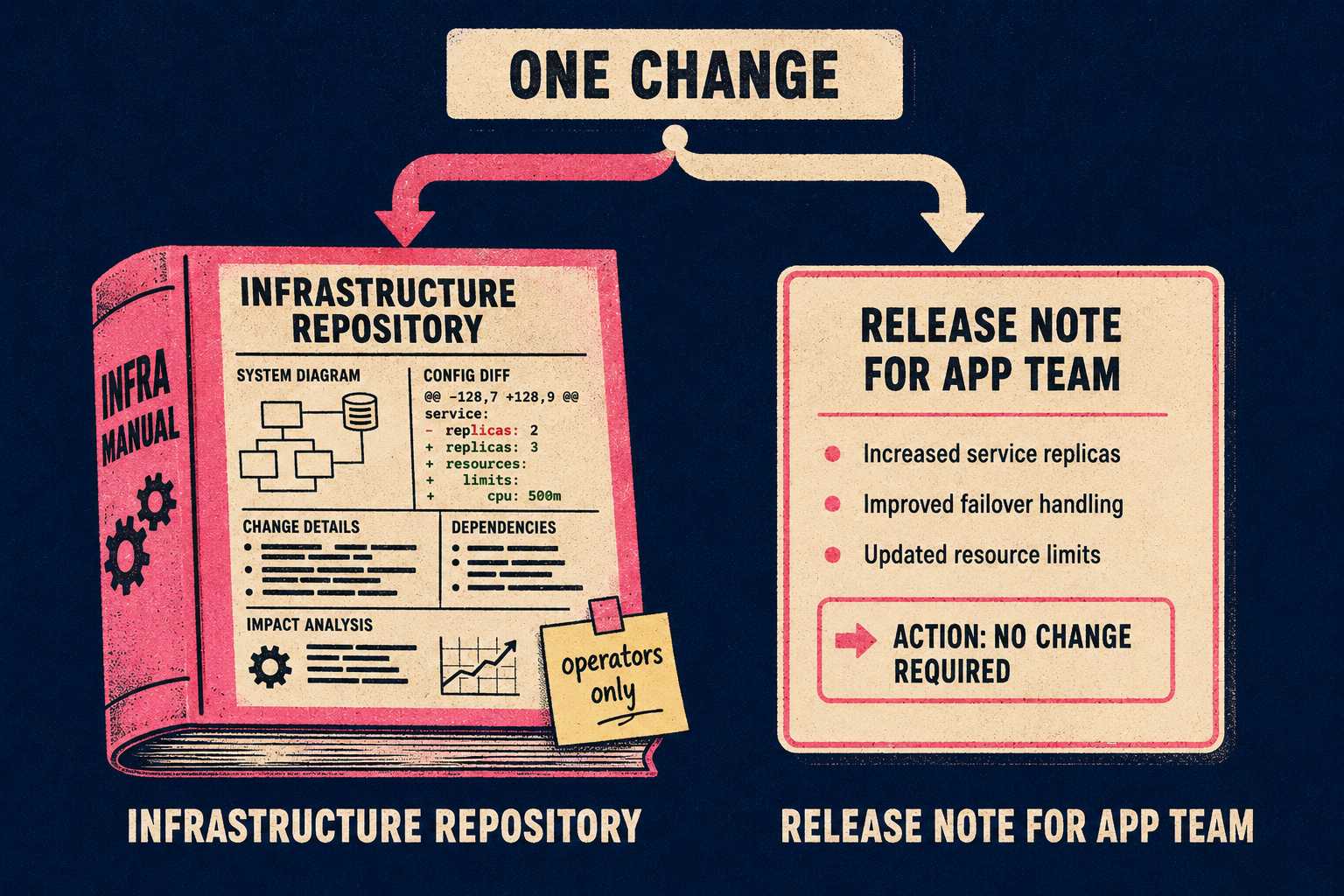
Use different artifacts for different moments. Keep the authoritative policy and full diff in the infrastructure repository. Publish a short changelog entry that links back to it. Then put the action-required summary into the place where the relevant team already works: a pull-request check, CI/CD deployment output, an ownership-targeted Slack or Teams notification, or a ticket created against the service owner.
The urgency should travel with the change. A safe, backwards-compatible update can appear in a weekly platform changelog. A deprecation with a date needs targeted notices to affected owners and a visible migration guide. A breaking policy that affects production traffic needs a direct, high-priority message, an owner who can answer for it, and a rollback or exception route. Sending all three through the same broadcast channel teaches people to ignore the one that matters.
Kubernetes already gives platform teams a way to stage this communication. Validating admission policies can return Warn, Audit, or Deny results, while Pod Security Admission supports warn, audit, and enforce modes. A sensible rollout documents the warning period, links the validation message to the migration instructions, then states exactly when enforcement begins. That turns a failed deployment into a readable next step rather than a small archaeological dig through policy code.
There is a related mistake here: treating the app-team summary as a watered-down copy of the platform documentation. It should be shorter and more direct. Keep the source documentation rich enough for an operator to reproduce the decision. Keep the release note concrete enough for a service owner to decide whether to change a manifest, test a dependency, or do nothing. The two documents serve different jobs and should link to each other.
Let the Change System Write the First Draft
Hand-maintained deployment notes decay because the workflow that changes infrastructure is moving somewhere else.
GitOps gives you a much better starting point. Its operating model keeps declarative desired state in a versioned, immutable store, automatically pulls that state, and continuously reconciles it with the cluster. That history can identify the resources changed, who approved the change, and the revision to which a rollback can return.
Treat the documentation pipeline as part of that system. When an infrastructure pull request merges, generate a draft release artifact from the changed manifests, policy metadata, ownership labels, and deployment context. Require the platform owner to confirm the blast radius, rollout stages, affected teams, and exception path before distribution. Documentation-as-code practices make this practical because the copy can sit in version control, receive review, and be tested alongside the change that prompted it.
That workflow also gives distribution a proper input. Flux’s notification controller can route events based on severity and involved objects, which is a useful model for sending a namespace-specific policy update to the teams that own matching workloads instead of announcing it to every engineer with a company email address.
The recurring mistakes are predictable. Teams paste raw YAML without writing the operational consequence. They publish one central wiki page and assume a link equals communication. They explain service-mesh or admission-controller internals in platform jargon, then wonder why junior developers are lost. They mark every maintenance update as urgent, until nobody notices the one that really is.
Platform teams need to iterate quickly. Application teams need the stability of knowing what will change around their services and what they must do before it does. Structured release documentation gives both groups a workable contract.
Doc Holiday can turn GitOps commits and cluster state into first drafts of release notes, API-change summaries, and policy notices. Platform engineers validate the interpretation, add the migration and exception context their app teams need, and distribute the finished change through the channels where it can actually be used.