How to Deprecate an Authentication Method Without Breaking Everything


Your security architects hand down the mandate on a Tuesday. Basic authentication is dead. The company is moving to OAuth 2.0, or maybe introducing mTLS, and every customer integration needs to be updated. You have 90 days.
The technical part of this transition is usually the easy part. Issue new credentials, stand up the new endpoints, run the new auth flow. The hard part is that your customers have integrations they built two years ago, maintained by developers who weren't there when the original code was written, running in production systems that nobody touches unless something breaks.
Most authentication changes fail not because the new method is bad, but because the documentation rollout assumes customers will read sequential release notes and migrate proactively.
They won't. Most find out when something stops working.
The Documentation Cascade Before the Change
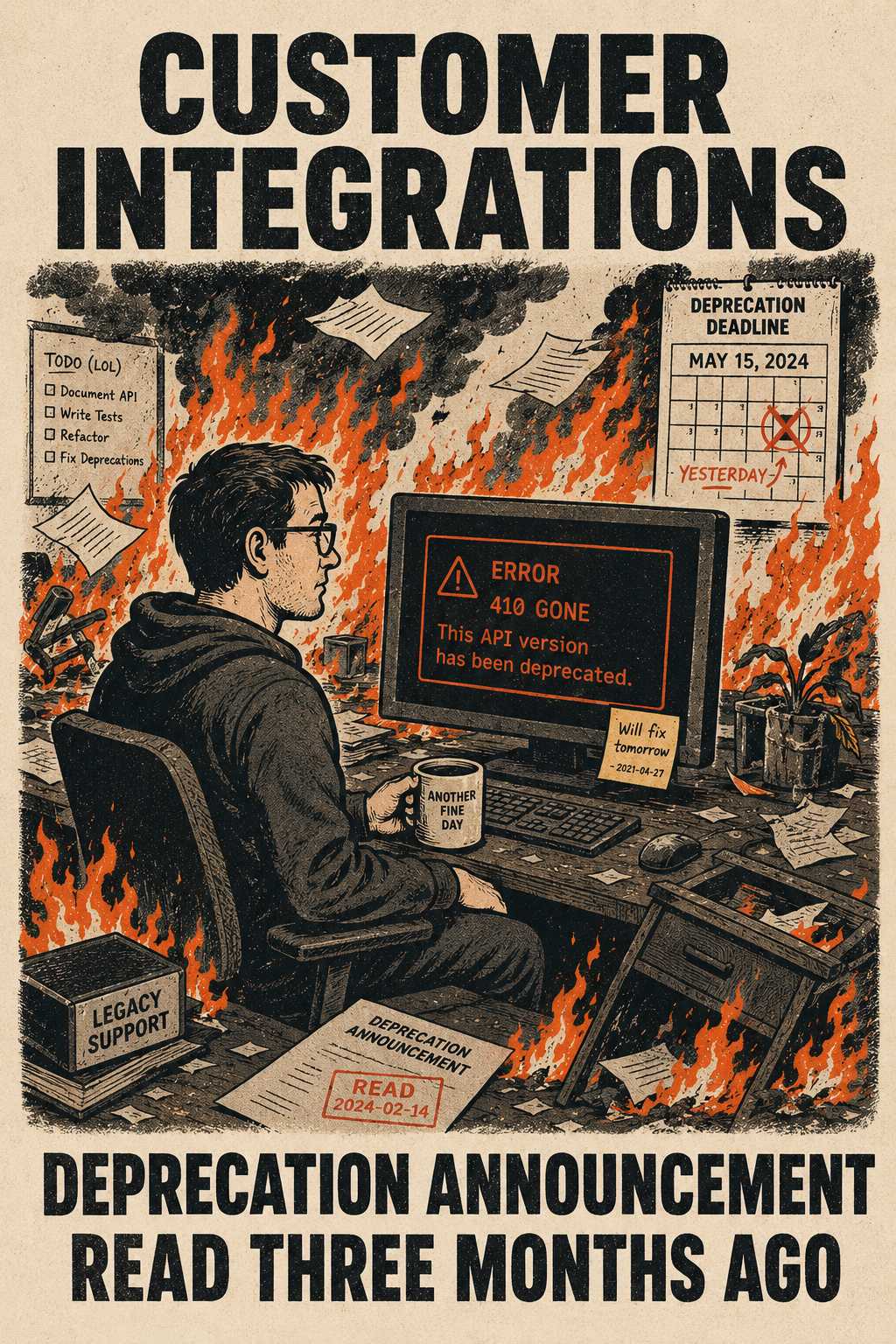
The first mistake teams make is assuming that publishing a migration guide is the same thing as communicating a migration.
A migration guide is a reference document. It tells a developer what to do once they have already decided to do it. It does not create the urgency to act. To create urgency, you need pre-announcement documentation that makes the deprecation timeline unmissable — and that means updating the places where developers actually look when they are trying to solve a problem today, not the places where you wish they would look.
When GitHub deprecated password authentication in 2021, the announcement wasn't just a blog post. The API reference was updated to warn developers that password authentication was going away. Warnings appeared in the developer portal dashboard. Targeted emails went to the owners of active integrations. Multiple channels, because relying on just one guarantees missed readers. This is the same logic that drove Microsoft's Exchange Online basic auth deprecation, where the team sent monthly Message Center posts to tenants still using basic auth, starting a full year before the October 2022 deadline.
Your migration guide itself also needs to change. It cannot assume prior knowledge. A developer migrating an integration they didn't write does not need a conceptual explanation of the OAuth 2.0 client credentials flow. They need side-by-side code examples showing exactly what the old request looked like and exactly what the new request should look like, in every supported language. Not just cURL. The Auth0 guide on migrating from API keys to OAuth 2.0 is a reasonable model here — it walks through each flow with concrete HTTP examples, not just theory.
The question of where to put this documentation is also worth thinking through. Your developer portal, your email list, and your in-dashboard warnings are three different audiences with three different reading contexts. A developer actively building something will see the portal. A developer who set up an integration six months ago and hasn't thought about it since will only see the email. A developer who logs in to check something unrelated will see the dashboard warning. None of these channels reaches all three groups. All three channels together might.
Managing the Transition Window
During the overlap period when both authentication methods are supported, the complexity of your documentation peaks. You have to maintain parallel support instructions without confusing new users who should only be looking at the new method.
The key is a clear cross-version compatibility matrix — a table that documents which endpoints accept which authentication methods during the overlap. As complexity grows, this matrix keeps the state of the system readable. Stripe's approach to API versioning, which has maintained compatibility with every version of their API since 2011, is instructive here. Their documentation is tailored to the user's pinned API version, annotating fields based on what has changed since the user last upgraded. The principle transfers: your documentation should tell developers what their integration needs to do, not just what the new system looks like.
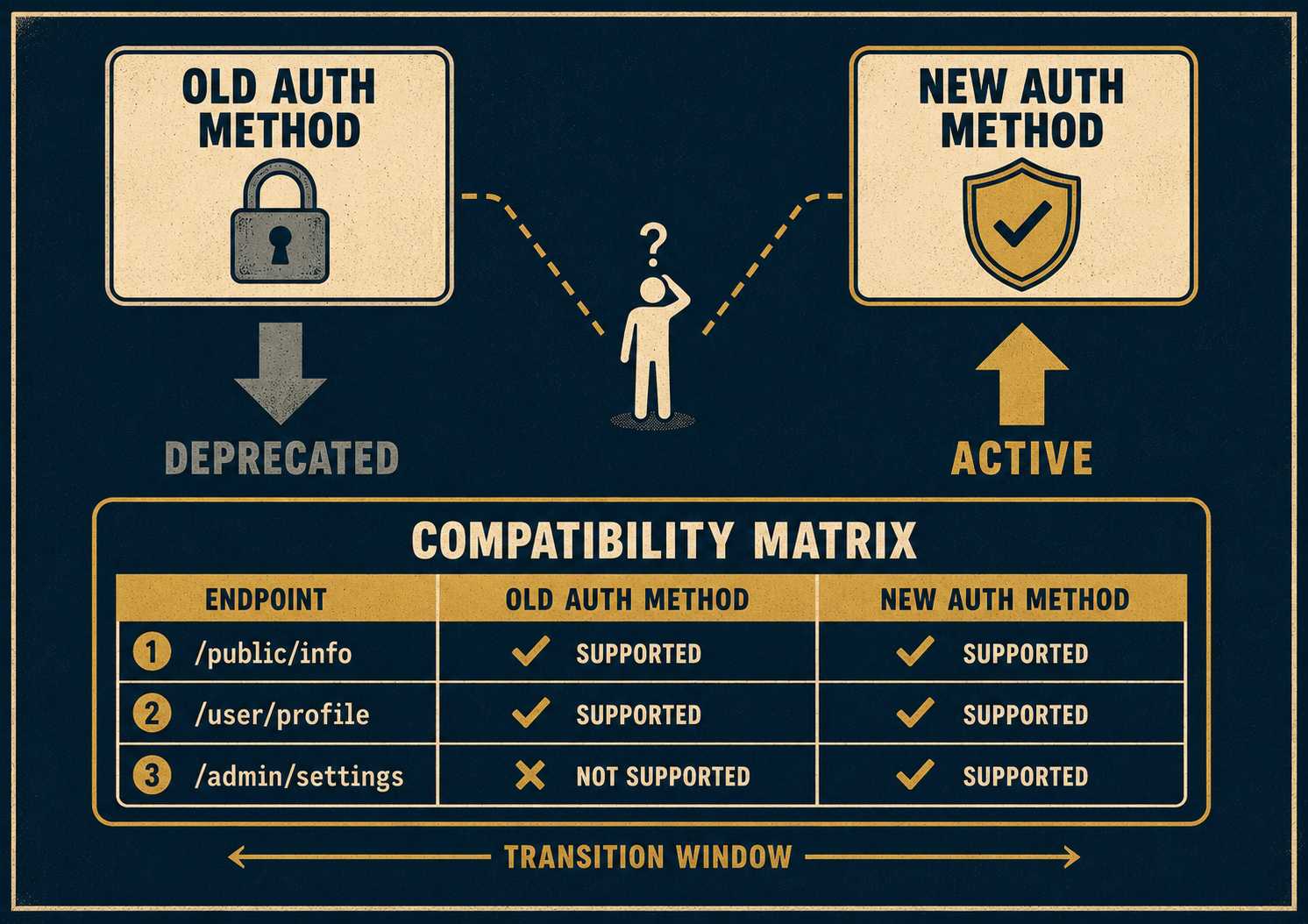
The most critical documentation during this window isn't the API reference, though. It's the error message documentation.
If a customer hits a deprecated endpoint, what does the error say? If your API returns a generic 401 Unauthorized when a basic auth request is rejected, the developer will assume their password expired. They will reset their password, try again, and fail again. Nielsen Norman Group's error message guidelines are clear on this: effective error messages must offer constructive advice, not just describe the failure. The error message must explicitly state that the authentication method is deprecated and provide a direct link to the migration guide. If that link goes to a 404 or to a page that doesn't answer the "I'm trying to make this work right now" question, you have failed the developer at the worst possible moment.
This is also when your internal runbooks are tested. Your support and developer relations teams are going to answer the same question hundreds of times. They need documentation that ensures they don't contradict each other or the public API reference. A support agent who tells a developer to "just re-enter your credentials" when the problem is a deprecated auth method is going to make the situation worse.
Sunset and Post-Mortem
When the deprecation date arrives and the old authentication method is turned off, the documentation work isn't finished.
You now have a versioned API reference problem. You have to maintain docs for the old method because people will still be searching for them when their integrations break, but you cannot make the old method look current. The IETF RFC 8594 Sunset header and RFC 9745 Deprecation header are machine-readable ways to signal this state programmatically — useful for monitoring tools that can detect and log sunset dates. But the human-readable documentation must also reflect this state. Old pages should be clearly marked as deprecated, with a prominent link to the current method. Inbound links from external sites, Stack Overflow answers, and old blog posts will keep sending developers to those pages for years. Breaking those links creates a dead end at the worst possible time.
After the dust settles, you need post-mortem artifacts. What broke? What did customers miss? What would you change next time? Research on API breaking changes consistently shows that the cost of API changes falls disproportionately on consumers who lack the context to anticipate them. Documenting what went wrong is the only way to reduce that cost in the next transition.
The Timing Failures That Cause Most of the Damage
There are a few ways teams reliably get this wrong.
Publishing migration steps the same day as the deprecation is the most obvious. It is hostile to developers. It assumes they have nothing else to do but update their integration immediately. The Stripe deprecation strategy is explicit on this: deprecation is defined as any change that would require customers to modify an existing integration, and the policy is to never do it without an unavoidable requirement. When you do have to do it, the lead time matters enormously.
Assuming customers monitor your status page is another common failure. A status page is for outages. If a developer checks the status page and sees all green, they will assume the problem is on their end, not yours.
Teams also frequently write for their own engineers instead of the junior developer who inherited the integration. The documentation assumes a level of system knowledge that the reader simply does not have. The Okta guide on migrating from static API tokens to OAuth 2.0 is a good example of writing for the developer who needs to understand why the change is necessary before they can act on it — the security risks of long-lived static tokens, the operational overhead of rotation — not just the mechanics of the new flow.
And teams often fail to document the "I'm just trying to make this work again" path. They only document the "I'm carefully planning a migration" path. When an integration breaks in production, the developer does not want to read a comprehensive guide to your new security architecture. They want the fastest path to restoring service. That path needs to be documented separately, clearly, and prominently.
What Authentication Changes Expose About Your Existing Docs
An authentication migration is a stress test for your entire documentation strategy. It exposes the cracks you have been ignoring.
If customers can't find your migration instructions, they probably couldn't find your onboarding instructions either. The navigation is broken, the search doesn't surface the right pages, and the developer portal is organized for the team that built it rather than the developer trying to use it.
If your error messages don't link to relevant docs, this is when you'll find out. You will see developers thrashing in your logs, trying the same failed request dozens of times because the error message didn't tell them what to do. Research on API deprecation patterns is consistent on this: the deprecation stage is the most commonly overlooked part of the API lifecycle, and the documentation failures that surface during it were usually present long before.
If your changelog is formatted for completeness rather than scannability, nobody will scan it when they're fixing something broken. A dense wall of text is useless to a developer under pressure. The IETF RFC 9745 Deprecation header exists precisely because machine-readable signals are more reliable than human-readable ones — developers can't miss a header in a response the way they can miss a paragraph in a changelog.
The Role of Automated Documentation
This is where the distinction between automated and human documentation becomes important.
AI-generated reference docs reliably produce the structured parts of the API: endpoint-level auth requirements, request/response examples, and error catalogs. These can be generated from OpenAPI specifications with reasonable accuracy and consistency. A recent ACL Industry Track paper introducing the OASBuilder framework demonstrates that LLMs can transform long API documentation pages into consistent, machine-readable specifications — the kind of structured output that feeds documentation generation pipelines.
Human editorial work is still required for the strategic parts. An AI cannot define your deprecation timeline. It cannot formulate your migration strategy or build the cross-version compatibility matrices. It certainly cannot write the customer-facing rationale that explains why the change is happening and why the security risk of the old method justifies the migration cost.
Authentication documentation is a useful test case for human and AI workflows precisely because the division of labor is clear. The structured parts — endpoint specs, code samples, error schemas — can be generated from API definitions, ensuring accuracy at scale. The strategic parts — migration sequencing, risk communication, timing decisions — require institutional context that only humans possess. Getting the structured parts right through automation frees the humans to focus on the parts that actually require judgment.
The 90-Day Operational Checklist
Most of the reference-level documentation described here — endpoint auth requirements, error schemas, request/response examples across auth methods — is exactly what Doc Holiday generates from engineering systems. The human work is the migration strategy, the timing decisions, and validating that what's generated actually matches what customers will encounter. The structure Doc Holiday provides lets a small team coordinate that without rebuilding headcount.